
Planet Ships Tanager-2 and 18 SuperDoves to Launch Site
Planet Labs (NYSE: PL) reported that its Tanager-2 hyperspectral satellite and 18 SuperDove satellites from Flock 4J have arrived at Vandenberg Space Force Base in California for launch on the upcoming SpaceX Transporter-18 rideshare mission.
Sentiment and the balance of points
Rhea-AI Sentiment reads the wording of the document, how positive or negative its language is on a 1 to 5 scale. The balance of points shown with the takes weighs what the document actually discloses, so the two can disagree, for example when a trial that missed its main goal is described in upbeat language.




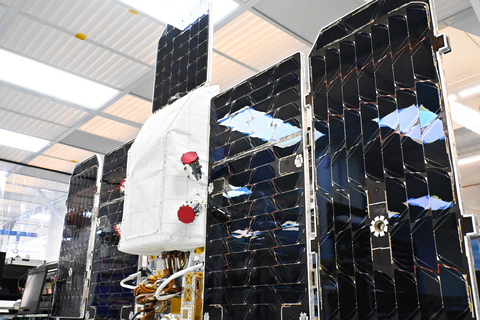
Tanager-2 photographed in Planet Labs'
“The growth of these constellations, and our third launch this year, are testaments to our satellite build velocity,” said Will Marshall, Co-Founder and CEO of Planet. “This launch includes 18 SuperDoves that enable Planet’s daily scan mission, which underpins the AI-powered broad area solutions that are core to unlocking new markets, as well as Tanager-2, which is designed to double our hyperspectral capacity and halve revisit times to detect methane super-emitters and more as part of our project with Carbon Mapper!”
Tanager features best-in-class hyperspectral VSWIR (Visible, Near Infrared and Short wave infrared) imaging capabilities. With a cutting-edge, adjustable sensitivity imaging spectroscopy payload onboard, Tanager is designed to capture imagery in 426 contiguous bands with ~5nm spectral resolution and at a 30-meter spatial resolution. In partnership with Carbon Mapper, Planet continues to scale the fleet, with plans to build and deploy at least three additional Tanager satellites following Tanager-2.
“Our public methane data and many partners are driving global emissions action, informing mitigation efforts and policy, and reducing harmful impacts on climate, public health and air quality,” said Riley Duren, CEO of Carbon Mapper. “This launch represents a major milestone as we continue to expand the capacity of the constellation and scale up data-driven climate action. Carbon Mapper’s methane detection and notification efforts have already enabled the mitigation of large methane sources in diverse regions, and we look forward to making even more impact with Tanager-2.”
While the core mission of the growing Tanager constellation is to detect and mitigate methane emissions across the globe, Tanager can also support an increasing array of potential commercial applications, including monitoring active mines, analyzing coral reef health, providing agricultural management tools, assessing the health of water bodies, and more. In conjunction with Tanager-1, Tanager-2 is designed to support Planet’s evolving hyperspectral data offerings, including more advanced collection modes such as glint tasking for offshore methane emissions detection and an improved collection capacity.
The 18 SuperDoves of Flock 4J will supplement PlanetScope, Planet’s flagship daily, global monitoring mission, which provides consistent global coverage across millions of square kilometers for customers in commercial enterprise, civil government, and defense and intelligence sectors.
Learn more about Planet’s SuperDove and Tanager constellations, including our plans for a specialized shortwave infrared (SWIR) Tanager.
About Planet Labs PBC
Planet is a leading provider of global, daily satellite imagery and geospatial solutions. Planet is driven by a mission to image the world every day, and make change visible, accessible and actionable. Founded in 2010 by three NASA scientists, Planet designs, builds, and operates the largest commercial Earth observation fleet of imaging satellites. Planet provides mission-critical data, advanced insights, and software solutions to customers comprising the world’s leading agriculture, forestry, intelligence, education and finance companies and government agencies, enabling users to simply and effectively derive unique value from satellite imagery. Planet is a public benefit corporation listed on the New York Stock Exchange as PL. To learn more visit www.planet.com and follow us on X, LinkedIn, or tune in to HBO’s ‘Wild Wild Space’.
Forward-looking Statements
Certain statements contained in this press release are “forward-looking statements” about Planet within the meaning of the securities laws, including statements about the expansion of the high resolution capacity of Planet’s fleet, the delivery of such capacity to Planet customers, and the Company’s ability to realize any of the potential benefits from product and satellite launches, either as designed, within the expected time frame, in a cost-effective manner, or at all. Such statements, which are not of historical fact, involve estimates, assumptions, judgments and uncertainties. There are a number of factors that could cause actual results or outcomes to differ materially from those addressed in the forward-looking statements, including risks related to the macroeconomic environment. Such factors are detailed in Planet’s filings with the Securities and Exchange Commission, including our most recent Annual Report on Form 10-K and Quarterly Reports on Form 10-Q. Planet does not undertake an obligation to update its forward-looking statements to reflect future events, except as required by applicable law.
View source version on businesswire.com: https://www.businesswire.com/news/home/20260831223640/en/
Planet Press
Emily Lewis Benz
press@planet.com
Planet Investor Relations
Cleo Palmer-Poroner
ir@planet.com
Source: Planet