
New Industry Study Finds Quantum Computing Has Entered a Capability Era, With Early Movers Building an Advantage Later Entrants Will Struggle to Close
IQM Quantum Computers, which is nearing its planned Nasdaq listing via merger with Real Asset Acquisition (Nasdaq: RAAQ), published the State of Quantum 2026 study.




State of Quantum 2026, based on tracked transaction data, a survey of 107 practitioners, and 19 interviews, finds
ESPOO,
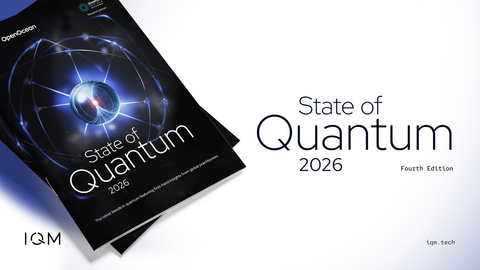
State of Quantum 2026 is based on independently conducted research and analysis, authored by The Quantum Insider (Resonance), published by IQM Quantum Computers, and supported by OpenOcean.
According to the State of Quantum 2026, the fourth annual industry study published today by IQM Quantum Computers, which is nearing its planned listing on the Nasdaq Global Select Market through its merger with Real Asset Acquisition Corp. (Nasdaq: RAAQ), with research and analysis independently conducted by The Quantum Insider, a Resonance company — enterprise engagement is now nearly universal but production use remains rare:
That gap is the central tension the report documents. Momentum is real and rising, but the work of converting access into usable capability has barely begun, and the report finds that the organizations doing it now will hold an advantage later entrants find structurally difficult to close.
The report draws on tracked transaction data from 2021 to Q1 2026, a validated survey of 107 senior practitioners across AMER, EMEA, and APAC, and 19 in-depth interviews with leaders at organizations including Airbus, BMW, Moderna, Deutsche Bahn, Argonne National Laboratory, and the Oxford Quantum Institute.
A market that can be measured for the first time
To quantify how prepared the buyer base is, the report introduces the Quantum Readiness Index, a composite score across four dimensions: Workforce, Innovation, Investment, and Adoption, mapped to five tiers from Aware to Leading. The global cohort scores 58 out of 100, placing it in the "Developing" tier: a market that has moved beyond awareness and early exploration but is not yet prepared for scaled adoption. The pattern inside the score is the finding that matters: hiring, budget, and pilots are more advanced than proprietary output or scaled deployment. Only
"Markets mature when their questions do," said Alex Challans, CEO of The Quantum Insider. "A year ago, people were still asking whether quantum investment had peaked. This year's report closes that debate. Capital is arriving at scale, and it is going to the companies with demonstrated results behind their roadmaps. The question now is not whether there is money in quantum. It is whether your organization is building the capability to be ready when that investment turns into a commercial product."
The shift the data shows
For most of quantum's commercial history, the market measured itself by access. The 2026 evidence shows that is changing. Across hybrid and standalone models, roughly
The reason this matters, the report argues, is timing. Quantum advantage is not delivered at the point of installation. It is built incrementally through trained people, algorithms written for specific problems, and operational experience accumulated over successive cycles, none of which can be assembled quickly later. Vendor roadmaps across all major modalities now converge on a 2029 to 2031 window for fault-tolerant quantum computing, which makes the intervening years the period in which capability has to be built.
"The quantum future is closer than it looks," wrote Jan Goetz, Co-Founder and CEO of IQM Quantum Computers, in the report's foreword. "The work of being ready for it starts now. The organizations holding out for a clear signal tend to find the signal and the deadline show up on the same morning."
Where the constraints actually sit
The report is direct that the binding limits are no longer mainly about hardware. The most consistent barrier is skills, cited by
Capital has moved toward demonstrated execution
The report finds that investors are now rewarding verifiable milestones over roadmap ambition. Quantum computing drew
Procurement criteria are shifting alongside the capital. Openness, calibration access, and co-development quality are becoming more important, and the report finds that a black-box system is increasingly incompatible with buyers whose goal is to build capability of their own. Sovereignty requirements in
On market position, the report's transaction data, based on publicly available information, finds that IQM leads vendors with
The report's read on timing was echoed this month at the Wall Street Journal CEO Council Summit in
State of Quantum 2026 is based on independently conducted research and analysis, authored by The Quantum Insider (Resonance), published by IQM Quantum Computers, and supported by OpenOcean. The full report is free to download here and includes the complete Quantum Readiness Index methodology, regional breakdowns, and recommendations for enterprise leaders, policymakers, HPC centers, investors, and academic institutions.
About The Quantum Insider
The Quantum Insider is the leading provider of media and market intelligence on the quantum technology industry, part of Resonance, headquartered in
About IQM Quantum Computers IQM Quantum Computers delivers full-stack quantum computers and cloud platform access to research institutions, universities, high-performance computing centers, national laboratories, and enterprises worldwide. IQM's on-premises deployment model gives customers direct ownership and control of their quantum infrastructure. Founded in 2018, headquartered in
About OpenOcean OpenOcean is a pan-European early-stage venture capital firm partnering with technical founders at Seed and Series A. We lead or co-lead Seed and early Series A rounds, investing up to
View source version on businesswire.com: https://www.businesswire.com/news/home/20260618639340/en/
Media Contacts:
The Quantum Insider
hello@resonance.holdings
IQM Quantum Computers
press@meetiqm.com
OPENOCEAN
samuli@bamla.agency
Source: IQM Quantum Computers