
DAT: Spot truckload rates rise in May on capacity pressure across the market
Rhea-AI Summary
DAT Freight & Analytics (ROP) reported that in May 2026 U.S. truckload spot rates rose even as freight demand fell. The DAT Truckload Volume Index declined 9%-14% month over month, while van, reefer, and flatbed spot and contract rates increased both monthly and year over year.
Positive
- Van spot rate $2.89/mi, up $0.22 vs April and $0.90 YoY
- Reefer spot rate $3.35/mi, up $0.24 MoM and $0.99 YoY
- Flatbed spot rate $3.65/mi, up $0.19 MoM and $1.07 YoY
- Contract rates up MoM across all modes, +$0.06–$0.07 per mile
- Spot-contract gap narrows as reefer spot rate exceeds contract at $3.35 vs $3.28
Negative
- DAT Truckload Volume Index down 9%–14% MoM across van, reefer, flatbed
- Freight volumes lower in May despite higher spot pricing
- Ongoing immigration enforcement shrinking available driver pool
- Capacity pulled from spot market due to Roadcheck and holiday-related delays
News Market Reaction – ROP
In the Jun 16 session, ROP gained 1.47%, reflecting a mild positive market reaction.
Data tracked by StockTitan Argus on the day of publication.
Key Figures
Historical Context
| Date | Event | Sentiment | 24h Move | Catalyst |
|---|---|---|---|---|
| Jun 11 | Product feature update | Positive | -0.4% | DAT expanded reload visibility in Convoy Platform for better carrier planning. |
| May 19 | Executive appointment | Positive | +1.4% | Illumia named a new COO to drive operational unification and AI adoption. |
| May 19 | Dividend declaration | Positive | +1.4% | Board approved a cash dividend of $0.91 per share for July payment. |
| May 18 | DAT freight update | Positive | +3.1% | DAT reported higher April spot and contract truckload rates despite softer volumes. |
| May 04 | Conference participation | Positive | -0.8% | DAT showcased DAT iQ and freight intelligence at a major supply chain event. |
24h Move is the share-price change in the day after each event; other market factors may also have contributed.
Recent DAT and corporate updates have mostly seen modest positive price alignment, with occasional negative divergences on product and marketing news.
Over the last few months, ROP-linked news has included DAT freight market updates, product enhancements, governance actions, and corporate appointments. A DAT rate-and-volume update on Apr 2026 coincided with a 3.15% gain, while a Convoy Platform feature expansion on Jun 11, 2026 saw a slight -0.42% move. A dividend announcement of $0.91 per share and leadership changes at Illumia each aligned with a 1.43% rise. Today’s DAT freight-rate release fits this pattern of frequent, data‑driven operating updates.
Key Terms
spot rates financial
fuel surcharges financial
linehaul rates financial
truckload spot rates financial
contract freight financial
AI-generated analysis. How Rhea-AI works. Not financial advice.




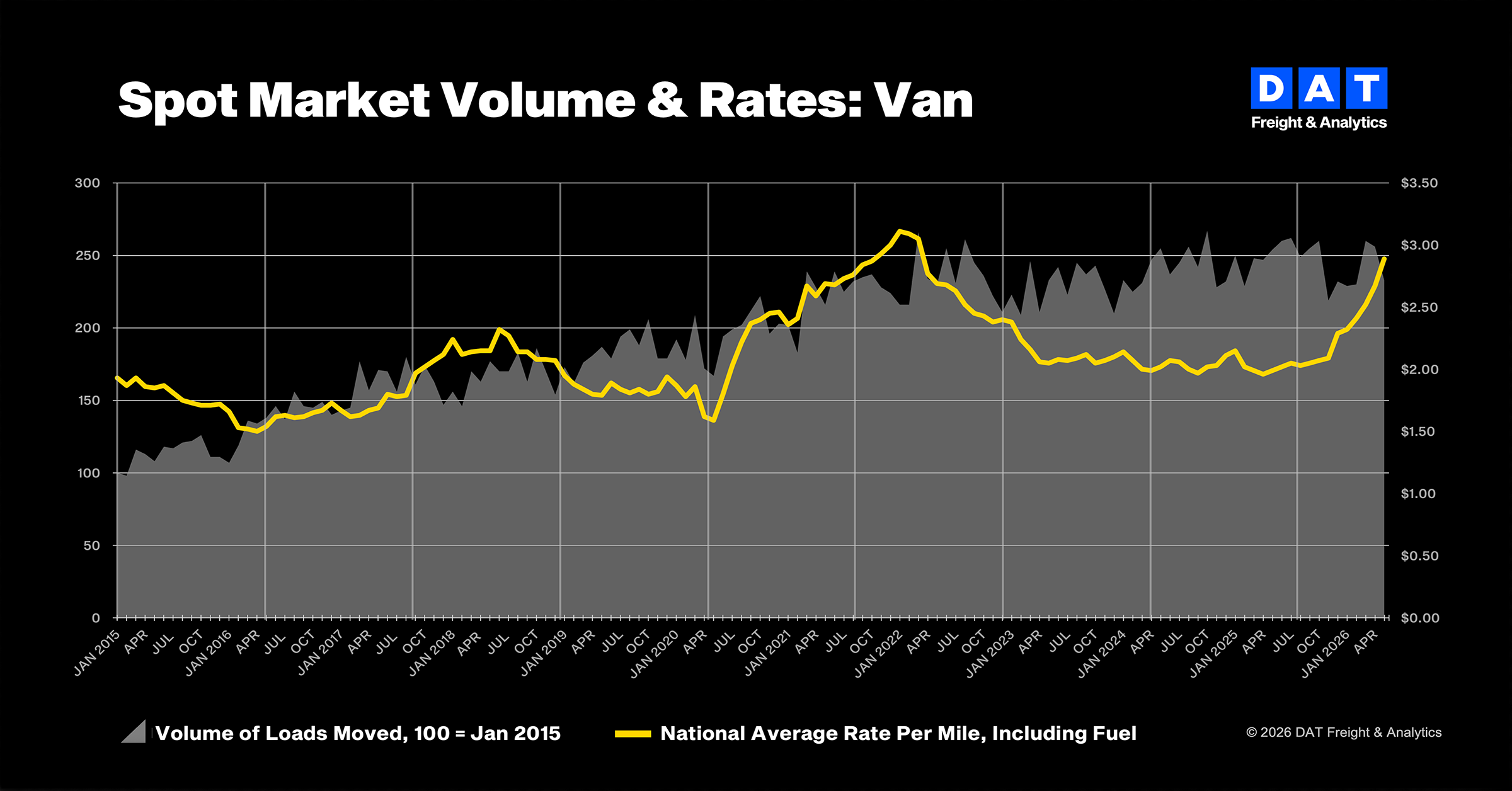
PORTLAND, Ore., June 16, 2026 (GLOBE NEWSWIRE) -- Truckload spot rates moved higher in May even as freight volumes fell, according to DAT Freight & Analytics, provider of the industry’s leading load boards and freight analytics. Several factors disrupted the supply of available trucks, including the CVSA International Roadcheck inspection blitz, Memorial Day weekend, and ongoing immigration enforcement that continues to shrink the available driver pool.
The DAT Truckload Volume Index (TVI), which measures demand for truckload services, fell across all three equipment types compared to April:
- Van TVI: 233, down
9% compared to April - Refrigerated (“reefer”) TVI: 172, down
10% - Flatbed TVI: 267, down
14%
Spot pricing: Volumes down, rates up
Spot rates increased across all three equipment types in May despite lower freight volumes, reflecting tighter capacity rather than rising demand. Enforcement-driven attrition continues to remove drivers from circulation, and truck-post data from the DAT One marketplace during the week of May 10 reflected carriers pulling equipment to avoid Roadcheck-related delays.
- Spot van rate:
$2.89 per mile, up 22 cents from April - Spot reefer rate:
$3.35 per mile, up 24 cents - Spot flatbed rate:
$3.65 per mile, up 19 cents
Fuel surcharges remained elevated — van at 73 cents per mile, reefer at 79 cents, flatbed at 87 cents — but linehaul rates drove last month’s pricing increases. The average van linehaul rate was up 20 cents to
Spot-contract rate gap narrows
Carriers have also been shifting capacity toward contract freight to take advantage of fuel surcharge programs, which offer more predictable cost recovery than spot transactions. That shift is reducing truck supply on the open market, making the spot market more sensitive to disruptions like Roadcheck and holiday slowdowns.
Reefer spot rates crossed above contract rates in May —
Spot rates were higher across all modes compared to May 2025. The average spot van rate was 90 cents per mile higher, the reefer rate was up 99 cents, and the flatbed rate increased by
Contract rates: Modest gains
Contract rates moved modestly higher in May across all three equipment types.
- Contract van rate:
$2.92 per mile, up 7 cents month over month - Contract reefer rate:
$3.28 per mile, up 6 cents - Contract flatbed rate:
$3.77 per mile, up 6 cents
Year over year, contract rates were up 54 cents for van freight, 57 cents for reefer, and 70 cents for flatbed.
“Last month’s lower volumes do not mean May was a weak freight market,” said Dean Croke, principal industry analyst at DAT. “The capacity supply has come down to meet demand, and carriers in the spot market are being compensated for it. Add in the migration of capacity toward contract freight for fuel surcharge certainty, and you have a spot market that’s tighter than load volumes alone would suggest.”
About the Truckload Volume Index
The DAT Truckload Volume Index measures monthly changes in loads with a pickup date during that month. A baseline of 100 equals the number of loads moved in January 2015, based on data from DAT RateView, part of the DAT iQ freight analytics platform, which tracks rates paid on actual shipments. Benchmark spot rates reflect invoice data for hauls of 250 miles or more, offering a consistent view of truckload demand and spot rate trends across the United States and Canada.
About DAT Freight & Analytics
DAT Freight & Analytics operates the DAT One truckload freight marketplace; Convoy Platform, an automated freight-matching technology; DAT iQ analytics service; Trucker Tools load-visibility platform; and Outgo factoring and financial services for truckers. Shippers, transportation brokers, carriers, news organizations, and industry analysts rely on DAT for market trends and data insights, informed by nearly 700,000 daily load posts and a database exceeding
Founded in 1978, DAT is a business unit of Roper Technologies (Nasdaq: ROP), a constituent of the Nasdaq 100, S&P 500, and Fortune 500. Headquartered in Portland, Oregon, DAT continues to set the standard for innovation in the trucking and logistics industry. Visit dat.com for more information.
Media contact:
Georgia Jablon
DAT Freight & Analytics
904-305-6454; georgia.jablon@dat.com
A photo accompanying this announcement is available at https://www.globenewswire.com/NewsRoom/AttachmentNg/57d409dc-32d3-46a9-88bb-5de44d8f17a0
