
U.S. Army Corps of Engineers Validates 374Water's AirSCWO(TM) Technology at 99.9993% PFAS Destruction in Report on AFFF Treatment
374Water (NASDAQ:SCWO) announced that a U.S. Army Engineer Research and Development Center (ERDC) technical report independently validated its AirSCWO™ technology for destroying PFAS in aqueous film-forming foam (AFFF).
Rhea-AI Summary
374Water (NASDAQ:SCWO) announced that a U.S. Army Engineer Research and Development Center (ERDC) technical report independently validated its AirSCWO™ technology for destroying PFAS in aqueous film-forming foam (AFFF). The AirSCWO 6 system achieved a total PFAS destruction and removal efficiency of 99.9993% across 42 PFAS compounds, with individual compounds between 99.994% and 100%.
Treated liquid effluent was reported to meet U.S. EPA maximum contaminant levels for all regulated PFAS, indicating potential for direct discharge. Volatile fluorinated stack emissions were near zero, at 0.0005 g/hour versus a PFAS throughput of 16.6 g/hour, and broader organics were reduced to near-non-detect. The ERDC TR-26-19 report, performed under the Army’s Environmental Quality Technology 6.4 Program, supports 374Water’s strategic collaboration with Arcadis to pursue federal and commercial PFAS destruction contracts.
Positive
- PFAS destruction efficiency 99.9993% in AFFF, independently validated by ERDC and Arcadis
- Treated effluent met U.S. EPA PFAS MCLs, indicating potential for direct discharge
- Volatile fluorinated stack emissions near zero at 0.0005 g/hour versus 16.6 g/hour PFAS throughput
- Broader organic load minimized, with COD and TOC reduced to near-non-detect levels
- ERDC TR-26-19 validation under Army Environmental Quality Technology 6.4 Program enhances technology readiness
- Strategic collaboration with Arcadis to jointly pursue federal and commercial PFAS destruction contracts
Negative
- None.
Details
News Market Reaction – SCWO
In the Jul 23 session, SCWO gained 2.43%, reflecting a moderate positive market reaction. Argus tracked a peak move of +5.7% during that session. Our momentum scanner triggered 6 alerts that day, indicating moderate trading interest and price volatility.
Data tracked by StockTitan Argus on the day of publication.
Key Figures
- PFAS destruction and removal efficiency
- 99.9993%
- AirSCWO 6 demonstration measured by TOP Assay
- PFAS compounds evaluated
- 42 PFAS compounds
- Total PFAS destruction and removal efficiency assessment
- Individual PFAS DRE range
- 99.994% to 100%
- Measured by EPA Method 1633
- Detectable stack emissions
- 0.0005 grams per hour
- Volatile fluorinated compounds in the gas stack
- PFAS throughput
- 16.6 grams per hour
- PFAS throughput into the AirSCWO system
- PFAS stockpiles
- More than 650 installations
- Department of Defense survey in 2020
- Military installations requiring remediation
- 574 military installations
- Installations identified by the U.S. Department of Defense
- Report publication
- July 2026
- ERDC TR-26-19 technical report
Historical Context
-
Arcadis collaboration pursued federal and commercial PFAS destruction contracts using AirSCWO systems.
-
Charles Weiser became CFO while the prior interim CFO continued as a consultant.
-
374Water joined the Russell Microcap Index as it expanded its waste-services hub.
-
Phase 1 mobile AirSCWO deployment completed under a $600,000 services contract.
-
Amended license expanded Orlando storage, space, and PFAS destruction hub capacity.
24h Move is the share-price change in the day after each event; other market factors may also have contributed.
Key Terms
pfas technical
aqueous film-forming foam technical
supercritical water oxidation technical
total oxidizable precursor technical
destruction and removal efficiency technical
maximum contaminant levels regulatory
AI-generated analysis. How Rhea-AI works. Not financial advice.




Independently validated USACE Engineer Research and Development Center ("ERDC") demonstration - conducted with Arcadis - confirms permanent destruction of PFAS in aqueous film-forming foam ("AFFF"), with treated liquid effluent below U.S. EPA drinking water limits and near-zero fluorinated stack emissions.
MORRISVILLE, NC / ACCESS Newswire / July 23, 2026 / 374Water Inc. (NASDAQ:SCWO) ("374Water" or the "Company"), a cleantech and environmental services company deploying supercritical water oxidation technology for the permanent destruction of PFAS and hazardous organic waste streams, today announced the public release of a U.S. Army ERDC technical report documenting an independently validated demonstration of the Company's AirSCWO™ technology destroying PFAS in AFFF. The demonstration was conducted with Arcadis U.S., Inc. ("Arcadis"), which co-authored the report and independently validated the results.
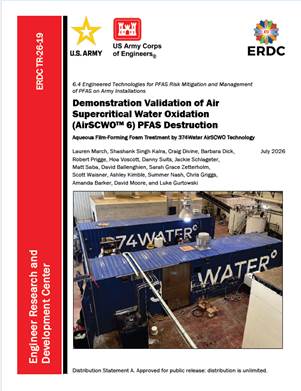
374Water's AirSCWO system treated AFFF concentrate at the Company's Waste Destruction Facility "WDS" in Orlando, Florida. Performance was evaluated across three objectives: PFAS destruction efficiency, PFAS in gaseous stack emissions, and treatment operating data. Liquid effluent and direct gas-stack sampling were conducted using certified U.S. EPA methods - including EPA Method 1633, the Total Oxidizable Precursor ("TOP") Assay, and OTM-45 and OTM-50 for stack emissions - with analyses performed and cross-validated by multiple independent laboratories, including ERDC, the Colorado School of Mines, and Eurofins.
Results
As documented in the report, the AirSCWO 6 system achieved a total PFAS destruction and removal efficiency (DRE) of
The report further documented that volatile fluorinated compounds in the gas stack were near zero - a total detectable emission rate of 0.0005 grams per hour, against a PFAS throughput of 16.6 grams per hour into the system. The report notes this as an advantage of supercritical water oxidation over conventional thermal treatment, because the minimal generation of volatile fluorinated compounds means secondary treatment or air-pollution abatement systems are not required. Beyond PFAS, the system also oxidized the broader organic load in the AFFF matrix, reducing chemical oxygen demand and total organic carbon to near-non-detect levels in the treated effluent.
"This is exactly the kind of rigorous, independent validation that the federal market demands," said Howard Teicher, VP, Government, 374Water. "The U.S. Army put our technology to the test on AFFF under field conditions, measured it with the most stringent methods available, and documented destruction of PFAS at
The report - ERDC TR-26-19, Demonstration Validation of Air Supercritical Water Oxidation (AirSCWO 6) PFAS Destruction: Aqueous Film-Forming Foam Treatment by 374Water AirSCWO Technology - was published in July 2026 under Distribution Statement A (approved for public release; distribution unlimited). The work was performed under the U.S. Army's Environmental Quality Technology 6.4 Program, "Engineered Technologies for Risk Mitigation and Management of PFAS on Army Installations."
Building on the 374Water-Arcadis Partnership
The demonstration underpins the strategic collaboration 374Water and Arcadis announced earlier this month. Under that Memorandum of Understanding, the two companies are jointly pursuing federal and commercial contracts for the permanent destruction of AFFF and other PFAS-impacted waste streams - pairing Arcadis's federal contracting platform and PFAS remediation expertise with 374Water's AirSCWO destruction technology and waste destruction services. The independently validated performance documented in ERDC TR-26-19 (LINK) provides the technical foundation on which that partnership intends to build.
Market Potential
The federal PFAS remediation market represents a long-duration, mission-critical opportunity driven by regulatory pressure, legacy AFFF inventories, and the growing mandate for permanent destruction rather than continued storage or disposal. In a 2020 survey, the U.S. Department of Defense reported PFAS stockpiles at more than 650 installations worldwide and has separately identified 574 military installations where PFAS contamination requires remediation action. By advancing the maturity, reliability, and Technology Readiness Level of AirSCWO through a coordinated bench-to-field validation, the ERDC program materially reduces deployment risk and helps accelerate federal adoption of supercritical water oxidation as a permanent PFAS destruction solution. 374Water believes this validated performance positions its AirSCWO platform - and the regional Waste Destruction Services hub model it is commercializing - to serve recurring federal and commercial demand at scale.
About 374Water
374Water Inc. (NASDAQ:SCWO) is a cleantech and environmental services company deploying supercritical water oxidation technology for the destruction of organic waste streams within the industrial, municipal, and federal markets. 374Water's AirSCWO technology is designed to efficiently destroy and mineralize a broad spectrum of nonhazardous and hazardous organic wastes, producing safe dischargeable water streams, safe mineral effluent, safe vent gas, and recoverable heat energy. 374Water's AirSCWO technology has the potential to assist its customers to meet discharge requirements, reduce or eliminate disposal costs, remove bottlenecks, and reduce litigation and other risks. 374Water continues to be a leader in innovative waste treatment solutions, dedicated to creating a greener future and eradicating harmful pollutants. Learn more by visiting www.374water.com and follow us on LinkedIn.
Forward-Looking Statements
Certain statements in this communication are "forward-looking statements" within the meaning of the "safe harbor" provisions of the Private Securities Litigation Reform Act of 1995, as amended. Words such as "anticipate," "believe," "confidence," "could," "design," "estimate," "expect," "intend," "may," "plan," "predict," "project," "potential," or other comparable terminology are intended to identify forward-looking statements. 374Water has based these forward-looking statements on its current expectations, assumptions, estimates, beliefs, and projections. While 374Water believes these expectations, assumptions, estimates, and projections are reasonable, such forward-looking statements are only predictions and involve known and unknown risks and uncertainties, many of which involve factors or circumstances that are beyond 374Water's control. These forward-looking statements are subject to risks and uncertainties, including those discussed under "Risk Factors" in 374Water's Form 10-K for the year ended December 31, 2025, and in 374Water's subsequent filings and reports with the SEC. The forward-looking statements herein are made only as of the date they were first issued, and unless otherwise required by laws, 374Water disclaims any intention or obligation to update or revise any forward-looking statements, whether as a result of new information, future events, or otherwise.
Investor Relations Contact
Belton Copp
Vice President
Direct: 401-419-1545
Belton.Copp@374water.com
www.374Water.com
SOURCE: 374Water, Inc.
View the original press release on ACCESS Newswire
FAQ
AI-generated questions and answers. How Rhea-AI works. Not financial advice.