
New data for Smith+Nephew’s CARTIHEAL◊ AGILI-C◊ Cartilage Repair Implant demonstrates superior pain relief and functional gains at 5-years
Smith+Nephew (NYSE:SNN) reported 5-year randomized trial results showing the CARTIHEAL AGILI-C implant delivered higher KOOS scores versus standard care through 60 months with superior pain relief and functional gains.
Rhea-AI Summary
Smith+Nephew (NYSE:SNN) reported 5-year randomized trial results showing the CARTIHEAL AGILI-C implant delivered higher KOOS scores versus standard care through 60 months with superior pain relief and functional gains. The implant is FDA-approved, commercially available in the US, and received a Category I CPT code effective Jan 1, 2027.
Results were comparable for patients with and without osteoarthritis, and clinicians reported roughly twice the pain reduction versus debridement or microfracture.
Positive
- Higher KOOS scores through 60 months
- Patients reported twice the pain reduction versus standard care
- Durable functional gains at 2, 4, and 5 years
- FDA-approved and commercially available in the United States
- Granted Category I CPT code effective Jan 1, 2027
Negative
- None.
Details
News Market Reaction – SNN
On Apr 21, the day this news came out, SNN closed 4.00% below the previous close.
Data tracked by StockTitan Argus for the Apr 21 session.
Key Figures
- Follow-up duration
- 60 months
- KOOS outcomes reported versus standard of care
- Pain relief period
- 5-year period
- Superior knee pain relief and quality of life with CARTIHEAL
- Functional gains duration
- 2 years
- Improved activities of daily living, sport, recreation at 2 years
- Functional gains duration
- 4 years
- Sustained functional improvements at 4 years
- Functional gains duration
- 5 years
- Sustained functional improvements at 5 years
- CPT code effective date
- January 1, 2027
- Category I CPT code for CARTIHEAL procedures becomes effective
Historical Context
-
REGENETEN implant halved recovery times versus traditional repair in RCT.
-
Launch of ALLEVYN COMPLETE CARE high-performance foam dressing.
-
Showcase of handheld robotics and reconstruction technologies at AAOS 2026.
-
Presentation of rotator cuff repair portfolio including Tendon Seam and REGENETEN.
-
Exclusive US distribution deal for A’TOMIC Nitinol Fixation System.
24h Move is the share-price change in the day after each event; other market factors may also have contributed.
Key Terms
randomized controlled trial medical
knee injury and osteoarthritis outcome scores (koos) medical
osteochondral medical
category i current procedural terminology (cpt) code regulatory
debridement medical
microfracture medical
biphasic scaffold medical
aragonite medical
AI-generated analysis. How Rhea-AI works. Not financial advice.




Smith+Nephew (LSE:SN, NYSE:SNN), the global medical technology company, today announces further compelling evidence from a multicenter, randomized controlled trial highlighting the clinical superiority of its CARTIHEAL AGILI-C Cartilage Repair Implant recently published in the American Journal of Sports Medicine (AJSM). The CARTIHEAL AGILI-C Cartilage Repair Implant resulted in higher overall Knee injury and Osteoarthritis Outcome Scores (KOOS) versus surgical standard of care* for all time points out to 60 months.1,2
- Superior pain relief: Patients treated with the CARTIHEAL AGILI-C Implant reported significantly better knee pain relief, and quality of life improvements over a 5-year period.1
- Superior functional gains: Patients treated with the CARTIHEAL Implant reported superior improvements in performing activities related to daily living, sport and recreation at 2, 4 and 5-years.1,2
- Patients with/without osteoarthritis (OA): Equal clinical outcomes were found in OA and non-OA patients receiving the CARTIHEAL Implant.1,2
“Having been involved with CARTIHEAL from the initial trial design, through patient enrollment, and now in daily clinical use, I’m thrilled by the 5-year outcomes. Notably, CARTIHEAL patients had twice the reduction in pain scores compared to standard care,” said Dr. Andreas Gomoll, Professor of Orthopedic Surgery at Weill-Cornell Medical School and Attending Orthopedic Surgeon at the Hospital for Special Surgery in New York. “What excites me even more is that these outcomes were comparable for both patients with and without osteoarthritis. This represents a vital new option for those in the osteoarthritis treatment gap where cartilage is too damaged for standard repair but not enough for joint replacement. Historically, these patients relied on non-surgical methods with mixed success. Now, we have a durable solution to restore function and quality of life.”
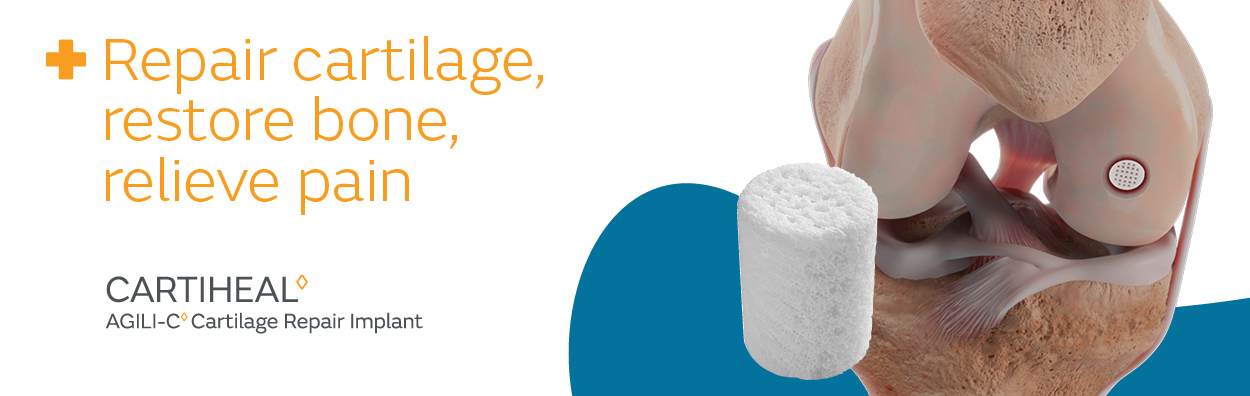
Smith+Nephew's FDA-approved CARTIHEAL Implant is revolutionizing the cartilage repair landscape with the implant’s broad indication allowing physicians to treat patients who previously may not have had access. The implant recently received a Category I Current Procedural Terminology (CPT) code for procedures that will go into effect on January 1, 2027.
“Patients need an off the shelf scaffold with strong clinical evidence—one that can effectively treat both chondral and osteochondral defects, even in those with mild to moderate osteoarthritis. These new 5-year results further validate the promise of the CARTIHEAL Implant,” said Professor Elizaveta Kon from Humanitas Research Hospital. “They show that we can finally offer a reliable, evidence backed solution to a large patient population that, in many cases, has had limited treatment options. Seeing such durable outcomes is truly exciting.”
About the CARTIHEAL AGILI-C Cartilage Repair Implant
The CARTIHEAL Implant is commercially available in the United States, including Puerto Rico. Composed of aragonite, a naturally occurring calcium carbonate acting as a biphasic scaffold – the implant is able to repair cartilage and restore subchondral bone.3-7 To learn more about Smith+Nephew’s CARTIHEAL AGILI-C Cartilage Repair Implant, please visit www.smith-nephew.com/cartiheal.
- ends –
Media Enquiries
Dave Snyder +1 (978) 749-1440
Smith+Nephew david.snyder@smith-nephew.com
* compared to debridement or microfracture
References
- Altschuler N ZK, Di Matteo B, et al. Five-Year Follow-up of a Multicenter Randomized Controlled Trial Comparing an Aragonite-Based Scaffold with Microfracture and Debridement for Chondral and Osteochondral Knee Lesions. Am J Sports Med 2026.
- Conte P, Anzillotti G, Crawford DC, et al. Differential analysis of the impact of lesions' location on clinical and radiological outcomes after the implantation of a novel aragonite-based scaffold to treat knee cartilage defects. Int Orthop. 2024;48(12):3117-3126
- Altschuler N, Zaslav KR, Di Matteo B, et al. Aragonite-Based Scaffold Versus Microfracture and Debridement for the Treatment of Knee Chondral and Osteochondral Lesions: Results of a Multicenter Randomized Controlled Trial. Am J Sports Med. 2023;51(4):957-967. doi:10.1177/03635465231151252
- Kon E, Di Matteo B, Verdonk P, et al. Aragonite-Based Scaffold for the Treatment of Joint Surface Lesions in Mild to Moderate Osteoarthritic Knees: Results of a 2-Year Multicenter Prospective Study. Am J Sports Med. 2021;49(3):588-598. doi:10.1177/0363546520981750
- Kon E, Filardo G, Shani J, et al. Osteochondral regeneration with a novel aragonite-hyaluronate biphasic scaffold: up to 12-month follow-up study in a goat model. J Orthop Surg Res. 2015;10:81. Published 2015 May 28. doi:10.1186/s13018-015-0211-y
- Matta C, et al. Differentiation.2019;107:24-34.
- Chubinskaya S, et al. Knee Surg Sports Traumatol Arthrosc. 2019;27(6):1953-1964.
About Smith+Nephew
Smith+Nephew is a portfolio medical technology business focused on the repair, regeneration and replacement of soft and hard tissue. We exist to restore people’s bodies and their self-belief by using technology to take the limits off living. We call this purpose ‘Life Unlimited’. Our 17,000 employees deliver this mission every day, making a difference to patients’ lives through the excellence of our product portfolio, and the invention and application of new technologies across our three global business units of Orthopaedics, Sports Medicine & ENT and Advanced Wound Management.
Founded in Hull, UK, in 1856, we now operate in around 100 countries, and generated annual sales of
For more information about Smith+Nephew, please visit www.smith-nephew.com and follow us on X, LinkedIn, Instagram or Facebook.
Forward-looking Statements
This document may contain forward-looking statements that may or may not prove accurate. For example, statements regarding expected revenue growth and trading profit margins, market trends and our product pipeline are forward-looking statements. Phrases such as "aim", "plan", "intend", "anticipate", "well-placed", "believe", "estimate", "expect", "target", "consider" and similar expressions are generally intended to identify forward-looking statements. Forward-looking statements involve known and unknown risks, uncertainties and other important factors that could cause actual results to differ materially from what is expressed or implied by the statements. For Smith+Nephew, these factors include: conflicts in Europe and the Middle East, economic and financial conditions in the markets we serve, especially those affecting healthcare providers, payers and customers; price levels for established and innovative medical devices; developments in medical technology; regulatory approvals, reimbursement decisions or other government actions; product defects or recalls or other problems with quality management systems or failure to comply with related regulations; litigation relating to patent or other claims; legal and financial compliance risks and related investigative, remedial or enforcement actions; disruption to our supply chain or operations or those of our suppliers; competition for qualified personnel; strategic actions, including acquisitions and disposals, our success in performing due diligence, valuing and integrating acquired businesses; disruption that may result from transactions or other changes we make in our business plans or organisation to adapt to market developments; relationships with healthcare professionals; reliance on information technology and cybersecurity; disruptions due to natural disasters, weather and climate change related events; changes in customer and other stakeholder sustainability expectations; changes in taxation regulations; effects of foreign exchange volatility; and numerous other matters that affect us or our markets, including those of a political, economic, business, competitive or reputational nature. Please refer to the documents that Smith+Nephew has filed with the U.S. Securities and Exchange Commission under the U.S. Securities Exchange Act of 1934, as amended, including Smith+Nephew's most recent annual report on Form 20-F, which is available on the SEC’s website at www. sec.gov, for a discussion of certain of these factors. Any forward-looking statement is based on information available to Smith+Nephew as of the date of the statement. All written or oral forward-looking statements attributable to Smith+Nephew are qualified by this caution. Smith+Nephew does not undertake any obligation to update or revise any forward-looking statement to reflect any change in circumstances or in Smith+Nephew's expectations.
◊ Trademark of Smith+Nephew. Certain marks registered in US Patent and Trademark Office.

FAQ
AI-generated questions and answers. How Rhea-AI works. Not financial advice.