
Synopsys Details Growth Strategy and Long-term Financial Model at 2026 Investor Day
The long-term capital-return objective is up to 50% of free cash flow through share repurchases after investment in the business.
Sentiment and the balance of points
Rhea-AI Sentiment reads the wording of the document, how positive or negative its language is on a 1 to 5 scale. The balance of points shown with the takes weighs what the document actually discloses, so the two can disagree, for example when a trial that missed its main goal is described in upbeat language.
Rhea-AI Summary
Synopsys (SNPS) outlined its growth strategy and financial targets, expecting fiscal 2027 revenue growth of approximately 15% year over year. Revenue guidance is $11.1 billion–$11.2 billion for the year ending October 31, 2027. The company targets GAAP earnings per share of $8.16–$8.61 and operating margin of approximately 20.7%; adjusted targets are $19.04–$19.12 and approximately 44.0%, respectively.
Synopsys targets approximately 15% annual revenue growth from fiscal 2026 through fiscal 2030, with adjusted operating margin reaching approximately 50%. Fiscal 2027 free cash flow, operating cash flow less capital spending, is targeted at approximately $3.1 billion. It intends to repurchase approximately $1 billion in shares over the coming months, subject to market conditions. Multiple customers have committed to application-optimized chip-design IP, including Amazon. A preferred-partner collaboration with OpenAI will develop GPT-Synopsys for chip design.
How this balance works
Rhea-AI gives every point it takes from this document a weight. Minor counts 1, Moderate 3 and Major 9, so one Major point outweighs several Minor ones. The bar adds up the weights on each side, and when neither side holds more than 65% of the total the balance reads Mixed.
It reads the document as published, with the same rules for every company, and it does not look at what the market expected or at how the stock traded, so a point can be objectively good on a day the stock falls.
Rhea-AI Sentiment measures something else, the tone of the wording.
Hollow bars mark forward-looking points. How the balance works
Positive
- Moderate point. Forward-looking: it has not happened yet and may not happen.Fiscal 2027 revenue guidance of $11.1 billion–$11.2 billion implies approximately 15% year-over-year growth at the midpoint.
- Moderate point. Forward-looking: it has not happened yet and may not happen.Fiscal 2027 free cash flow is targeted at approximately $3.1 billion, after capital expenditures.
- Moderate point. Forward-looking: it has not happened yet and may not happen.Share repurchases of approximately $1 billion are intended over the coming months, subject to market conditions. 1.3% of market cap
- Moderate point. Forward-looking: it has not happened yet and may not happen.Company revenue targets approximately 15% compound annual growth from fiscal 2026 through fiscal 2030.
- Moderate point. Forward-looking: it has not happened yet and may not happen.Fiscal 2030 non-GAAP operating margin is targeted at approximately 50%.
- Moderate point. Forward-looking: it has not happened yet and may not happen.Non-GAAP EPS targets compound annual growth in the mid 20%s from fiscal 2026 through fiscal 2030.
- Moderate point. Forward-looking: it has not happened yet and may not happen.Free cash flow targets compound annual growth in the mid 20%s from fiscal 2026 through fiscal 2030.
- Moderate pointApplication-optimized IP has secured multiple customers, including an IP agreement with Amazon.
- Moderate point. Forward-looking: it has not happened yet and may not happen.OpenAI preferred-partner collaboration plans to develop and deliver GPT-Synopsys, a specialized chip-design model.
7 minor points
- Minor point. Forward-looking: it has not happened yet and may not happen.Fiscal 2027 earnings targets are $8.16–$8.61 GAAP EPS and $19.04–$19.12 non-GAAP EPS.
- Minor point. Forward-looking: it has not happened yet and may not happen.Fiscal 2027 operating-margin targets are approximately 20.7% GAAP and 44.0% non-GAAP at guidance midpoints.
- Minor point. Forward-looking: it has not happened yet and may not happen.Long-term capital returns target up to 50% of free cash flow through share repurchases after business investment.
- Minor point. Forward-looking: it has not happened yet and may not happen.Electronic design automation revenue targets 13%+ compound annual growth from fiscal 2026 through fiscal 2030.
- Minor point. Forward-looking: it has not happened yet and may not happen.S&A revenue targets 10%+ compound annual growth from fiscal 2026 through fiscal 2030.
- Minor point. Forward-looking: it has not happened yet and may not happen.Design IP revenue targets 17%+ compound annual growth from fiscal 2026 through fiscal 2030.
- Minor point. Forward-looking: it has not happened yet and may not happen.AI engineering monetization plans combine subscription and consumption-based models across tools, agents and platform.
Negative
- Minor point. Forward-looking: it has not happened yet and may not happen.Fiscal 2027 expenses are targeted at $8.765 billion–$8.905 billion GAAP, or $6.215 billion–$6.275 billion non-GAAP.
- Minor point. Forward-looking: it has not happened yet and may not happen.Fiscal 2027 non-GAAP interest and other expense, net, is targeted at $455 million–$465 million.
- Minor point. Forward-looking: it has not happened yet and may not happen.Fiscal 2027 capital expenditures are targeted at approximately $500 million.
News Explained
Synopsys set a long-term objective to return up to
Key Figures
- FY2027 revenue guidance
- $11,100–$11,200 million
- Fiscal year ending October 31, 2027
- FY2027 GAAP EPS
- $8.16–$8.61 per diluted share
- Fiscal year ending October 31, 2027
- FY2027 non-GAAP EPS
- $19.04–$19.12 per diluted share
- Fiscal year ending October 31, 2027
- GAAP operating margin
- 20.7% midpoint
- FY2027 guidance
- Non-GAAP operating margin
- 44.0% midpoint
- FY2027 guidance
- Non-GAAP tax rate
- 18%
- FY2027 target
- Free cash flow returned via repurchases
- Up to 50%
- Long-term capital return objective
Historical Context
-
Introduced AgentEngineer and Autopilot, which the current strategy again positions within its AI engineering portfolio.
24h Move is the share-price change in the day after each event; other market factors may also have contributed.
Key Terms
gaap financial
cagr financial
stock-based compensation financial
fully diluted financial
AI-generated analysis. How Rhea-AI works. Not financial advice.




News Highlights
- Leading portfolio of engineering solutions positions Synopsys to capitalize on the continued expansion of digital and physical AI and the AI-driven transformation of engineering.
- Updates long-term growth targets to reflect accelerating revenue and expanding non-GAAP operating margins. Company expects fiscal year 2027 revenue growth of approximately
15% year over year to$11.15 billion - After investing in the business, Synopsys expects to return up to
50% of free cash flow to shareholders via share repurchases; with intent to repurchase approximately$1 billion
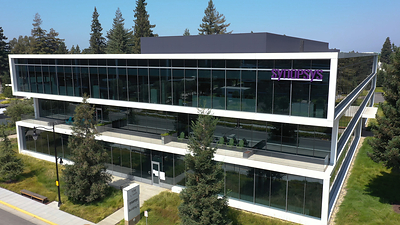
Synopsys President and CEO, Sassine Ghazi, said: "AI is creating multiple, reinforcing growth engines for Synopsys. The acceleration of frontier intelligence is fueling an unprecedented demand for compute power while increasing system complexity. Simultaneously, purpose-built silicon is reshaping the IP market, while Physical AI and agentic workflows are driving deeper integration of our trusted tools. Together, these forces are expanding our addressable market, increasing consumption of our technology, and creating new, recurring revenue streams."
Highlights from executive presentations include:
Silicon IP Business Expands to Serve Growing Demand for Special-purpose Silicon
Synopsys is expanding beyond traditional standards-based IP into application-optimized IP (AOIP), helping customers develop differentiated silicon tailored to specific workloads and system architectures. As AI drives demand for custom silicon across hyperscalers and system companies, Synopsys is leveraging its interface IP leadership, system expertise, and engineering scale to deliver optimized IP subsystems and platforms that accelerate time-to-market while improving performance and efficiency.
This 'Factory 2' IP model expands Synopsys' value capture per design win and increases its participation in the long-term growth of custom silicon and AI infrastructure. Demonstrating early momentum for the new IP business model, the company has secured multiple AOIP customers spanning compute, ASIC, and AI connectivity architectures. This includes an IP agreement with Amazon, which was announced today.
Powering the Next Frontier of AI-Driven Design
Ghazi today also explained the company's strategy to create and capture value in the delivery of AI-powered engineering solutions and announced a groundbreaking partnership with OpenAI to collaborate as preferred partners to develop and deliver GPT-Synopsys, a specialized model for chip design that brings together OpenAI's frontier AI with Synopsys' trusted EDA tools and chip design expertise.
Synopsys is advancing the next frontier of AI-driven design and simulation with a strategy that enables customers to adopt its agentic AI portfolio in the way that best fits their engineering environment. Customers can deploy the full Synopsys Autopilot platform, integrate Synopsys agents into their own AI platforms, or leverage frontier AI models optimized for specialized engineering workflows. Across all approaches, Synopsys provides the trusted engineering context, domain-specific agents, and ground-truth execution engines that power the development of the world's most advanced products. This flexible model expands Synopsys' opportunity to participate across the emerging AI engineering ecosystem while creating multiple avenues to monetize AI-driven engineering through a combination of subscription and consumption-based models across tools, agents and platform.
Synopsys Fiscal 2027 and Long-term Financial Outlook
Synopsys provided financial guidance for fiscal year 2027 and a comprehensive multi-year financial framework through fiscal year 2030. The company also announced its intent to repurchase approximately
Shelagh Glaser, Synopsys CFO, said, "Our updated financial framework reflects confidence in both our growth trajectory and our ability to scale efficiently while helping customers re-engineer their engineering to accelerate AI-powered products. We remain focused on disciplined execution, converting growth into expanding margins and strong free cash flow, while continuing to invest in innovation and deliver sustainable long-term value for our shareholders."
The company's updated long-term targets and fiscal year 2027 outlook are provided below:
|
Our long-term, FY26E - FY30E objectives (1) |
|
||||||
|
|
|
|
|
|
|
|
|
|
Revenue |
Operating Margin |
Free Cash Flow (2) |
|||||
|
Company (2) |
Long-term non-GAAP |
Free Cash Flow Growth |
|||||
|
Mid-Teens growth ~ |
FY30E operating margin ~ |
in the Mid |
|||||
|
|
|
|
|||||
|
Design Automation (2) |
Earnings (2) |
Capital Return(3) |
|||||
|
EDA: Mid-Teens: |
Non-GAAP EPS growth |
Up to |
|||||
|
S&A: Double-Digit: |
in the Mid |
of Free Cash Flow |
|||||
|
Design IP (2) |
|
via share repurchases |
|||||
|
High-Teens: |
|
|
|||||
|
(1) These multi-year objectives are provided as of September 30, 2026. See below for additional information regarding these forward-looking non-GAAP measures, including reconciliations to the most comparable GAAP measures to the extent available without unreasonable efforts |
||
|
(2) FY26E - FY30E Growth CAGR |
||
|
(3) Capital allocation objectives are based on current business outlook and may vary based on market conditions, strategic opportunities, and balance sheet priorities |
|
Full Fiscal Year 2027 Financial Targets |
|||
|
(in millions, except per share amounts) |
|||
|
|
|
|
|
|
|
|
Range for Fiscal Year Ending |
|
|
|
|
October 31, 2027 |
|
|
|
|
Low |
High |
|
Revenue |
|
|
|
|
GAAP Expenses |
|
|
|
|
Non-GAAP Expenses |
|
|
|
|
Non-GAAP Interest and Other Income (Expense), net |
|
( |
( |
|
Non-GAAP Tax Rate |
|
18 % |
18 % |
|
Outstanding Shares (fully diluted) |
|
190 |
192 |
|
GAAP Operating Margin |
|
Midpt: ~ |
|
|
Non-GAAP Operating Margin |
|
Midpt: ~ |
|
|
GAAP EPS |
|
|
|
|
Non-GAAP EPS |
|
|
|
|
Operating Cash Flow |
|
|
|
|
Free Cash Flow (1) |
|
|
|
|
Capital Expenditures |
|
|
|
|
(1) Free cash flow is calculated as cash provided from operating activities less capital expenditures |
|
GAAP to Non-GAAP Reconciliation of Full Fiscal Year 2027 Targets |
|||
|
(in thousands, except per share data) |
|||
|
|
Range for Fiscal Year |
||
|
|
Ending October 31, 2027 |
||
|
|
Low |
|
High |
|
Target GAAP expenses |
$ 8,765,000 |
|
$ 8,905,000 |
|
Adjustments: |
|
|
|
|
Amortization of acquired intangible assets |
(1,540,000) |
|
(1,550,000) |
|
Stock-based compensation |
(960,000) |
|
(980,000) |
|
Restructuring charges |
(50,000) |
|
(100,000) |
|
Target non-GAAP expenses |
$ 6,215,000 |
|
$ 6,275,000 |
|
|
|
|
|
|
|
Range for Fiscal Year |
||
|
|
Ending October 31, 2027 |
||
|
|
Low |
|
High |
|
Target GAAP earnings per diluted share attributed to Synopsys |
$ 8.16 |
|
$ 8.61 |
|
Adjustments: |
|
|
|
|
Amortization of acquired intangible assets |
$ 8.12 |
|
$ 8.06 |
|
Stock-based compensation |
$ 5.13 |
|
$ 5.03 |
|
Restructuring charges |
$ 0.52 |
|
$ 0.26 |
|
Tax adjustments and settlement |
$ (2.89) |
|
$ (2.84) |
|
Target non-GAAP earnings per diluted share attributed to Synopsys |
$ 19.04 |
|
$ 19.12 |
|
|
|
|
|
|
Shares used in non-GAAP calculation (midpoint of target range) |
191,000 |
|
191,000 |
|
GAAP to Non-GAAP Reconciliation of Operating Margin at Midpoint of Full Fiscal Year 2027 Targets |
|
|
|
|
|
|
Twelve Months Ending |
|
|
October 31, 2027 |
|
At midpoint of revenue and expense guidance ranges |
|
|
GAAP operating margin |
20.7 % |
|
Amortization of acquired intangible assets |
13.9 % |
|
Stock-based compensation |
8.7 % |
|
Restructuring charges |
0.7 % |
|
Target non-GAAP operating margin |
44.0 % |
Presentations and the webcast replay from today's Synopsys 2026 Investor Day are available at: https://investor.synopsys.com/.
Forward Looking Statements
Certain statements contained herein and in our investor conference call contain forward-looking statements within the meaning of the federal securities laws, including, but not limited to, statements concerning our anticipated financial performance, guidance, long-term financial objectives and projections; anticipated synergies and other benefits; capital allocation plans, including planned share repurchases; revenue growth objectives and the expected timing and pace of realization; operating margin expansion objectives; customer demand, market opportunities and industry trends, including the anticipated impact of artificial intelligence; products, services, technologies, business offerings and models, strategies, and anticipated product performance and customer benefits; partnerships and customer agreements; and our operating structure and growth strategy. These forward-looking statements generally are identified by the words "believe," "project," "expect," "anticipate," "estimate," "intend," "strategy," "future," "opportunity," "plan," "may," "should," "will," "would," "will be," "will continue," "will likely result," and similar expressions or the negatives of these words or other comparable terminology to convey uncertainty of future events or outcomes. Forward-looking statements are predictions, projections and other statements about future events that are based on current expectations and assumptions and, as a result, are subject to risks and uncertainties.
Many risks, uncertainties and other factors that could cause Synopsys' actual future events to differ materially from any future results, time frames, performance or achievements expressed or implied by the forward-looking statements, including, but not limited to: (i) macroeconomic conditions and geopolitical uncertainty in the global economy; (ii) uncertainty in the growth of the semiconductor and electronics industries; (iii) the highly competitive industry in which we operate; (iv) actions by the U.S. or foreign governments, such as the imposition of additional export restrictions or tariffs; (v) consolidation among our customers and our dependence on a relatively small number of large customers; (vi) risks and compliance obligations relating to the global nature of our operations; (vii) failure to realize the benefits expected from the transactions we complete, including the acquisition of ANSYS, Inc. ("Ansys"), or unexpected difficulties or expenditures arising therefrom; (viii) risks related to inaccuracies in, or failures to achieve, our operational and business metrics or forecasts of growth; and (ix) other risks and uncertainties described in our filings with the SEC. Unlisted factors may present significant additional obstacles to the realization of forward-looking statements.
Additional information on potential risks, uncertainties and other factors that could affect Synopsys' results is included in filings we make with the SEC from time to time, including in the sections entitled "Risk Factors" in our latest Annual Report on Form 10-K and in our latest Quarterly Report on Form 10-Q. The financial information contained in this press release should be read in conjunction with the consolidated financial statements and notes thereto included in Synopsys' most recent reports on Forms 10-K and 10-Q, each as may be amended from time to time. All forward-looking statements by their nature address matters that involve risks and uncertainties, many of which are beyond Synopsys' control, and are not guarantees of future results. Readers are cautioned not to put undue reliance on forward-looking statements, and Synopsys gives no assurances that it will achieve its expectations.
GAAP to Non-GAAP Reconciliations
This press release contains certain forward-looking financial measures that are not in accordance with the U.S. generally accepted accounting principles ("GAAP"). It also includes future estimates for non-GAAP operating margin, non-GAAP tax rate, non-GAAP interest and other income (expense), net, non-GAAP expenses, non-GAAP earnings per diluted share ("EPS"), non-GAAP EPS compound annual growth rate ("CAGR"), free cash flow ("FCF") and FCF CAGR.
- FCF is calculated as cash provided from operating activities less capital expenditures
- FCF CAGR is calculated as the average annual growth rate of FCF over a period of time
- Non-GAAP EPS is calculated as GAAP net income excluding amortization of acquired intangible assets, stock-based compensation, restructuring charges, acquisition/divestiture-related items, loss on sale of strategic investments, and legal matters, adjusted for the difference between GAAP and non-GAAP tax rates, divided by fully diluted outstanding shares
- Non-GAAP EPS CAGR is calculated as the average annual growth rate of non-GAAP EPS over a period of time
- Non-GAAP expenses are calculated as GAAP expenses, excluding amortization of acquired intangible assets, stock-based compensation, restructuring charges, and acquisition/divestiture-related items
- Non-GAAP operating margin is non-GAAP operating income for a period divided by revenue for the same period
- Non-GAAP tax rate is set at a three-year normalized tax rate of
18.0% . In projecting this rate, we evaluated our historical and projected mix of U.S. and international profit before tax, excluding the impact of stock-based compensation, the amortization of purchased intangibles and other GAAP only adjustments. - Non-GAAP interest and other income (expense), net is calculated as GAAP interest and other income (expense), net adjusted for the change in fair value of our non-qualified deferred compensation plan
Synopsys continues to provide all information required in accordance with GAAP but acknowledges evaluating its ongoing operating results may not be as useful if an investor is limited to reviewing only GAAP financial measures. Accordingly, Synopsys presents non-GAAP financial measures in reporting its financial results to provide investors with an additional tool to evaluate Synopsys' operating results in a manner that focuses on what Synopsys believes to be its core business operations and what Synopsys uses to evaluate its business operations and for internal budgeting and resource allocation purposes. These non-GAAP financial measures may be different from non-GAAP financial measures used by other companies. In addition, these non-GAAP measures are not based on any comprehensive set of accounting rules or principles, and management exercises judgment in determining which items should be excluded in the calculation of non-GAAP measures. The presentation of non-GAAP financial information is not meant to be considered in isolation from, as superior to or as a substitute for the directly comparable financial measures prepared in accordance with GAAP. These non-GAAP financial measures are meant to supplement, and be viewed in conjunction with, the corresponding GAAP financial measures.
Certain non-GAAP financial measures used by management, as well as the reconciliation of non-GAAP financial measures to their most closely applicable GAAP financial measures, is contained in this press release and in our investor conference call presentation available in the investor relations portion of Synopsys' corporate website at www.synopsys.com. Synopsys is unable to provide a full reconciliation of non-GAAP tax rate for FY 2027E; non-GAAP interest and other income (expense), net for FY 2027E; non-GAAP operating margin for FY 2028E-FY 2030E; non-GAAP EPS for FY 2028E-FY 2030E; non-GAAP EPS CAGR for FY 2026E-FY 2030E; FCF for FY 2028E-FY 2030E; and FCF CAGR for FY 2026E-FY 2030E projections, targets and guidance measures to the corresponding GAAP financial measures on a forward-looking basis because Synopsys believes that it would not be possible for it to have the information necessary to quantitatively reconcile such measures with sufficient precision without unreasonable efforts due to, among other things, the potential variability and limited predictability of the excluded adjustment items necessary for a full reconciliation such as certain acquisition/divestiture related items, tax deduction variability, changes in the fair value of non-qualified deferred compensation plan, and gains (losses) on the sale of strategic investments. For the same reasons, Synopsys is unable to address the probable significance of the unavailable information. Synopsys is presenting forward looking non-GAAP financial measures for illustrative purposes and may not report on this basis going forward.
Effectiveness of Information
The information provided herein is as of September 30, 2026. Although this press release is expected to remain available on Synopsys' website through the time Synopsys announces its results for the fourth quarter and fiscal year 2026, its continued availability through such time does not mean that Synopsys is reaffirming or confirming its continued validity. Synopsys undertakes no duty, and does not intend, to update any forward-looking statement, whether as a result of new information, future events or otherwise, unless required by law.
About Synopsys
Synopsys, Inc. (Nasdaq: SNPS) is the leader in engineering solutions from silicon to systems, enabling customers to rapidly innovate AI-powered products. We deliver industry-leading silicon design, IP, simulation and analysis solutions, and design services. We partner closely with our customers across a wide range of industries to maximize their R&D capability and productivity, powering innovation today that ignites the ingenuity of tomorrow. Learn more at www.synopsys.com.
© 2026 Synopsys, Inc. All rights reserved. Synopsys, Ansys, the Synopsys and Ansys logos, and other Synopsys trademarks are available at https://www.synopsys.com/company/legal/trademarks-brands.html. Other company or product names may be trademarks of their respective owners.
Contacts
Investors
Tushar Jain
synopsys-ir@synopsys.com
Media
Cara Walker
cara@synopsys.com
corp-pr@synopsys.com
 View original content to download multimedia:https://www.prnewswire.com/news-releases/synopsys-details-growth-strategy-and-long-term-financial-model-at-2026-investor-day-302894684.html
SOURCE Synopsys, Inc.
FAQ
AI-generated questions and answers. How Rhea-AI works. Not financial advice.
What is Synopsys SNPS revenue guidance for fiscal 2027?
Synopsys targets fiscal 2027 revenue of $11.1 billion–$11.2 billion for the year ending October 31, 2027. The company expects approximately 15% year-over-year revenue growth at the $11.15 billion midpoint.
How much stock does Synopsys plan to repurchase?
Synopsys intends to repurchase approximately $1 billion of shares over the coming months, subject to market conditions. Its long-term capital allocation objective is to return up to 50% of free cash flow through repurchases after investing in the business. That objective may vary with market conditions, strategic opportunities and balance sheet priorities.
How can customers adopt Synopsys AI engineering tools?
Customers can deploy the Synopsys Autopilot platform, integrate Synopsys agents into their own AI platforms, or use frontier AI models optimized for specialized engineering workflows. These are alternative adoption approaches rather than a requirement to use the full platform.
What does Synopsys exclude from its fiscal 2027 non-GAAP expense targets?
The fiscal 2027 expense reconciliation excludes amortization of acquired intangible assets, stock-based compensation and restructuring charges. These adjustments reconcile GAAP expense targets of $8.765 billion–$8.905 billion to non-GAAP expense targets of $6.215 billion–$6.275 billion.