
Synopsys Launches Electronics Digital Twin Platform to Accelerate Physical AI System Development
Synopsys (NASDAQ: SNPS) launched the Electronics Digital Twin (eDT) Platform on March 10, 2026, an open cloud-native solution to create, deploy, manage, and use electronics digital twins for physical AI systems.
Sentiment and the balance of points
Rhea-AI Sentiment reads the wording of the document, how positive or negative its language is on a 1 to 5 scale. The balance of points shown with the takes weighs what the document actually discloses, so the two can disagree, for example when a trial that missed its main goal is described in upbeat language.
Rhea-AI Summary
Synopsys (NASDAQ: SNPS) launched the Electronics Digital Twin (eDT) Platform on March 10, 2026, an open cloud-native solution to create, deploy, manage, and use electronics digital twins for physical AI systems. The platform targets automotive use cases and claims up to 90% software validation prior to hardware availability, offers pre-integrated Synopsys and partner tools, and supports SaaS or BYOC deployments including AWS Graviton4 compute for large-scale virtual validation.
The eDT Platform provides eDT Labs, role-based provisioning, APIs, and ecosystem blueprints to accelerate shift-left development, collaborative software workflows, and system validation across virtual ECUs, SoC models, and software stacks.
Positive
- Up to 90% software validation prior to hardware availability
- Pre-integrated Synopsys and partner ecosystem tools for ready-to-use eDT Labs
- AWS Graviton4 cloud compute partnership for high-performance virtual testing
Negative
- Initial commercial focus limited to automotive use cases, narrowing near-term addressable market
Details
News Market Reaction – SNPS
On Mar 10, the day this news came out, SNPS closed 1.05% below the previous close.
Data tracked by StockTitan Argus for the Mar 10 session.
Key Figures
- Software validation before hardware
- Up to 90%
- Portion of software validation OEMs can perform prior to hardware availability
- Automotive software scale
- More than 600 million lines
- Lines of software cited for modern automotive systems
- Vehicle development cycle
- 3–4 years
- Traditional automotive development cycle length noted in article
- Embedded World stand
- Stand 4-208
- Location of Synopsys booth at Embedded World 2026
- Synopsys Converge dates
- March 11–12, 2026
- Dates of Synopsys Converge 2026 conference
- Keynote time
- 9:00am PT
- Start time of CEO Sassine Ghazi’s opening keynote on March 11
Previous AI Reports
-
Showcased AI-driven, software-defined automotive engineering with major virtualization benefits.
-
Highlighted Agentic AI and GPU-accelerated engineering integrations at NVIDIA GTC.
-
Sumitomo Riko adopted Ansys SimAI to accelerate automotive component simulations.
-
Expanded Synopsys.ai Copilot and AI features to boost design productivity and speed.
-
Ansys 2025 R2 introduced broad AI-powered enhancements and productivity gains.
24h Move is the share-price change in the day after each event; other market factors may also have contributed.
Key Terms
electronics digital twin technical
System-on-Chip technical
Microcontrollers technical
ECUs technical
SaaS financial
BYOC technical
APIs technical
virtual prototypes technical
AI-generated analysis. How Rhea-AI works. Not financial advice.




Open platform enables seamless integrations with a comprehensive technology ecosystem and cloud‑based deployment to improve engineering collaboration and speed time-to-market for intelligent systems
Key Highlights
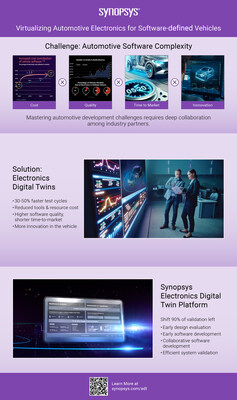
- Open platform to create, deploy, manage, and use electronics digital twins, establishing a new integrated and collaborative engineering paradigm across electronics, software, and systems
- Pre‑integrated Synopsys and ecosystem partner solutions, combined with management and administration capabilities, provide teams ready-to-use, cloud-based environments that reduce development costs, increase product quality, and accelerate innovation
- Initially focused on high-value automotive use cases, the platform enables OEMs to achieve up to
90% of software validation prior to hardware availability — significantly shrinking vehicle development cycles
"Volvo Cars is rapidly adopting holistic, whole‑vehicle validation, and we're bringing that rigor into the earliest stages of design and development," Johannes Foufas, Technical Manager, Software Factory, Volvo Cars. "Core to this transformation is our pioneering use of electronics digital twins working with Synopsys. With virtualized ECUs, our teams can 'shift left' test and validation before hardware exists, enabling us to reduce development cost, increase software quality, and accelerate innovation throughout the lifecycle of our vehicles."
"Automotive engineering teams are at their breaking point with more than 600 million lines of software, hundreds of software suppliers, rapidly shrinking development cycles, and mounting cost pressures," said Ravi Subramanian, Chief Product Management Officer. "Intelligent system development from vehicles to AI factories, requires a fundamentally different approach — one that connects silicon designs to software behavior and full‑system validation from the earliest stages of development. With the new eDT Platform, Synopsys is transforming engineering with an end‑to‑end digital twin foundation, bringing together our product and market leadership supplying virtual SoC models and large‑scale system simulations, along with our extensive partner ecosystem, to simplify, accelerate, and scale the development of next‑generation vehicles."
Accelerate the Path to Production-Ready Software and Systems with eDT Labs
The platform enables users to configure cloud-based eDT Labs, a collection of pre-integrated assets including
Synopsys technologies, open‑ecosystem tools, models, software, and scalable compute for high-value automotive use cases such as:
- Early customer evaluation of new System-on-Chip or Microcontrollers: Frictionless access to early virtual prototypes reduces time-to-selection decision.
- Early customer start-of-software development: Shift-left milestones by starting software development well before hardware availability with pre-integrated tools support.
- Collaborative software development: Enable seamless collaboration between customer teams, suppliers and tool vendors to accelerate time to market.
- System validation: Integration in continuous integration/testing workflows with rapid provisioning of eDTs reduces validation effort while improving software quality.
Simplify Creation, Deployment, and Management of eDT Labs
The eDT Platform includes Synopsys and partner capabilities that can be used to establish eDT Labs such as:
- Synopsys' leading virtualization and AI technologies, along with advanced debug, test tools, ecosystem integration, and blueprints to rapidly build and validate eDTs.
- System composition using the open-source SIL Kit by Vector and Synopsys, enabling teams to rapidly assemble and connect virtual ECUs, models, and software components.
- A broad set of pre-integrated ecosystem partner technologies including silicon models; simulation, debug and analysis tools; and software IP; among others.
In addition, eDT Labs can be deployed and managed easily using platform capabilities, including:
- Provisioning: The platform provides a comprehensive set of features such as role-based user management, secure access and encryption, administrative analytics, global license provisioning, and a workflow editor.
- User interfaces, applications, and APIs (CLI and TEST APIs) to integrate with commercial and customer software factory solutions.
- Flexible compute options: With SaaS or BYOC deployment options, the eDT Platform leverages flexible compute in the cloud. For example, it can be powered by AWS cloud infrastructure and AWS Graviton4 processors delivering the computational performance and flexibility required for modern automotive development.
"As compute systems grow in complexity, a virtual-first validation approach is essential to improving efficiency and speeding time-to-market for safe, reliable physical AI platforms," Suraj Gajendra, Vice President of Products and Solutions, Physical AI Business Unit, Arm. "With Synopsys' eDT Platform, developers can access a pre-integrated Arm Zena CSS virtual platform in Synopsys Virtualizer and take advantage of Arm-on-Arm hardware-assisted virtualization, using ISA parity and software binary compatibility to validate rich workloads and production software stacks earlier."
"Validating complex automotive software traditionally required expensive physical prototypes and took years," said Ozgur Tohumcu, General Manager of Automotive and Manufacturing at AWS. "AWS and Synopsys have fundamentally changed that equation. Our Graviton4 processors deliver breakthrough performance for virtual vehicle testing, while our global cloud infrastructure provides the scale automotive teams need. Together, we're helping customers compress 3-4 year development cycles into a fraction of that—a game-changer for the industry."
"Software-defined vehicles are reshaping how automotive systems are designed, validated, and operated. As software and AI become the dominant value drivers, the industry must move toward scalable, platform-based development approaches," said Gavin C. Rogers, Senior Vice President at Vector. "By combining Synopsys' electronics digital twin platform with Vector's automotive-proven software platforms and software factory, we are jointly enabling a seamless, software-first development workflow across the entire vehicle lifecycle. Together, we empower automotive customers to industrialize software development, shorten time to market, and sustain continuous innovation at scale."
Availability and Additional Resources
Customers interested in deploying an electronics digital twin can engage with Synopsys regarding the eDT Platform today. For more information, visit: https://www.synopsys.com/edt.
- Industry Support for the Synopsys eDT Platform: https://news.synopsys.com/synopsys-electronics-digital-twin-platform-industry-support
- Blog: Unveiling the Synopsys Electronics Digital Twin (eDT) Platform
- Video: Synopsys Electronics Digital Twin Platform for Physical AI System Development
Join Synopsys at Embedded World 2026
Visit Synopsys during Embedded World 2026 at Stand 4-208 for discussions about the company's engineering solutions, including demos of the eDT Platform powered by AWS Graviton4.
Follow Synopsys Converge 2026 News and Updates
Synopsys Converge is taking place March 11-12, 2026, at the
About Synopsys
Synopsys, Inc. (Nasdaq: SNPS) is the leader in engineering solutions from silicon to systems, enabling customers to rapidly innovate AI-powered products. We deliver industry-leading silicon design, IP, simulation and analysis solutions, and design services. We partner closely with our customers across a wide range of industries to maximize their R&D capability and productivity, powering innovation today that ignites the ingenuity of tomorrow. Learn more at www.synopsys.com.
© 2026 Synopsys, Inc. All rights reserved. Synopsys, Ansys, the Synopsys and Ansys logos, and other Synopsys trademarks are available at https://www.synopsys.com/company/legal/trademarks-brands.html. Other company or product names may be trademarks of their respective owners.
Contacts
Media
Kelli Wheeler: kelliw@synopsys.com
Pete Smith: pete.smith@synopsys.com
corp-pr@synopsys.com
 View original content to download multimedia:https://www.prnewswire.com/news-releases/synopsys-launches-electronics-digital-twin-platform-to-accelerate-physical-ai-system-development-302708812.html
SOURCE Synopsys, Inc.
FAQ
AI-generated questions and answers. How Rhea-AI works. Not financial advice.