
STOCK TITAN

Georgia Power begins construction of newest battery storage system in Wadley, Ga.

Rhea-AI Impact
(Moderate)
Rhea-AI Sentiment
(Neutral)
Tags

Georgia Power (NYSE: SO) began construction March 31, 2026 on a company-owned 260 MW battery energy storage system (BESS) in Jefferson County near Wadley, Ga., with expected completion in 2027. The Wadley BESS will pair with nearby solar, support reliability, and follow PSC approvals for nearly 3,000 MW of planned storage statewide.

Loading...
Loading translation...

Positive

  • 260 MW Wadley BESS under construction
  • Wadley BESS expected completed in 2027
  • Four BESS nearing completion totaling 765 MW
  • PSC-approved plan adds nearly 3,000 MW planned storage
  • Two new solar+BESS projects totaling 350 MW

Negative

  • Project risks include cost and schedule overruns noted by company
  • Potential increased financing costs if project delays occur

Key Figures

Wadley BESS capacity: 260 MW Discharge duration: 4 hours Project completion: 2027 +5 more
8 metrics
Wadley BESS capacity 260 MW New battery energy storage system in Jefferson County, Ga.
Discharge duration 4 hours Designed to dispatch stored energy over a four-hour period
Project completion 2027 Expected completion year for Wadley BESS project
Near-term BESS buildout 765 MW Four new BESS facilities in Bibb, Cherokee, Floyd, Lowndes counties
Additional planned storage 3,000 MW Nine new BESS facilities approved by Georgia PSC statewide
Solar + storage capacity 350 MW Two new solar systems paired with battery storage
Customer base 2.8 million Georgia Power customers served across most Georgia counties
Counties served 155 of 159 All but four of Georgia’s 159 counties

Market Reality Check

Price: $96.93 Vol: Volume 5,875,742 vs. 20-d...
normal vol
$96.93 Last Close
Volume Volume 5,875,742 vs. 20-day average 5,460,086 (1.08x), indicating slightly elevated trading. normal
Technical Price $96.93 is trading above the 200-day MA $92.22 and about 3.87% below the 52-week high.

Peers on Argus

SO gained 1.44% with modestly elevated volume, while close peers showed mixed, m...

SO gained 1.44% with modestly elevated volume, while close peers showed mixed, mostly small moves (DUK, D, XEL slightly up; NGG, AEP slightly down). No broad, directional sector move is evident.

Historical Context

5 past events · Latest: Mar 24 (Neutral)
Pattern 5 events
Date Event Sentiment Move Catalyst
Mar 24 Earnings timing Neutral +0.3% Announced schedule for releasing and discussing Q1 2026 earnings.
Mar 24 Solar expansion Positive +0.3% Awarded largest distributed generation solar procurement adding 110 MW capacity.
Mar 17 Community grant impact Positive -0.8% ACT Grant funding linked to significant improvement in teacher retention.
Mar 17 Public safety network Positive -0.8% Southern Linc deal to integrate two-way radio systems for public safety agencies.
Mar 04 Leadership change Neutral +0.9% Mississippi Power named a new VP of Customer Solutions and Communications.
Pattern Detected

Recent company news has typically led to small price moves, with occasional negative reactions to otherwise positive community and infrastructure updates.

Recent Company History

Over the past month, Southern Company has issued several operational and community-focused updates. These include an upcoming Q1 2026 earnings release, a major distributed generation solar procurement adding over 110 MW, education-focused grant impacts, a public safety communications partnership, and a leadership appointment at Mississippi Power effective March 16, 2026. Price reactions have generally been modest (within about 1%), suggesting that similar strategic and ESG-related announcements, like the new Wadley BESS project, tend to be absorbed without large immediate revaluations.

Market Pulse Summary

This announcement highlights Georgia Power’s continued investment in grid reliability and renewables...
Analysis

This announcement highlights Georgia Power’s continued investment in grid reliability and renewables integration, centered on a new 260 MW BESS in Wadley and part of a statewide plan totaling over 3,000 MW of additional storage plus 350 MW of solar+storage. In context of Southern Company’s broader capital program and regulatory oversight, investors may watch execution timelines, cost control, and how these assets support load growth and resource planning in future filings and earnings updates.

Key Terms

battery energy storage system, bess, integrated resource plan (irp), megawatt (mw)
4 terms
battery energy storage system technical
"Georgia Power recently started construction on a new 260 megawatt (MW) battery energy storage system"
A battery energy storage system is a device that stores electricity for later use, much like a rechargeable battery for a phone or laptop. It allows energy generated during times of low demand or from renewable sources to be saved and released when needed, helping to balance supply and demand. For investors, it represents a way to support reliable energy flow and capitalize on the increasing demand for flexible, clean power solutions.
bess technical
"Company to build 260 MW BESS to meet growing energy needs"
BESS stands for Battery Energy Storage System, a technology that stores electricity for later use. Think of it as a large rechargeable battery that can hold excess power generated during times of low demand and release it when usage is high, helping balance supply and demand. This is important for investors because it supports the stability of energy grids, enables the integration of renewable sources, and can create new opportunities for profitability in the energy market.
integrated resource plan (irp) technical
"These projects help to address the state's growing power needs identified in the 2025 Integrated Resource Plan (IRP)"
An integrated resource plan (IRP) is a long-range strategy used by utilities and regulators to decide how to meet future electricity demand through a mix of power plants, grid upgrades, energy purchases, efficiency programs and demand-reduction measures. It matters to investors because the IRP sets expected capital spending, operating costs, and regulatory approvals that shape a utility’s future revenue, risk profile and rate changes — like a household budget that plans major purchases and monthly bills years ahead.
megawatt (mw) technical
"new 260 megawatt (MW) battery energy storage system (BESS) in Jefferson County"
A megawatt (MW) is a unit of power equal to one million watts, used to describe how much electricity a generator, power plant, solar farm, or battery can produce or deliver at a given moment. For investors it signals scale and potential revenue — larger MW capacity usually means more energy to sell or store, and helps compare projects like power plants or renewable installations the way horsepower compares cars, influencing costs, earnings and project value.

AI-generated analysis. Not financial advice.

Company to build 260 MW BESS to meet growing energy needs
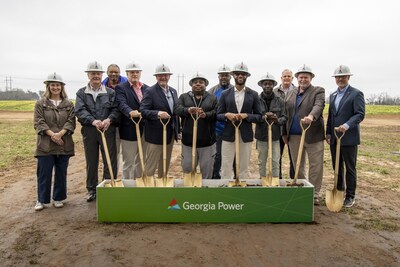
ATLANTA, March 31, 2026 /PRNewswire/ -- Georgia Power recently started construction on a new 260 megawatt (MW) battery energy storage system (BESS) in Jefferson County, Ga. just outside of the City of Wadley. The project, approved by the Georgia Public Service Commission (PSC), is located beside the existing third-party owned Wadley solar facility and near existing transmission infrastructure. The new Wadley BESS is a company-owned asset that strengthens the grid and the area's growing renewable energy resources.

Members of the Jefferson County Board of Commissioners, the Wadley City Council, and other community partners joined Georgia Power leaders to break ground on the project, underscoring the strong partnerships that will help bring this project to life. The event spotlighted not only the importance of the project but also the lasting economic impact and benefits it will bring to Jefferson County.

"On behalf of the Jefferson County community, we welcome this Georgia Power project," said Mitchell McGraw, chairman of the Jefferson County Board of Commissioners. "We're so proud to have your investment in Jefferson County, and we hope for more in the future."

Designed to quickly dispatch stored energy over a four-hour period, the 260 MW system will strengthen reliability and support the growing mix of renewable resources on Georgia's electric system. At this battery and solar co-located facility, battery energy storage helps capture power generated by renewable resources to use during peak demand periods, such as on cold winter mornings. Battery energy storage helps capture renewable resources produced during periods when the demand for electricity is lower, to use when the demand is higher, such as on cold winter mornings. These projects help to address the state's growing power needs identified in the 2025 Integrated Resource Plan (IRP) in a cost-effective and strategic manner.

"At Georgia Power, our collaboration with the Georgia PSC and other stakeholders is key to making necessary investments for a reliable and resilient power grid," said Kerry Bridges, region executive for Georgia Power. "With the construction of the 260 MW BESS in Jefferson County, we are able to better serve our customers today and support Georgia's growth. As we expand our energy mix to include more renewable sources, these batteries will play an invaluable role in helping ensure reliability and flexibility, particularly when renewable sources are not available."

The Wadley BESS project, constructed by Burns & McDonnell, is expected to be completed in 2027.

Georgia Power adding BESS statewide
Across the state, Georgia Power is nearing completion of four new BESS facilities totaling 765 MW in Bibb, Cherokee, Floyd, and Lowndes counties, projects previously approved in the 2023 IRP Update.

Building on this momentum, the Georgia PSC approved the construction of nine new BESS facilities strategically placed on seven sites throughout the state, adding nearly 3,000 MW of additional planned storage. The sites were strategically selected based on deployment capabilities, including the opportunity to locate additional resources at existing company plant sites, existing company-owned land, and proximity to substations or current company facilities. New BESS facilities include locations at Plants Bowen, Hammond, McIntosh, Wansley and Yates and stand-alone locations in Hall and McDuffie counties.

To support the increasing demand for renewable energy, the company is also planning two new state-of-the-art solar systems paired with battery storage for a combined capacity of 350 MW. These projects are designed to maximize high solar irradiance, while minimizing land disturbance. New solar + BESS projects include locations in Laurens and Dougherty County.

About Georgia Power
Georgia Power is the largest electric subsidiary of Southern Company (NYSE: SO), America's premier energy company. Value, Reliability, Customer Service and Stewardship are the cornerstones of the company's promise to 2.8 million customers in all but four of Georgia's 159 counties. Committed to delivering clean, safe, reliable and affordable energy, Georgia Power maintains a diverse, innovative generation mix that includes nuclear, coal and natural gas, as well as renewables such as solar, hydroelectric and wind. Georgia Power offers rates below the national average, focuses on delivering world-class service to its customers every day and the company is recognized by J.D. Power as an industry leader in customer satisfaction. For more information, visit www.GeorgiaPower.com and connect with the company on Facebook (Facebook.com/GeorgiaPower), X (X.com/GeorgiaPower) and Instagram (Instagram.com/ga_power).

Cautionary note regarding forward-looking statements
Certain information contained in this release is forward-looking information based on current expectations and plans that involve risks and uncertainties. Forward-looking information includes, among other things, statements concerning the expected completion date for the Wadley BESS project. Georgia Power cautions that there are certain factors that can cause actual results to differ materially from the forward-looking information that has been provided. The reader is cautioned not to put undue reliance on this forward-looking information, which is not a guarantee of future performance and is subject to a number of uncertainties and other factors, many of which are outside the control of Georgia Power; accordingly, there can be no assurance that such suggested results will be realized. The following factors, in addition to those discussed in Georgia Power's Annual Report on Form 10-K for the year ended December 31, 2025 and subsequent securities filings, could cause actual results to differ materially from management expectations as suggested by such forward-looking information: the ability to control costs and avoid cost and schedule overruns during the development, construction and operation of facilities or other projects due to challenges which include, but are not limited to, changes in labor costs, availability, and productivity, challenges with the management of contractors or vendors, subcontractor performance, adverse weather conditions, shortages, delays, increased costs or inconsistent quality of equipment, materials and labor, contractor or supplier delay, the impacts of inflation and trade policies (including tariffs and other trade measures) of the United States and other countries, delays due to judicial or regulatory action, nonperformance under construction, operating or other agreements, operational readiness, including specialized operator training and required site safety programs, engineering or design problems or any remediation related thereto, design and other licensing-based compliance matters, challenges with start-up activities, including major equipment failure, or system integration and/or operational performance, challenges related to future epidemic or pandemic health events, continued public and policymaker support for projects, environmental and geological conditions, delays or increased costs to interconnect facilities to transmission grids and increased financing costs as a result of changes in interest rates or as a result of project delays; legal proceedings and regulatory approvals and actions related to past, ongoing and proposed construction projects; the ability to construct facilities in accordance with the requirements of permits and licenses, to satisfy any environmental performance standards and the requirements of tax credits and other incentives and to integrate facilities into the Southern Company system upon completion of construction; and catastrophic events such as fires, including wildfires, land movement, earthquakes, explosions, floods, high winds, tornadoes, hurricanes and other storms, solar flares, droughts, future epidemic or pandemic health events, wars, political unrest, or other similar occurrences. Georgia Power expressly disclaims any obligation to update any forward-looking information.
Cision View original content to download multimedia:https://www.prnewswire.com/news-releases/georgia-power-begins-construction-of-newest-battery-storage-system-in-wadley-ga-302730157.html

SOURCE Georgia Power

FAQ

What is Georgia Power (SO) building in Wadley, Georgia and when is it due?

Georgia Power is building a 260 MW battery energy storage system in Wadley, due for completion in 2027. According to the company, the project is co-located with a solar facility and began construction on March 31, 2026.

How will the 260 MW Wadley BESS impact reliability for Georgia Power (SO)?

The Wadley BESS will dispatch stored energy over a four-hour period to support peak demand and reliability. According to the company, batteries capture renewable output to deliver power during high-demand periods like cold winter mornings.

How much additional battery storage has the Georgia PSC approved for Georgia Power (SO)?

The Georgia PSC approved nearly 3,000 MW of additional planned storage across nine new BESS facilities. According to the company, sites were selected for proximity to substations and existing company land or plant sites.

What other BESS and solar projects is Georgia Power (SO) building statewide?

Georgia Power is completing four BESS projects totaling 765 MW and planning two solar-plus-storage projects totaling 350 MW. According to the company, these efforts expand storage capacity across multiple counties and plant sites.

What are key risks investors should note about the Wadley BESS (SO)?

Key risks include potential cost and schedule overruns, supply delays, and higher financing costs if delayed. According to the company, these factors could cause actual results to differ materially from expectations.
Southern

NYSE:SO

View SO Stock Overview

SO Rankings

SO Latest News

SO Latest SEC Filings

SO Stock Data

106.96B
1.12B
Utilities - Regulated Electric
Electric Services
Link
United States
ATLANTA
