
Sempra Infrastructure's ECA LNG Phase 1 Exports First LNG Cargo from Mexico's Pacific Coast
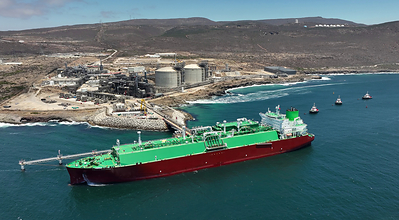
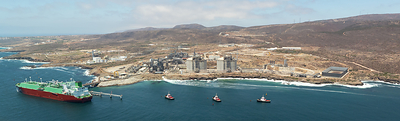
Sempra (NYSE:SRE) subsidiary Sempra Infrastructure announced that ECA LNG Phase 1 in Ensenada, Mexico has safely loaded and shipped its first LNG cargo, marking a key milestone toward full commercial operations.
Rhea-AI Summary
Sempra (NYSE:SRE) subsidiary Sempra Infrastructure announced that ECA LNG Phase 1 in Ensenada, Mexico has safely loaded and shipped its first LNG cargo, marking a key milestone toward full commercial operations.
The joint venture with TotalEnergies features a 3.25 Mtpa train, long-term offtake contracts, and strategic Pacific access to Asian and Pacific Basin markets, with substantial completion expected in summer 2026 and a larger Phase 2 under development.
Positive
- First LNG cargo shipped from ECA LNG Phase 1 toward commercial operations
- 3.25 Mtpa nameplate liquefaction capacity in Phase 1
- Strategic Pacific Coast location offers shorter shipping routes to Asia
- Supported by long-term sale and purchase agreements with TotalEnergies and Mitsui & Co.
- ECA LNG Phase 1 structured as a joint venture with TotalEnergies
- Substantial completion targeted for summer 2026 with Phase 2 under development
Negative
- None.
Details
News Market Reaction – SRE
In the Jul 9 session, SRE declined 0.74%, reflecting a mild negative market reaction.
Data tracked by StockTitan Argus on the day of publication.
Key Figures
- Nameplate capacity
- 3.25 Mtpa
- ECA LNG Phase 1 liquefaction train
Previous Clinical trial Reports
-
ECA LNG Phase 1 achieved first LNG production as commissioning advanced.
-
20-year LNG supply deal with EQT from Port Arthur LNG Phase 2.
-
EQT signed 20-year 2 Mtpa LNG agreement tied to Port Arthur Phase 2.
-
20-year sale and purchase agreement with JERA for 1.5 Mtpa LNG.
-
DOE non-FTA export permit for up to 13.5 Mtpa Port Arthur Phase 2.
24h Move is the share-price change in the day after each event; other market factors may also have contributed.
Key Terms
liquefied natural gas technical
lng technical
liquefaction train technical
nameplate capacity technical
sale and purchase agreements financial
AI-generated analysis. How Rhea-AI works. Not financial advice.




"At a time of increased uncertainty in the global LNG trade, we are excited to begin shipping a new and reliable source of natural gas from
"The start-up of ECA LNG, whose strategic location provides privileged access to Asian markets, strengthens the quality of our integrated LNG portfolio in
Once the facility begins commercial operations, ECA LNG Phase 1 will be the first LNG liquefaction facility on
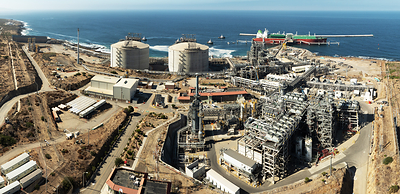
ECA LNG Phase 1 is a joint venture with TotalEnergies and consists of a single liquefaction train with nameplate capacity of 3.25 million tonnes per annum (Mtpa) of LNG. The project is supported by long-term sale and purchase agreements with TotalEnergies and Mitsui & Co.
The project is expected to reach substantial completion in the summer of 2026, with sales under long-term sale and purchase agreements commencing shortly thereafter, when the facility begins commercial operations. A second and significantly larger phase is also under active development at the same site.
The ECA LNG facility is a cornerstone of Sempra Infrastructure's dual-coast LNG portfolio. With projects along the
About Sempra Infrastructure
Sempra Infrastructure, headquartered in Houston, is focused on delivering energy for a better world by developing, building, operating and investing in modern energy infrastructure, such as LNG, energy networks and low-carbon solutions that are expected to play a crucial role in the energy systems of the future. Through the combined strength of its assets in North America, Sempra Infrastructure is connecting customers to safe and reliable energy and advancing energy security. Sempra Infrastructure is a subsidiary of Sempra (NYSE: SRE), a leading utility growth company. For more information, visit SempraInfrastructure.com or connect with Sempra Infrastructure on social media @SempraInfra.
This press release contains forward-looking statements within the meaning of the Private Securities Litigation Reform Act of 1995. Forward-looking statements are based on assumptions about the future, involve risks and uncertainties, and are not guarantees. Future results may differ materially from those expressed or implied in any forward-looking statement. These forward-looking statements represent our estimates and assumptions only as of the date of this press release. We assume no obligation to update or revise any forward-looking statement as a result of new information, future events or otherwise.
In this press release, forward-looking statements can be identified by words such as "believe," "expect," "intend," "anticipate," "contemplate," "plan," "estimate," "project," "forecast," "envision," "should," "could," "would," "will," "confident," "may," "can," "potential," "possible," "proposed," "in process," "construct," "develop," "opportunity," "preliminary," "pro forma," "strategic," "initiative," "target," "outlook," "optimistic," "poised," "positioned," "maintain," "continue," "progress," "advance," "goal," "aim," "commit," or similar expressions, or when we discuss our guidance, priorities, strategies, goals, vision, mission, projections, intentions or expectations.
Factors, among others, that could cause actual results and events to differ materially from those expressed or implied in any forward-looking statement include: decisions, audits, investigations, inquiries, regulations, legislative actions, denials or revocations of permits, consents, approvals or other authorizations, and other actions, including the failure to honor contracts and commitments, by the (i) Comisión Nacional de Energía, U.S. Department of Energy, U.S. Federal Energy Regulatory Commission, U.S. Internal Revenue Service and other regulatory bodies and (ii) U.S., Mexico and states, counties, cities and other jurisdictions therein and in other countries where we do business; the success of business development efforts, construction projects, acquisitions, divestitures and other significant transactions such as the planned sale of a portion of Sempra's equity interest in Sempra Infrastructure Partners, including risks related to, as applicable, (i) being able to reach a positive final investment decision, (ii) negotiating pricing and other terms in definitive contracts, (iii) completing construction projects or other transactions on schedule and budget, (iv) realizing anticipated benefits from any of these efforts if completed, (v) obtaining regulatory and other approvals and (vi) third parties honoring their contracts and commitments, including with respect to closing or post-closing payments; changes to our capital expenditure plans and their potential impact on growth; changes, due to evolving economic, political and other factors and increasing geopolitical instability as a result of wars or other conflicts in various parts of the world, to (i) trade and other foreign policy, including the imposition of tariffs by the U.S. and foreign countries (and uncertainty related to the implementation and enforceability thereof), and (ii) laws and regulations, including those related to tax and the energy industry in the U.S. and Mexico; litigation, arbitration, property disputes and other proceedings; cybersecurity threats, including by nation-state actors, of ransomware or other attacks on our systems, the energy grid or our other infrastructure, or the systems of third parties with which we conduct business; the availability, uses, sufficiency, and cost of capital resources and our ability to borrow money or otherwise raise capital on favorable terms and meet our obligations, which can be affected by, among other things, (i) actions by credit rating agencies to downgrade our credit ratings or place those ratings on negative outlook, (ii) instability in the capital markets, and (iii) fluctuating interest rates and inflation; the impact on our ability to pass through higher costs to customers due to volatility in inflation, interest rates, commodity prices, tariff rates, and foreign currency exchange rates; the impact of climate policies, laws, rules, regulations, trends and required disclosures, including actions to reduce or eliminate reliance on natural gas, the risk of nonrecovery for stranded assets, and uncertainty related to emerging technologies; weather, natural disasters, pandemics, accidents, equipment failures, explosions, terrorism, information system outages or other events, such as work stoppages, that disrupt our operations, damage our facilities or systems, cause the release of harmful materials or fires or subject us to liability for damages, fines and penalties, some of which may not be recoverable through insurance or may impact our ability to obtain satisfactory levels of affordable insurance; the availability of natural gas and natural gas transportation capacity, including disruptions caused by failures in the pipeline and storage systems or limitations on the injection and withdrawal of natural gas from storage facilities; and other uncertainties, some of which are difficult to predict and beyond our control.
These risks and uncertainties are further discussed in the reports that Sempra has filed with the U.S. Securities and Exchange Commission (SEC). These reports are available through the EDGAR system free-of-charge on the SEC's website, www.sec.gov, and on Sempra's website, www.sempra.com. Investors should not rely unduly on any forward-looking statements.
Sempra Infrastructure Partners and its subsidiaries, and the Sempra Texas utilities (Oncor and Sharyland Utilities) are not the same companies as the Sempra California utilities, SDG&E or SoCalGas, nor are they regulated by the California Public Utilities Commission (CPUC).
 View original content to download multimedia:https://www.prnewswire.com/news-releases/sempra-infrastructures-eca-lng-phase-1-exports-first-lng-cargo-from-mexicos-pacific-coast-302821217.html
SOURCE Sempra Infrastructure
FAQ
AI-generated questions and answers. How Rhea-AI works. Not financial advice.