Expanded portfolio supports growing demand for high-performance motion control solutions across next-generation aerospace platforms
The new focus builds on Sensata’s BEI Kimco motor expertise to support more complex, higher-value aerospace applications
Application-specific Brushless DC Motor (BLDC) technology is designed to deliver precision motion control, efficiency and reliability in demanding mission-critical environments
SWINDON, United Kingdom--(BUSINESS WIRE)--
Sensata Technologies (NYSE: ST) announced the expansion of its motor’s portfolio into flight control actuation and propulsion applications, showcasing its high-power density motor solutions at Farnborough Airshow 2026 (Hall 1, Stand 1430). Building on decades of expertise in precision motion solutions, Sensata is helping aerospace and defense customers address increasing demands for electrification, autonomy, performance and reliability across next-generation platforms.
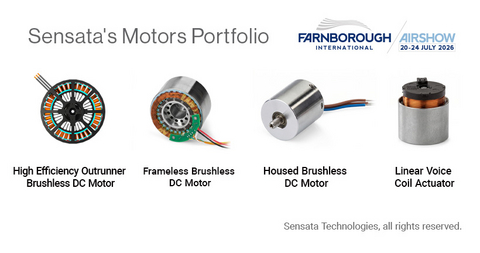
Sensata's Motors Portfolio
Motors and actuators are critical enablers of guidance, propulsion, and stabilization as aerospace and defense systems shift toward more autonomous, scalable, and high-volume architectures. Sensata’s new focus positions the company to support higher-value applications where performance, reliability, and responsiveness directly impact system safety and mission success.
“Motion control is evolving from a component-level requirement to a mission-critical capability in modern aerospace & defense systems,” said Stuart Parker, Vice President and General Manager for Aerospace and Defense Business, Sensata Technologies. “We are expanding our high-power density motors portfolio to address emerging flight control actuation and propulsion opportunities, where precision, efficiency, and reliability are essential. This marks an important step forward in how we support our customers across next-generation aerospace platforms.”
Sensata's application-specific design approach enables customers to optimize motor performance for unique mission requirements rather than relying on standard off-the-shelf solutions. The motors are engineered with an emphasis on SWaP-C optimization and are enabled by Sensata’s vision to build a world-class network of AS9100-certified manufacturing hubs across the United States and Mexico. This expanding aerospace-grade manufacturing ecosystem is designed to provide customers with greater capacity, regional flexibility, supply-chain security, and uncompromising quality for next-generation aerospace and defense platforms. The portfolio is engineered to withstand harsh operating environments, including shock, vibration, altitude and temperature extremes, in alignment with RTCA/DO-160 and MIL-STD-810 requirements.
Sensata's motors portfolio supports a wide range of aerospace and defense applications, including flight control actuation, propulsion, stabilization, guidance, surveillance, targeting and precision positioning systems.
Sensata will showcase its motors portfolio and application capabilities at Farnborough Airshow 2026, Hall 1, Stand 1430. To learn more, visit www.sensata.com.
About Sensata Technologies
Sensata Technologies is a global industrial technology company striving to create a safer, cleaner, more efficient and electrified world. Through its broad portfolio of mission-critical sensors, electrical protection components and sensor-rich solutions, Sensata helps its customers address increasingly complex engineering and operating performance requirements. With more than 16,000 employees and global operations in 13 countries, Sensata serves customers in the automotive, industrial, aerospace, defense and commercial equipment markets.
An electric motor that uses electronic controllers instead of physical brushes to switch current to its coils, producing rotation with permanent magnets or wound rotors. Think of it as replacing rubbing contacts with invisible electronic switches, which typically yields higher efficiency, lower maintenance, and longer life; those features matter to investors because they can affect product performance, operating costs, reliability, and competitive positioning across industries from consumer electronics to transportation.
bldctechnical
A BLDC, or brushless DC motor, is an electric motor that uses electronic controllers instead of physical brushes to switch current, making it quieter, more efficient, and longer-lasting than traditional brushed motors. For investors, BLDCs matter because they can lower operating and maintenance costs, improve product performance and energy use, and enable competitive advantages in markets like electric vehicles, appliances, and industrial automation—factors that can influence sales, margins, and capital spending.
as9100-certifiedtechnical
AS9100-certified means a company has passed an independent audit showing its quality-management system meets the AS9100 standard, which adapts general ISO 9001 rules with extra controls for aerospace and defense — covering safety, traceability, documentation and risk controls. For investors, it signals lower risk of manufacturing errors, easier qualification as a supplier to aircraft and defense customers, and stronger prospects for stable contracts and predictable production, like a factory following a safety-rated recipe with inspection stamps.
rtca/do-160technical
RTCA DO-160 is an industry standard that lists environmental tests (temperature, vibration, humidity, electrical interference, etc.) used to qualify electronic equipment for use on aircraft. Think of it as a ruggedness checklist and lab test program that proves a part can survive real flight conditions. For investors, DO-160 compliance signals that aerospace components meet regulatory and market entry requirements, affecting certification timelines, customer acceptance, and sales potential.
mil-std-810technical
A U.S. military test standard that specifies a wide range of environmental and durability tests—like temperature extremes, shock, vibration, rain, dust and salt spray—used to evaluate whether equipment can survive harsh real‑world conditions. For investors, a product that meets this standard is like a car that has passed crash and weather tests: it signals lower risk of field failures, access to military or ruggedized markets, and often a competitive sales advantage.