
STOCK TITAN

Solidion Technology Granted 7 New Patents on Composite Anode Materials For Batteries Targeting Humanoid Robots, Space-Based Artificial Intelligence Data Centers and the Lunar Economy

Rhea-AI Impact
(Moderate)
Rhea-AI Sentiment
(Neutral)
Tags
AI

Solidion Technology (Nasdaq: STI) announced 7 new US patents on composite silicon anode materials, bringing its US anode-technology portfolio to 130 patents. The patented design targets batteries for AI data centers, drones, humanoid robots, EVs, and future lunar economy applications.

The technology uses porous graphene balls that can hold up to 90% silicon, a silane-free, lower-cost, faster process, and domestically sourced biomass-based graphene feedstock to address safety, cost, and supply-chain concerns.

Loading...
Loading translation...

AI-generated analysis. Not financial advice.

Positive

  • Grant of 7 new US patents, totaling 130 US anode patents
  • Graphene-based anode design accommodates up to 90% silicon content
  • Silane-free production process claimed to be safer, faster, and lower cost
  • Domestically sourced biomass-based graphene reduces supply-chain risk in North America
  • Battery applications span AI data centers, drones, humanoid robots, EVs, and lunar economy

Negative

  • None.

Key Figures

New US patents: 7 Total US anode patents: 130 Legacy Si loading limit: 50% +2 more
5 metrics
New US patents 7 Newly granted patents on composite anode materials
Total US anode patents 130 US patents on anode materials for lithium batteries
Legacy Si loading limit 50% Max silane-derived silicon in current porous carbon particles
Graphene ball Si capacity 90% Silicon content accommodated in graphene/Si composite anode
Anode strategies 3 Energy density, cost, and domestic feedstock strategy pillars

Market Reality Check

Price: $35.72 Vol: Volume 37,403,199 is 5.17...
high vol
$35.72 Last Close
Volume Volume 37,403,199 is 5.17x the 20-day average of 7,227,820, indicating unusually heavy trading before this patent update. high
Technical Price 35.72 is trading above the 200-day MA at 7.26, reflecting a strong pre-news uptrend.

Peers on Argus

STI was up 57.29% with elevated volume while momentum scanners also flagged IPWR...
2 Up 1 Down

STI was up 57.29% with elevated volume while momentum scanners also flagged IPWR and DFLI moving up (median ~6.7%), and CCTG moving down. Broader peer list shows several names down, so sector rotation is present but STI’s move is notably stronger.

Previous AI Reports

3 past events · Latest: Jun 05 (Positive)
Same Type Pattern 3 events
Date Event Sentiment Move Catalyst
Jun 05 AI battery patents Positive +57.3% Announced patented lithium metal anode protection for high-energy AI and space batteries.
Jun 04 Extreme-climate battery Positive +350.6% Unveiled Gen-ECB graphene-based battery for LEO AI data centers and lunar missions.
Oct 13 AI UPS launch Positive +293.9% Introduced PEAK Series UPS batteries for AI data centers with longer life and space savings.
Pattern Detected

AI-tagged technology announcements have repeatedly coincided with very large positive moves following prior AI battery-related news.

Recent Company History

Over recent AI-focused releases, Solidion emphasized patented platforms for lithium metal and extreme-climate batteries serving AI data centers, EVs, drones, robots, and space uses. AI-tagged news on Jun 04 and Jun 05, 2026 each coincided with large gains, and an AI data-center UPS launch on Oct 13, 2025 also saw a substantial move. The current AI-tagged patent expansion fits this pattern of IP-driven narratives around AI and space battery applications.

Historical Comparison

+233.9% avg move · Past AI-tagged announcements produced average moves near 233.93%. The current AI-focused patent expa...
AI
+233.9%
Average Historical Move AI

Past AI-tagged announcements produced average moves near 233.93%. The current AI-focused patent expansion and pre-news gain of 57.29% sit below prior spikes but follow the same strong-reactivity pattern.

AI-related disclosures show a progression from AI data-center UPS systems to extreme-climate and lithium-metal platforms, and now additional silicon-anode patents targeting humanoid robots, space-based AI data centers, and lunar applications.

Market Pulse Summary

This announcement adds 7 new US patents, bringing Solidion’s silicon-anode portfolio to 130 US paten...
Analysis

This announcement adds 7 new US patents, bringing Solidion’s silicon-anode portfolio to 130 US patents and targeting applications from humanoid robots to space-based AI data centers and the lunar economy. The technology claims to overcome CVD and silane-based drawbacks by enabling up to 90% silicon loading in graphene composites and using domestically sourced feedstock. Against a backdrop of recent AI-focused launches and tight liquidity in filings, future updates on commercialization and funding will be key to monitor.

Key Terms

anode, lithium batteries, chemical vapor deposition (CVD), graphene
4 terms
anode technical
"portfolio of patents on anode materials for high-energy and fast-charging lithium batteries"
An anode is the electrode in a battery, electrochemical cell, or certain medical devices where chemical reactions release electrons that flow out into a circuit; think of it as the exit door for electrical charge. For investors, anode materials and design matter because they strongly influence a product’s efficiency, lifespan, safety and manufacturing cost—key factors that affect a company’s competitive position and future revenue in industries like energy storage and electronics.
lithium batteries technical
"anode materials for high-energy and fast-charging lithium batteries"
Lithium batteries are rechargeable energy storage devices that power many portable electronics, electric vehicles, and renewable energy systems. They work by storing and releasing electrical energy through chemical reactions involving lithium, a lightweight metal. For investors, advances or disruptions in lithium battery technology can influence the demand for lithium and related industries, impacting market opportunities and valuations.
chemical vapor deposition (CVD) technical
"produced from chemical vapor deposition (CVD) of Si in pores of highly porous carbon"
A manufacturing method that creates thin, uniform solid layers on surfaces by turning gas into a solid material at high temperature; think of it like spraying paint at the molecular level so a surface gets a precise, durable coating. Investors care because this process is central to making advanced chips, batteries, and specialty coatings that determine product performance, production cost, and a company’s ability to scale or compete.
graphene technical
"well-designed porous graphene balls that can readily accommodate up to 90% Si"
Graphene is a one-atom-thick sheet of carbon atoms arranged in a honeycomb pattern, like an ultra-thin, incredibly strong and highly conductive version of chicken wire. It matters to investors because its combination of lightness, strength, flexibility and excellent electrical and thermal conductivity could enable breakthroughs across electronics, batteries, sensors and materials; investors monitor who can produce and scale it cost-effectively and turn lab promise into real products.

AI-generated analysis. Not financial advice.

See more from StockTitan in Google Search and AI answers. Adds StockTitan as a preferred source · opens Google
Add on Google

 The newly granted patents further strengthen an already globally leading portfolio of patents on anode materials for high-energy and fast-charging lithium batteries
DALLAS, June 8, 2026 /PRNewswire/ -- Solidion Technology Inc. ("Solidion" or the "Company") (Nasdaq: STI), an advanced battery technology solutions provider, today announced the grant of 7 new US patents, bringing the Company's IP portfolio to the total of 130 US patents alone on anode materials for lithium batteries.

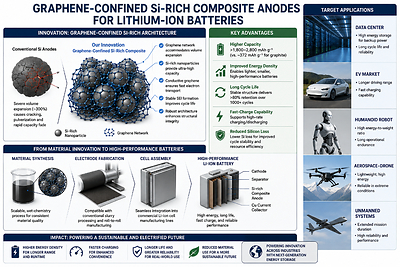
Graphene-confined Si-rich composite anodes for lithium-ion batteries

Solidion's silicon anode is engineered to (i) deliver a longer uptime for AI data centers on the ground or in the space; (ii) extend the flying range of an unmanned aerial vehicle or drone; (iii) increase the operational time of a humanoid robot on one battery charge; and (iv) drive EV battery technology to a lower cost and provide a higher energy density, significantly extending the EV driving range.

One of the globally leading silicon anode materials is produced from chemical vapor deposition (CVD) of Si in pores of highly porous carbon particles. This technology has several major drawbacks, due to the use of a silane gas-based feedstock, which is known to be scarce in North America, highly explosive, costly and challenging to produce, transport, and store. Additionally, current porous carbon particles are incapable of accepting more than 50% of silane-derived Si in their pores, a feature which significantly compromises the achievable cell energy density.

Solidion's patented Si anode technology overcomes these technical and economical obstacles by using an innovative combination of three strategies:

(1) Higher energy density: well-designed porous graphene balls that can readily accommodate up to 90% Si in the graphene/Si composite;

(2) Lower cost: A low-cost silane-free process that is safer, faster, and lower cost; and

(3) Domestically sourced feedstock (no supply-chain disruption issue): for instance, graphene is produced by Solidion's affiliated company (Global Graphene Group) from biomass, which is abundant in North America.

About Solidion Technology, Inc.
Headquartered in Dallas, Texas, with pilot production facilities in Dayton, Ohio, Solidion Technology (NASDAQ: STI) is an advanced battery technology solutions provider focused on manufacturing next-generation battery materials and components, and developing high-performance batteries for energy storage, including UPS systems serving the AI data center market, electric vehicles, and aerospace applications. The Company holds a portfolio of over 385 patents, covering innovations such as high-capacity, silane-gas-free and graphene-enabled silicon anodes, biomass-based graphite, and advanced lithium-sulfur and lithium-metal technologies.

For more information, please visit www.solidiontech.com or contact Investor Relations.

Cautionary Note Regarding Forward-Looking Statements
This press release contains forward-looking statements within the meaning of the Private Securities Litigation Reform Act of 1995. Solidion Technology Inc. (NASDAQ: STI) (the "Company," "Solidion," "we," "our" or "us") desires to take advantage of the safe harbor provisions of the Private Securities Litigation Reform Act of 1995 and is including this cautionary statement in connection with this safe harbor legislation. The words "forecasts," "believe," "may," "estimate," "continue," "anticipate," "intend," "should," "plan," "could," "target," "potential," "is likely," "expect," and similar expressions, as they relate to us, are intended to identify forward-looking statements. We undertake no obligation to publicly update any forward-looking statements, whether as a result of new information, future developments, or otherwise, except as may be required by law.

Solidion Logo

Cision View original content to download multimedia:https://www.prnewswire.com/news-releases/solidion-technology-granted-7-new-patents-on-composite-anode-materials-for-batteries-targeting-humanoid-robots-space-based-artificial-intelligence-data-centers-and-the-lunar-economy-302793673.html

SOURCE Solidion Technology, Inc.

FAQ

What did Solidion Technology (Nasdaq: STI) announce on June 8, 2026?

Solidion Technology announced the grant of 7 new US patents on composite silicon anode materials. According to Solidion, this brings its US anode-related portfolio to 130 patents, strengthening its position in advanced lithium battery technology for multiple end markets.

How many US patents on anode materials does Solidion Technology (STI) now hold?

Solidion Technology now holds 130 US patents on anode materials for lithium batteries. According to Solidion, the 7 newly granted patents expand an already broad portfolio focused on high-energy, fast-charging silicon anodes for AI data centers, drones, humanoid robots, EVs, and lunar-focused applications.

What is unique about Solidion Technology’s silicon anode for AI data centers and EVs (STI)?

Solidion’s silicon anode uses porous graphene balls that can accommodate up to 90% silicon. According to Solidion, this design aims to increase energy density, lower costs, and extend uptime or range for AI data centers, unmanned aerial vehicles, humanoid robots, and electric vehicles.

How does Solidion Technology (STI) secure feedstock for its graphene-based silicon anodes?

Solidion uses domestically sourced feedstock, including graphene produced from biomass by its affiliated Global Graphene Group. According to Solidion, this North America–based supply aims to reduce supply-chain disruption risks and support scalable anode production for emerging robotics, EV, and space-related markets.

Which markets could benefit from Solidion Technology’s new silicon anode patents?

Targeted markets include AI data centers, drones, humanoid robots, EVs, and the lunar economy. According to Solidion, the patented silicon anode aims to extend uptime or driving range and lower battery costs, supporting advanced robotics and space-based computing applications.
