
STOCK TITAN

Solidion Technology Announced AI-Assisted Design and Manufacturing Technology of Bipolar Solid-State Batteries for Space Vehicles, Ground, Sea, Air and Infrastructure

Rhea-AI Impact
(High)
Rhea-AI Sentiment
(Neutral)
Tags
AI

Solidion Technology (Nasdaq: STI) introduced its patented AI-assisted bipolar electrode-to-pack (BEEP) solid-state battery technology. The design directly stacks bipolar electrodes and solid electrolyte layers, aiming to increase energy and power density while reducing battery weight, volume, and cost.

BEEP targets eVTOL aircraft, drones, robots, AI data centers, and space and infrastructure applications.

Loading...
Loading translation...

AI-generated analysis. Not financial advice.

Positive

  • BEEP design aims to increase battery energy and power densities
  • Architecture targets reduced battery weight, volume, and cost
  • Single casing and fewer connectors simplify pack construction
  • Stacked bipolar electrodes and solid electrolyte enable solid-state packs
  • Technology addresses manufacturing complexity of solid-state batteries

Negative

  • None.

News Market Reaction – STI

-0.33%
13 alerts
-0.33% News Effect
-32.5% Trough in 6 hr 21 min
-$588K Valuation Impact
$177.56M Market Cap
0.1x Rel. Volume

On the day this news was published, STI declined 0.33%, reflecting a mild negative market reaction. Argus tracked a trough of -32.5% from its starting point during tracking. Our momentum scanner triggered 13 alerts that day, indicating notable trading interest and price volatility. This price movement removed approximately $588K from the company's valuation, bringing the market cap to $177.56M at that time.

Data tracked by StockTitan Argus on the day of publication.

Peers on Argus

Sector peers show mixed moves: one notable gainer (DFLI +9.48%) while others lik...

Sector peers show mixed moves: one notable gainer (DFLI +9.48%) while others like GWH (-5.88%) and XPON (-3.8%) declined. No peers appeared in the real-time momentum scanner, supporting this as a stock-specific rather than sector-driven event.

Previous AI Reports

4 past events · Latest: Jun 08 (Positive)
Same Type Pattern 4 events
Date Event Sentiment Move Catalyst
Jun 08 AI battery patents Positive -20.8% Announced 7 new US patents on composite silicon anode materials for AI uses.
Jun 05 AI battery platform Positive +57.3% Unveiled patented lithium metal anode protection platform for ultra-high energy batteries.
Jun 04 Extreme-climate battery Positive +350.6% Introduced Gen-ECB extreme-climate battery for LEO AI data centers and space uses.
Oct 13 AI UPS system Positive +293.9% Launched PEAK Series UPS battery system tailored for AI data centers.
Pattern Detected

AI-tagged announcements have often produced very large price swings, mostly positive but with at least one sharp negative reaction.

Recent Company History

Over recent AI-focused releases, Solidion highlighted technologies for space-based AI data centers, extreme-climate batteries and AI-centric UPS systems. Prior AI-tagged news on Jun 4, 2026 and Oct 13, 2025 coincided with strong gains, while the Jun 8, 2026 patent update saw a sharp drop. Today’s AI-assisted bipolar solid-state battery pack fits this pattern of frequent, technology-heavy announcements aimed at EV, space and AI infrastructure applications.

Historical Comparison

+170.3% avg move · Past 4 AI-tagged announcements saw an average move of 170.25%, underscoring how AI-related battery l...
AI
+170.3%
Average Historical Move AI

Past 4 AI-tagged announcements saw an average move of 170.25%, underscoring how AI-related battery launches have historically triggered outsized volatility around Solidion.

AI-tagged news shows a progression from AI data center UPS systems to extreme-climate and space-focused batteries, and now AI-assisted bipolar solid-state pack architecture spanning eVTOL, drones, robots and infrastructure.

Market Pulse Summary

This announcement introduces AI-assisted bipolar solid-state battery pack architecture designed to c...
Analysis

This announcement introduces AI-assisted bipolar solid-state battery pack architecture designed to cut weight, volume and cost while targeting eVTOL, robots, AI data centers and space uses. It continues a series of AI-tagged technology unveilings that previously drove large stock moves, with an average historical AI-news reaction of 170.25%. Investors may focus on commercialization progress, manufacturing scalability and how this platform complements earlier extreme-climate and space-oriented battery technologies.

Key Terms

solid-state batteries, bipolar electrode-to-pack, eVTOL, AI data centers
4 terms
solid-state batteries technical
"Solid-state batteries are expected to revolutionize the electric vehicle and space industries"
Solid-state batteries store and deliver electrical energy using a solid material instead of the liquid or gel found in conventional lithium-ion cells; imagine replacing a puddle that carries traffic with a solid, well-paved bridge that moves charge more compactly and securely. They matter to investors because they promise higher energy density, faster charging, improved safety and longer lifespan—advantages that can expand markets and margins—while commercial success depends on manufacturing scale, costs and raw-material supply.
bipolar electrode-to-pack technical
"unveiled their patented bipolar electrode-to-pack (BEEP) battery technology"
A bipolar electrode-to-pack design is a battery assembly approach where cells share a common conductive plate so current flows through stacked layers rather than relying on external wiring between individual cells. For investors, this matters because the layout can reduce weight, parts and manufacturing steps—potentially lowering cost and increasing energy density—while also affecting cooling and safety trade-offs that influence a product’s performance and cost profile.
eVTOL technical
"engineered to power electric vertical take-off and landing (eVTOL) aircraft, drones, robots"
eVTOL stands for "electric vertical takeoff and landing" aircraft, which are small, electric-powered vehicles capable of taking off and landing vertically like a helicopter. They are designed to provide quick, on-demand transportation within cities or between locations, potentially transforming urban mobility. For investors, eVTOLs represent a growing segment of innovative transportation technology with potential for significant market impact and future growth.
AI data centers technical
"robots, AI data centers, space infrastructure and devices"
AI data centers are specialized facilities built to store massive datasets and run powerful processors that train and operate artificial intelligence models — think of them as factories designed specifically for building and running AI. They matter to investors because they require large, ongoing capital and energy investments while driving revenue for cloud and chip providers; changes in demand, costs, or regulation can materially affect returns and company valuation.

AI-generated analysis. Not financial advice.

See more from StockTitan in Google Search and AI answers. Adds StockTitan as a preferred source · opens Google
Add on Google

The company's revolutionary, patented bipolar electrode-to-pack technology increases the battery energy and power densities; reducing weight, volume, and cost
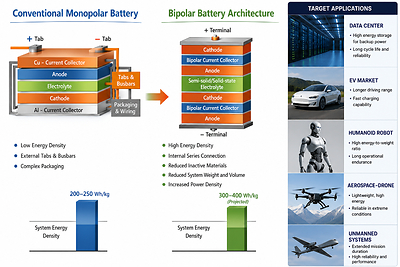
DALLAS, June 16, 2026 /PRNewswire/ -- Solidion Technology, Inc. (Nasdaq: STI), an advanced battery technology solutions provider, today unveiled their patented bipolar electrode-to-pack (BEEP) battery technology, engineered to power electric vertical take-off and landing (eVTOL) aircraft, drones, robots, AI data centers, space infrastructure and devices.

Conventional Monopolar Battery vs Bipolar Battery Architecture

Rather than making individual cells and modules, Solidion's AI-assisted designed BEEP technology entails directly stacking and connecting bipolar electrodes and solid electrolyte layers in series and in parallel to produce a solid-state battery pack that delivers exceptional power and energy densities.

Solid-state batteries are expected to revolutionize the electric vehicle and space industries with their inherent safety, fast charging, significantly extended driving or flying range on a single battery charge. However, two major issues have prevented the wide-spread commercialization of solid-state lithium batteries:

  1. the difficulty and high cost of manufacturing solid-state batteries and
  2. the limited space and payload weight available in an EV for ground, sea, air, or space transportation to accommodate a bulky and heavy battery system. Current battery pack designs devote much of that space to fire mitigation, a large number of connectors between cells or modules, and large volumes of protective housing materials.

Solidion's BEEP technology solves both this design issue and reduces the manufacturing challenges, while contributing to reduced battery weight, volume and cost. This is accomplished owing to the BEEP pack requiring only one casing and a small number of connectors – instead of the hundreds of housings and connectors in today's batteries. The bipolar electrode stacking procedure is intrinsically simpler and easier when compared to making individual cells and using external cables to connect multiple pre-fabricated cells.

Jaymes Winters, Chief Executive Officer of Solidion Technology, stated:

"BEEP represents a fundamental rethinking of how battery packs are built. By eliminating the redundant housings, connectors, and fire mitigation systems that burden conventional designs, we've created a pathway to batteries that are lighter, smaller, safer, and less expensive to manufacture — precisely the attributes demanded by next-generation eVTOL, space, and AI infrastructure applications. We believe this technology positions Solidion at the forefront of the solid-state battery revolution."

About Solidion Technology, Inc.

Headquartered in Dallas, Texas, with pilot production facilities in Dayton, Ohio, Solidion Technology (NASDAQ: STI) is an advanced battery technology solutions provider focused on manufacturing next-generation battery materials and components, and developing high-performance batteries for energy storage, including UPS systems serving the AI data center market, electric vehicles, and aerospace applications. The Company holds a portfolio of over 385 patents, covering innovations such as high-capacity, silane-gas-free and graphene-enabled silicon anodes, biomass-based graphite, and advanced lithium-sulfur and lithium-metal technologies.

For more information, please visit www.solidiontech.com or contact Investor Relations.

Cautionary Note Regarding Forward-Looking Statements

This press release contains forward-looking statements within the meaning of the Private Securities Litigation Reform Act of 1995. Solidion Technology Inc. (NASDAQ: STI) (the "Company," "Solidion," "we," "our" or "us") desires to take advantage of the safe harbor provisions of the Private Securities Litigation Reform Act of 1995 and is including this cautionary statement in connection with this safe harbor legislation. The words "forecasts," "believe," "may," "estimate," "continue," "anticipate," "intend," "should," "plan," "could," "target," "potential," "is likely," "expect," and similar expressions, as they relate to us, are intended to identify forward-looking statements. We undertake no obligation to publicly update any forward-looking statements, whether as a result of new information, future developments, or otherwise, except as may be required by law.

 

Solidion Logo

Cision View original content to download multimedia:https://www.prnewswire.com/news-releases/solidion-technology-announced-ai-assisted-design-and-manufacturing-technology-of-bipolar-solid-state-batteries-for-space-vehicles-ground-sea-air-and-infrastructure-302801248.html

SOURCE Solidion Technology, Inc.

FAQ

What did Solidion Technology (Nasdaq: STI) announce on June 16, 2026?

Solidion Technology announced its patented AI-assisted bipolar electrode-to-pack (BEEP) solid-state battery technology. According to the company, BEEP directly stacks bipolar electrodes and solid electrolyte layers to form packs intended for eVTOL aircraft, drones, robots, AI data centers, space infrastructure, and other advanced applications.

What is Solidion Technology's BEEP solid-state battery technology?

BEEP is a bipolar electrode-to-pack solid-state battery architecture developed by Solidion Technology. According to the company, it eliminates separate cells and modules by stacking bipolar electrodes and solid electrolyte layers directly, creating packs designed for higher energy and power densities with fewer housings and connectors.

How does Solidion's BEEP battery design aim to reduce weight, volume, and cost?

BEEP reduces components by using one casing and a small number of connectors. According to Solidion Technology, this replaces hundreds of housings and connectors in conventional packs, while bipolar electrode stacking simplifies manufacturing and contributes to lower battery weight, volume, and production cost.

Which applications does Solidion Technology target with its BEEP solid-state batteries (STI)?

BEEP batteries are intended for eVTOL aircraft, drones, robots, AI data centers, and space-related infrastructure. According to Solidion Technology, the design seeks to meet demanding requirements in ground, sea, air, and space transportation, including limited space, payload weight constraints, and safety considerations.

How does Solidion's BEEP technology address solid-state battery manufacturing challenges?

BEEP uses a bipolar electrode stacking procedure instead of assembling many individual cells. According to Solidion Technology, this approach is intrinsically simpler than making separate cells and connecting them with external cables, potentially easing manufacturing difficulties that have limited solid-state lithium battery commercialization.

Why is Solidion Technology focusing BEEP batteries on eVTOL and space applications?

BEEP is designed for lighter, smaller packs with high power and energy density. According to Solidion Technology, these attributes match the needs of next-generation eVTOL aircraft, space vehicles, and AI infrastructure, where space, payload weight, safety, and efficient energy delivery are critical constraints.
