
Stellantis and Factorial Integrate Advanced Solid-State Battery into Stellantis Development Vehicle and Launch Road Testing
Stellantis and Factorial (Nasdaq: FAC) have integrated Factorial's FEST® solid-state battery cells into a Dodge Charger Daytona development vehicle, the first such automotive integration in North America.
Sentiment and the balance of points
Rhea-AI Sentiment reads the wording of the document, how positive or negative its language is on a 1 to 5 scale. The balance of points shown with the takes weighs what the document actually discloses, so the two can disagree, for example when a trial that missed its main goal is described in upbeat language.
Rhea-AI Summary
Stellantis and Factorial (Nasdaq: FAC) have integrated Factorial's FEST® solid-state battery cells into a Dodge Charger Daytona development vehicle, the first such automotive integration in North America. A road-testing and calibration program is underway to validate performance, safety and reliability, advancing Factorial’s solid-state battery industrialization for automotive use.
Positive
- First integration of FEST® solid-state cells into a Stellantis vehicle
- Road-testing and calibration program for FEST® pack now underway
- Previously demonstrated FEST® energy density of 375 Wh/kg
- Fast charging from 15% to 90% in 18 minutes demonstrated in 2025
- Validated operation from -30 °C to 45 °C in prior FEST® tests
- Patented Stellantis pack architecture enables solid-state cell integration
Negative
- None.
Details
News Market Reaction – STLA
On Jun 11, the day this news came out, STLA closed 4.87% above the previous close.
Data tracked by StockTitan Argus for the Jun 11 session.
Key Figures
- Energy density
- 375 Wh/kg
- FEST solid-state cells demonstrated in 2025
- Fast charge window start
- 15%
- State of charge for start of 15–90% fast charge
- Fast charge window end
- 90%
- State of charge for end of 15–90% fast charge
- Fast charge time
- 18 minutes
- Charging from 15% to 90% in FEST cell demonstration
- Low operating temperature
- -30 °C
- Lower bound of FEST reliability temperature range
- High operating temperature
- 45 °C
- Upper bound of FEST reliability temperature range
Historical Context
-
Launch of Dodge Charger Fragrance as a themed branding product.
-
Unveiling of 2027 Dodge Charger multi‑energy lineup and pricing.
-
Announcement of 2027 Dodge Durango HEMI V‑8 lineup and options.
-
Jeep and Marvel collaboration for 2026 Summer of Jeep campaign.
-
Presentation of FaSTLAne 2030 plan with long‑term financial targets.
24h Move is the share-price change in the day after each event; other market factors may also have contributed.
Key Terms
solid-state battery technical
energy density technical
lithium-ion technical
mechanical architecture technical
AI-generated analysis. How Rhea-AI works. Not financial advice.




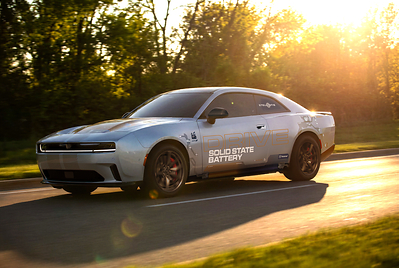
- Stellantis has incorporated Factorial's advanced solid-state battery cells into a Stellantis development vehicle - the first automotive integration of the technology in
North America - Road testing now underway to validate performance, safety and reliability under real-world conditions
- Battery pack leverages a patented mechanical architecture to accommodate solid-state cells
- Milestone marks the first vehicle in the previously announced multi-stage development vehicle program
Stellantis and Factorial Inc. (Factorial) (Nasdaq: FAC) have reached a significant milestone: the integration of Factorial's advanced FEST® (Factorial Electrolyte System Technology) solid-state battery technology into a Dodge Charger Daytona development vehicle and the launch of a road-testing program to verify performance, safety and reliability. Building on previous validation of automotive-scale FEST® cells, this achievement marks the first integration of solid-state cells into a Stellantis vehicle and a breakthrough step towards automotive-grade application.
"Battery development is a balancing act. It's not enough to optimize a single metric. We need a system that delivers real benefits in a real vehicle," said Ned Curic, Stellantis Chief Engineering and Technology Officer. "This milestone shows we are bringing solid-state batteries closer to our customers with the potential for longer range, faster charging and lower costs. Just as important, FEST®'s strong compatibility with lithium-ion manufacturing processes gives us a critical path to scale this technology."
In 2025, Stellantis and Factorial demonstrated FEST® cells with an impressive energy density of 375 Wh/kg, ultra-fast charging from
Transitioning from these cell testing results to a development vehicle demanded advanced engineering solutions from Stellantis and Factorial engineers. FEST® solid-state battery cells were integrated into the existing battery pack using an innovative, patented new mechanical architecture, designed by Stellantis, to bring out the best of solid-state cell performance. Engineers also adapted the control systems and pack design to optimize cell performance while meeting rigorous automotive requirements for safety and durability. These technical designs and adaptations are essential for ensuring cell performance in all conditions.
With this integration milestone complete, Stellantis and Factorial have started a road testing and calibration program. The testing program will help tune and further verify pack performance and reliability under charging and driving conditions, in addition to vehicle safety.
"We are deeply honored to work alongside Stellantis, one of the world's great mass-market automakers, on this STLA Large-based development car," said Siyu Huang, CEO of Factorial. "What we have built together, from cell chemistry to pack architecture to enable real-world road testing, is exactly the kind of deep, full-stack collaboration that solid-state has always required. This milestone doesn't just validate FEST®; it sets a new bar for what automotive-grade solid-state batteries can deliver and supports the development of future vehicles designed to meet the evolving needs of drivers."
This milestone marks continued progress on Stellantis and Factorial's previously announced demonstration program, as well as an important step in Factorial's ongoing development, calibration and industrialization of solid-state batteries for automotive use.
About Factorial Energy
Factorial Energy (Nasdaq: FAC) is a leading American solid-state battery innovator backed by In-Q-Tel - the not-for-profit strategic investor for the U.S. national security community and America's allies - and Mercedes-Benz, Stellantis, Hyundai, and Kia. Through its proprietary FEST® and Solstice™ platforms, engineered for scalable manufacturing, Factorial delivers industry-leading performance across defense, space, and energy storage applications. Mercedes-Benz' real-world road testing in a lightly modified test vehicle achieved over 1,200 km of range on a single charge, while Stellantis-lab testing verified 77 Ah cells demonstrating high energy density, fast-charging, and robust use for energy and power performance across temperature extremes. For more information, visit factorialenergy.com.
Stellantis
Stellantis (NYSE: STLA / Euronext Milan: STLAM / Euronext Paris: STLAP) is a leading global automaker, dedicated to giving its customers the freedom to choose the way they move, embracing the latest technologies and creating value for all its stakeholders. Its unique portfolio of iconic and innovative brands includes Abarth, Alfa Romeo, Chrysler, Citroën, Dodge, DS Automobiles, FIAT, Jeep®, Lancia, Maserati, Opel, Peugeot, Ram, Vauxhall, Free2move and Leasys. For more information, visit www.stellantis.com.
 View original content to download multimedia:https://www.prnewswire.com/news-releases/stellantis-and-factorial-integrate-advanced-solid-state-battery-into-stellantis-development-vehicle-and-launch-road-testing-302798015.html
SOURCE Stellantis
FAQ
AI-generated questions and answers. How Rhea-AI works. Not financial advice.