
Introducing the Teradata Autonomous Knowledge Platform
Teradata (NYSE: TDC) announced the Teradata Autonomous Knowledge Platform, a unified system combining AI, analytics, and data across cloud, on-premises, and hybrid environments.
Sentiment and the balance of points
Rhea-AI Sentiment reads the wording of the document, how positive or negative its language is on a 1 to 5 scale. The balance of points shown with the takes weighs what the document actually discloses, so the two can disagree, for example when a trial that missed its main goal is described in upbeat language.
Rhea-AI Summary
Teradata (NYSE: TDC) announced the Teradata Autonomous Knowledge Platform, a unified system combining AI, analytics, and data across cloud, on-premises, and hybrid environments. Key components include Teradata AI Studio, Tera workspace and agents, Teradata Cloud with Active and Elastic Compute, and Teradata Factory for on-prem sovereign AI. The platform emphasizes governed enterprise context, agentic automation, cost controls, and audit-ready lineage. Availability: Teradata Cloud in Q3 2026; Teradata Factory later in 2026; Tera Claw research preview by year-end.
Positive
- Unified AI, analytics, and data across cloud and on-premises
- Teradata Cloud combining Active Compute and Elastic Compute
- Teradata AI Studio available now for all deployments
- Teradata Factory offers on-prem sovereign AI with Dell and NVIDIA
- Platform preserves governed lineage and audit-ready traceability
Negative
- No quantitative pricing or cost-savings figures disclosed
- Teradata Factory availability delayed until later in 2026
- Tera Claw only in research preview, not yet production-ready
Details
News Market Reaction – TDC
On May 7, the day this news came out, TDC closed 2.15% below the previous close.
Data tracked by StockTitan Argus for the May 7 session.
Key Figures
- Productivity gains
- 10× gains
- Commentary on enterprises moving fastest with autonomous AI
- File formats supported
- 64+ file formats
- Unstructured ingestion into the enterprise vector store
- Data connectors
- 70+ connectors
- Unstructured ingestion to fuel RAG pipelines
- Cloud availability timing
- Q3
- Expected availability of Autonomous Knowledge Platform on Teradata Cloud
Historical Context
-
Reported Q1 2026 growth in ARR, cloud ARR, and revenue with EPS strength.
-
Named a Leader in Nucleus Research 2026 DSML Platform Technology Value Matrix.
-
Highlighted more than 150 AI-focused customer engagements across industries.
-
Announced Q1 2026 earnings release date and conference call logistics.
-
Launched Analyst Agent on Microsoft Marketplace for AI-assisted analytics.
24h Move is the share-price change in the day after each event; other market factors may also have contributed.
Key Terms
agentic ai technical
vector store technical
modelops technical
llm ops technical
mpp architecture technical
apache iceberg technical
delta lake technical
rag pipelines technical
AI-generated analysis. How Rhea-AI works. Not financial advice.




Production AI that runs anywhere — grounded in enterprise data and context
Teradata (NYSE: TDC) today announced the Teradata Autonomous Knowledge Platform, a new flagship product that unifies production-grade AI, analytics, and data into a single integrated system across cloud, on-premises, and hybrid environments. It delivers consistent performance and cost control as enterprise AI agents proliferate — purpose-built to activate enterprise intelligence.
What is Autonomous Knowledge?
Autonomous Knowledge is the ability of an enterprise software platform to turn structured and unstructured data, operating models, and experience into trusted, governed understanding. Grounded in industry-specific data, semantics, and lineage, it provides the business context for agentic AI to sense, decide, and act reliably and repeatedly across systems and tools — with minimal human intervention — while learning and improving over time.
New Teradata Capabilities
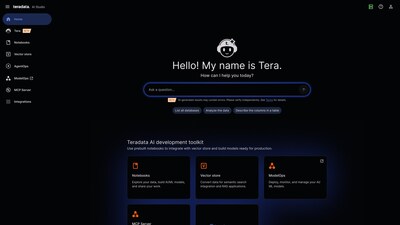
- Teradata AI Studio — The single place where users and creators build, activate, and govern AI outcomes across the full lifecycle using analytics, ML and agents.
- Tera — Teradata's autonomous AI-powered workspace, serving as the natural language interface with enterprise-grade agent execution environments.
- Tera Agents — Tera's pre-built platform agents that perform a range of tasks from continuously managing infrastructure to driving operational efficiency and cost optimization.
- Teradata Cloud — The first available deployment of the Autonomous Knowledge Platform, featuring new on-demand Elastic Compute and an enhanced Connected Data Foundation — enabling mission-critical and exploratory workloads to coexist in a single managed system without re-platforming or duplicating data.
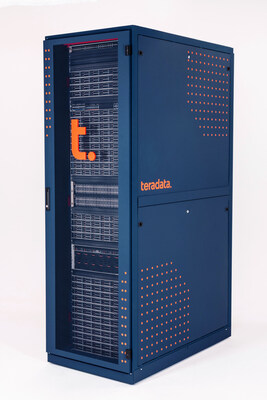
- Teradata Factory — Extends the platform on-premises for enterprises with strict data residency and regulatory requirements, delivering sovereign AI with Dell PowerEdge servers, NVIDIA AI Infrastructure, NVIDIA AI Enterprise software, and high-performance networking. By running AI where the data lives, it brings fundamentally stronger performance and governance. Additional details will be announced in the coming weeks.
Why It Matters
Agents generate exponentially more queries than humans — and the enterprises running them at scale know it. The pressure is unrelenting: infrastructure demands are rising; cost control has reached the C-suite; and enterprises need the freedom to run AI wherever it makes sense — choosing their environment, compute, storage, and cost model. And underneath it all, the data must carry business context — not just be accessible.
Why Teradata
Teradata provides the context, governance layer, and performance backbone autonomous AI demands at scale. Where other platforms require trade-offs — between cost and performance, between cloud and on-premises, between experimentation and production stability — the Autonomous Knowledge Platform is built to address them. Trusted data and business context give agents the knowledge to act. Always-on Active Compute and on-demand Elastic Compute give them the infrastructure to scale. And enterprises choose where intelligence runs — cloud, on-premises, or both.
Executive Quotes
"Enterprises are ready to move beyond AI pilots, but most infrastructure wasn't built to sustain what comes next — autonomous agents that are always-on, never sleeping, continuously turning insight into action. The Teradata Autonomous Knowledge Platform is where every capability we've built to accelerate autonomous AI comes together: unifying data, AI, and analytics into a single system where governance is built in and intelligence scales without operational trade-offs. And it runs wherever the enterprise requires — cloud, on-premises, or both."
— Sumeet Arora, Chief Product Officer, Teradata
"The real shift is from insights to decisions — and from decisions to automated action at scale. Enterprises moving fastest are already driving 10× gains in speed, cost, and productivity. The ones falling behind are still running pilots. Breaking that cycle means a strong data foundation, outcomes-based AI, and real governance as a single system, not assembled from parts. That's what customers seek in autonomous knowledge platforms."
— Ray Wang, Constellation Research
Details on Teradata Autonomous Knowledge Platform
- Teradata AI Studio brings all AI capabilities into one unified environment — from data to models to agents to applications. No switching tools, no exporting data, no rebuilding pipelines — everything is connected, governed, and built for scale. AI Studio takes AI from experimentation to production — and from production to continuously operating, autonomous enterprise intelligence.
AI Studio is available separately for organizations that want it for their existing infrastructure.
Key use cases include:
- Agentic Analytics — Business analysts and business users access instant insights through natural-language queries, no SQL required — driving faster decisions without depending on data teams.
- Hybrid Retrieval Agents — Production-ready agents built on the enterprise vector store, enabling billion-scale governed search across structured and unstructured data — on-prem and in the cloud, with time travel capabilities for superior auditability.
- End-to-End AI/ML Pipelines — Data scientists build, deploy, and operationalize scalable workflows with in-database analytics — no data movement required, with best performance from small to medium LMs.
- Model Lifecycle Management — Includes ModelOps, Model Catalog and LLM Ops spanning training, fine-tuning, monitoring, drift detection, and inference — on one platform, across any environment.
- Plus, real-time intelligence, decision optimization, multi-modal AI, and vision AI across enterprise environments.
Teradata AI Services turn AI Studio capabilities into real business outcomes — combining expert delivery with deep integration across the platform's data, governance, and execution layers. Consultants bring years of experience delivering sophisticated analytical solutions across industries, ensuring AI initiatives move reliably from concept to production-grade execution at speed.
- Tera is Teradata's autonomous AI-powered workspace — enabling business users, data teams, and developers to interact with data and AI agents in natural language, with responses grounded in governed enterprise context. Tera includes built-in modes for data analysis with Tera Analyze, coding with Tera Code, and multi-agent system automation and orchestration with Tera Claw.
- Tera Agents operate across the spectrum of autonomy from deterministic automation to policy‑governed autonomous actions, within a secure agent harness and runtime.
New Tera agents that enable platform automation to drive operational efficiency and cost optimization include:
- Sizing Agent — right sizes compute resources dynamically based on workload and SLA
- Telemetry Agent — observes platform signals across DBQL, system logs, and runtime metrics
- FinOps Agent — analyzes spend and consumption patterns to detect budget drift and inefficient resource utilization before they become overruns
- Tuning Agent — optimizes query execution, workload routing, and runtime parameters.
- Compute Agent — manages provisioning, concurrency, and execution placement
Specifics on Teradata Cloud
- The Autonomous Knowledge Platform is first available on Teradata Cloud. It combines always-on Active Compute with on-demand Elastic Compute in a single managed system — enabling teams to experiment and explore freely without impacting production workloads, re-platforming, or cost unpredictability.
The platform's massively parallel processing (MPP) architecture and mixed-workload management deliver the price-performance enterprises require as agent query volumes scale, while protecting mission-critical SLAs and giving teams the freedom to experiment. Cost controls and real-time visibility into utilization and spend ensure intelligence operates predictably at enterprise scale.
- Connected Data Foundation, available as part of the Teradata Cloud, unifies block and object storage under a governed architecture with open table format support for Apache Iceberg and Delta Lake — ensuring data is stored once and accessed consistently while preserving full customer ownership of data and metadata. Every data and model interaction is traceable and compliant, governed end-to-end across analytics, AI, and autonomous agents — making the platform AI audit-ready by design.
Unified Platform Experience
Autonomous knowledge travels with the platform — governed context, semantic meaning, and lineage preserved consistently across every environment — so agents operate reliably whether running in the cloud, on-premises, or at the edge. Security, access control, lineage, and policy enforcement are embedded directly across every data source, AI workflow, compute engine, and deployment environment. Global Identity ensures consistent authentication and access control wherever the platform runs.
Developing an ecosystem of partner integrations brings specialized AI capabilities directly into Teradata AI Studio wherever enterprises need them.
- Karini AI delivers full-lifecycle, no-code agent development inside Teradata AI Studio, helping business users and data teams build, deploy, scale, and continuously improve production-grade AI agents in days, not months.
- Pinecone works with Teradata to deliver enterprise-grade context for production AI. Teradata provides a unified foundation for both batch and real-time analytics across structured and unstructured data with the Teradata Enterprise Vector Store, while Pinecone delivers low-latency, highly-performant vector retrieval for production workloads at scale — all within a unified architecture.
- Unstructured powers the ingestion of unstructured data into the enterprise vector store, parsing 64+ file formats and 70+ connectors to fuel RAG pipelines at scale.
- WisdomAI brings agentic BI into AI Studio, letting businesses query enterprise data in natural language, build AI-powered dashboards from a single prompt, and automate analytical workflows. Proactive agents monitor KPIs, surface root causes, and recommend next actions — powered by an adaptive context engine built for enterprise scale.
Availability
The Teradata Autonomous Knowledge Platform is expected to be available in Q3 on Teradata Cloud. Teradata Factory availability will follow later this year. Tera Claw mode will be available in research preview by the end of the year.
Teradata AI Services and AI Studio are available for all deployments now.
About Teradata
Teradata empowers enterprises to turn intelligence into autonomous action, grounding AI agents in deep business context and trusted data. As AI agents multiply, Teradata is the context foundation, governance layer, and performance backbone that companies need now. The Teradata Autonomous Knowledge Platform puts AI into production across cloud, on-premises, and hybrid environments.
The Teradata logo is a trademark, and Teradata is a registered trademark of Teradata Corporation and/or its affiliates in the
MEDIA CONTACT
Jennifer Donahue
Jennifer.Donahue@Teradata.com
 View original content to download multimedia:https://www.prnewswire.com/news-releases/introducing-the-teradata-autonomous-knowledge-platform-302764902.html
SOURCE Teradata Corporation
FAQ
AI-generated questions and answers. How Rhea-AI works. Not financial advice.