
Universal Robots and Inbolt Make AI-Powered 3D Vision Guidance Easier to Deploy and Scale With Native Gen 7 Robot Integration
Sentiment and the balance of points
Rhea-AI Sentiment reads the wording of the document, how positive or negative its language is on a 1 to 5 scale. The balance of points shown with the takes weighs what the document actually discloses, so the two can disagree, for example when a trial that missed its main goal is described in upbeat language.




- Inbolt’s AI-powered 3D vision guidance software, Inbolt Standard, now runs natively on Universal Robots’ AI-ready Gen 7 platform, bringing vision intelligence directly onto the robot.
- This empowers manufacturers to run robotic 3D vision guidance without extra hardware or external cabling and lowers the bar for using AI vision-guided automation in industries like automotive, electronics and data center hardware manufacturing.
- Inbolt Standard will be sold and licensed through Universal Robots and is the first of several Inbolt licenses planned for Universal Robots customers.
NUREMBERG,
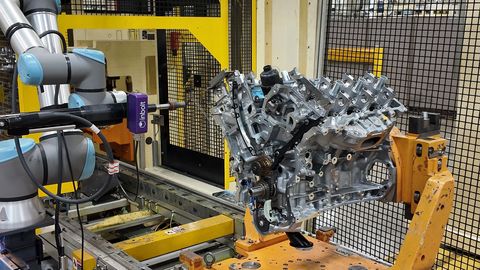
Inbolt’s 3D vision guidance on Universal Robots (UR) handles hard-to-automate tasks such as bolt tightening on a moving engine assembly line. The system adjusts dynamically to the engine’s actual position and is now integrated directly into UR's new Gen 7 platform
This new, 7th-generation robot family is AI-ready out of the box, giving manufacturers the platform they need to take AI from the lab into industrial operations with confidence. Following the launch in September, Inbolt is one of the first UR+ partners to run an AI application directly on the platform’s CB7 Core controller.
Inbolt Standard lets a UR robot locate a part and adapt its taught path to the part’s actual position on every cycle, for tasks ranging from screwdriving and machine tending to rack loading and depalletizing. A 3D camera on the robot’s wrist recognizes the part from its CAD file, locates it, and adjusts the robot’s taught path to the part’s actual position on every cycle. This means manufacturers no longer need to build custom jigs and fixtures for every part and station, making the switch to a new product a software change rather than a tooling project.
Vision guidance without a second system
Now licensed to run natively on UR’s CB7 Core controller, Inbolt Standard removes the external industrial PC system that vision guidance until now has required; this capability simplifies installation, deployment and support of the system. And thanks to Gen 7’s new tool flange ethernet connectivity and power connectors, the Inbolt camera is directly connected to the robot at the tool flange so that cables are no longer routed along the outside of the arm.
“Gen 7 is our platform for physical AI, giving partners the compute, connectivity and tools to develop AI applications and deploy them directly on the robot,” said Anders Billesø Beck, Vice President, AI Robotics Products at Universal Robots. “Inbolt Standard is a clear example of what that brings to the factory floor in terms of usability and reduced integration time. For manufacturers that standardize on UR across many sites, vision guidance is now a standard option for every new cell.”
Universal Robots and Inbolt have worked together since 2022, and vision-guided UR robot cells from the two companies already run in production at manufacturers in
From fixtures to software
Inbolt Standard covers stationary applications where parts arrive in a repeatable orientation, from single parts to layered racks and trays. In automotive, typical applications include screwdriving and bolt run-down, de-racking, machine tending and layered depalletizing.
The license also opens more of the high-mix electronics and data center hardware segment to UR collaborative industrial robots, where trays, enclosures and server chassis rarely sit in the same position twice, from tray and rack loading through to fastening and torquing on assemblies. A single program can switch between more than 80 part references, and end-user teams can retrain when a new part arrives.
“Inbolt and Universal Robots have deployed vision-guided cobots together for years, and with the new Gen 7, our products have never been closer,” said Rudy Cohen, co-founder and CEO of Inbolt. “Because vision guidance now runs on the robot itself, a manufacturer rolling out cobots across dozens of stations and several plants can specify it on every cell from day one, instead of engineering a new fixture for every part. We’ll bring more of the Inbolt range to UR customers in the coming months.”
How it runs on Gen 7
Inbolt Studio, the software used to train parts and set up stations, runs as a URCap on PolyScope X, and part localization runs on the CB7 Core controller’s own processor. An Orbbec 3D camera connects to the power connector and the 1 Gb Ethernet port in the g-Series tool flange, so its signal runs through the robot.
Training happens locally on the controller from the part’s CAD file in under 10 minutes, with no image datasets or labeling, and no production data leaving the plant. Inbolt commands appear in the PolyScope X program tree and are called like any other URScript instruction.
Repeatability is 0.5 to 0.7 mm on fixed parts, and the camera’s active infrared depth sensing works in bright, dim or dark conditions. Inbolt Standard runs natively on UR’s g-Series robots – UR10g-1750, UR17g-1300 and UR18g-950 – with PolyScope X 10.13 or later. It is also compatible with e-Series and UR Series robots with a CB7 controller. For these, the camera will connect via an external cable.
Availability and SPS 2026
Inbolt Standard will soon be available to order through Universal Robots and its distribution partners and is listed on the UR+ Marketplace.
Visitors to SPS 2026 (November 24 to 26, Nuremberg) can see Inbolt vision guidance running live on a Gen 7 collaborative industrial robot at the Teradyne Robotics booth, Hall 3C, Booth 111.
*****
About Inbolt
Inbolt gives robots the ability to see, think, and adapt in real time. Its generalist AI model enables any robot to master any process, part, or station, helping manufacturers deploy faster, cut costs, and keep production moving. Trusted by Stellantis, Toyota, Beko, and Ford, Inbolt combines real-time 3D vision and proprietary models to deliver precise part localization and robot trajectory control, even in unstructured environments or moving lines. Trained on a CAD model in minutes and compatible with all leading robot brands, Inbolt powers over 100 factories worldwide with flexible, scalable automation. www.inbolt.com
About Universal Robots
Universal Robots is a global leader in collaborative industrial robots (cobots). With over 100,000 cobots sold worldwide, the company’s user-friendly platform is supported by intuitive PolyScope software, award-winning training, comprehensive services, and the world’s best cobot ecosystem, delivering innovation and choice to customers across a wide range of industries. With the most advanced robots in their class and a growing catalogue of ready-to-deploy AI applications, UR’s latest technology is built for the physical AI revolution.
Universal Robots is part of Teradyne Robotics, a division of Teradyne, Inc. (NASDAQ:TER), a leading supplier of automated test equipment and advanced robotics systems. For more information, please visit www.universal-robots.com.
View source version on businesswire.com: https://www.businesswire.com/news/home/20261124366788/en/
Media
Inbolt: Carl Standertskjold, Head of Marketing, carl.standertskjold@inbolt.com
Universal Robots: Christoffer Voss, Global PR & Public Affairs Manager, pr@teradyne-robotics.com
Source: Universal Robots