
Universal Robots Unveils Gen 7, a New Platform for Industrial Automation and Physical AI Deployment
Universal Robots’ Gen 7 platform combines new g-Series arms, a higher-power controller and PolyScope X OS to simplify AI-enabled industrial automation.




Redesigned from controller to tool flange, the new Gen 7 robot platform is out-of-the-box AI-ready, giving companies the modern software tools and next-level connectivity that they need to confidently take AI from the lab into industrial operations.
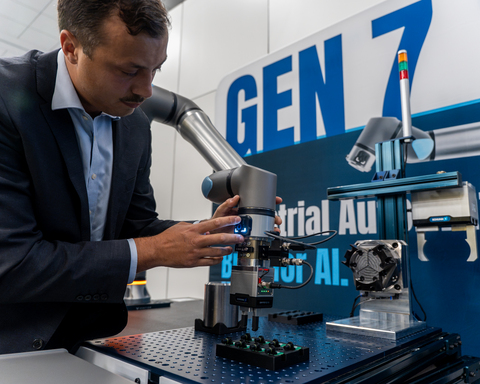
Universal Robots’ new Gen 7 platform launched at the IMTS tradeshow in
Gen 7 represents a unified system upgrade, enhancing the exceptional robot user experience that operators, engineers, and integrators already prefer to work with every day. Anchored by the PolyScope X robot operating system, Gen 7 has a fully reengineered control box, teach pendant and tool flange – all designed to make even the most demanding tasks and setups easier.
“The robots of the AI era must be advanced, not complicated,” said Jean-Pierre Hathout, President of the Teradyne Robotics Group. “Built on what we have learned from over 20 years of cobot innovation and more than 100,000 industrial deployments worldwide, Gen 7 is an end-to-end redesign of our platform that reduces integration friction and dramatically expands application capabilities. It will enable our customers and partners across industries to confidently deploy advanced AI-powered applications in real-world operations.”
Key innovations in Gen 7
Gen 7 introduces a unified collection of new hardware and features:
-
New g-Series robot arms with AI-ready tool flange: The Gen 7 platform adds three new robot arms: UR10g-1750, UR17g-1300, and UR18g-950, named after their payload (kg) and reach (mm), joining the e-Series and UR Series lineup.
The new g-Series tool flange enables the vision and sensing needed for AI models to run in real time with the robot, delivering data, power, and safety directly to the tool flange. This eliminates cabling complexity and makes it easier to connect cameras and high-bandwidth sensors, which is critical to advanced automation and physical AI deployments.
Additionally, built-in force-torque sensing, impedance control and RTDE (Real-Time Data Exchange) give the robot a sense of touch for physical AI applications such as dexterous manipulation and force-sensitive assembly tasks.
-
CB7 Core controller: Offering
40% more compute power in a30% smaller footprint than previous generations, the new controller enables multi-network communication for modern automation and physical AI architectures, connecting to PLCs, HMIs, MES platforms, IPCs, and vision systems, reducing the need for external switches. It is available at launch in a standalone control box version and a compact version for integration into an automation cabinet. CB7 is also compatible with e-Series and UR Series robot arms.
- PolyScope X: Brings to Gen 7 modern programming tools, ISO 10218-1 safety functionality and cybersecurity compliance. With open APIs and ROS2 communication, PolyScope X enables programmers to build and deploy edge-AI applications utilizing IPCs and external AI processing. With additional software packages, integrators can access further advanced robot functionality such as ProfiSafe, OPC-UA, or logic programs, and easily access application software from third-party developers, such as Rocketfarm Pally or Inbolt 3D Vision Guidance.
-
TP7 Core teach pendant: Building upon the already exceptional UR user experience, the new teach pendant is more than
20% lighter and more ergonomic than previous generations, has multiple grip positions, configurable smart buttons, and a full HD display, plus a new virtual joystick. It is designed to stay comfortable through long shifts and to make programming feel intuitive rather than technical, so operators spend less time learning the interface and more time getting the job done.
- New SP7 Smart Panel tool flange interface: A faster way to teach and program directly at the tool flange. The SP7 Smart Panel has safety-compliant freedrive functionality, LED lights and three configurable input buttons capable of running PolyScope X Smart Skills. By letting operators work at the point of the task, the Smart Panel cuts setup and programming time where touch-to-teach or operator interaction is important, such as high-mix, low-volume production.
- Safety and cybersecurity in focus: Gen 7's advanced and collaborative safety functions provide a PLd, Category 3 (ISO 13849-1) certified architecture. All g-Series robots are TÜV certified to ISO10218-1 and UL1740, and Teradyne Robotics is certified to IEC 62443-4-1 ML3 for cybersecurity, confirming that secure development practices are built into every stage of the software lifecycle.
A showcase of the physical AI ecosystem
At IMTS, Gen 7 is on display alongside new developments from 20+ ecosystem partners – including demos of Gen 7 functionality with Cognex, Schunk, Magswitch, Smooth Robotics, Psyonic, Robotiq and Inbolt. The demos illustrate how the platform’s open architecture lets best-in-class physical AI, machine vision and gripping providers build applications directly on Universal Robots hardware and software.
“Universal Robots and Inbolt share the same conviction, that automation should be simple to deploy and simple to live with,” said Rudy Cohen, CEO of Inbolt. “With Gen 7 and PolyScope X, Inbolt’s vision now runs natively on the UR controller itself, available directly through UR. No external vision PC, no extra cabling. Manufacturers get parts localized without jigs or fixtures, and reach production in hours, not weeks.”
The booth demonstrations also reflect a mature ecosystem: Gen 7 is backed by UR+, a curated, rigorously tested portfolio of automation products, each validated by both the partner and UR before it reaches the market. This de-risks integration and lets customers deploy their robots more quickly and with confidence.
Download images: Here
About Universal Robots
Universal Robots is a global leader in collaborative industrial robots (cobots). With over 100,000 cobots sold worldwide, the company's user-friendly platform is supported by intuitive PolyScope software, award-winning training, comprehensive services, and the world’s best cobot ecosystem, delivering innovation and choice to customers across a wide range of industries. With the most advanced robots in their class and a growing catalogue of ready-to-deploy AI applications, UR’s latest technology is built for the physical AI revolution.
Universal Robots is part of Teradyne Robotics, a division of Teradyne, Inc. (NASDAQ:TER), a leading supplier of automated test equipment and advanced robotics systems. For more information, please visit www.universal-robots.com.
View source version on businesswire.com: https://www.businesswire.com/news/home/20260914974443/en/
Media Contact:
Mette McCall, McCall Media
mette@mccallmedia.net
+1 251 278 9847
Source: Universal Robots