
Titan Mining Validates Kilbourne Graphite Concentrator Flowsheet and Achieves Battery-Grade Purity
Titan Mining (NYSE-A:TII, TSX:TI) reported that metallurgical programs have validated the concentrator flowsheet for the Kilbourne Graphite Project and confirmed its downstream purification and spherical graphite processes.
Sentiment and the balance of points
Rhea-AI Sentiment reads the wording of the document, how positive or negative its language is on a 1 to 5 scale. The balance of points shown with the takes weighs what the document actually discloses, so the two can disagree, for example when a trial that missed its main goal is described in upbeat language.
Rhea-AI Summary
Titan Mining (NYSE-A:TII, TSX:TI) reported that metallurgical programs have validated the concentrator flowsheet for the Kilbourne Graphite Project and confirmed its downstream purification and spherical graphite processes. Locked-cycle testing produced a 95.9% C(t) graphite concentrate at 91.4% recovery, exceeding the PEA design basis of 95% grade and 90% recovery.
The preferred purification flowsheet consistently delivers battery-grade purified graphite at ≥99.90% Fixed Carbon, with thermal pretreatment plus purification achieving 99.99% Fixed Carbon for spherical purified graphite. About 66% of concentrate is converted into spherical graphite products, above the ~50% industry average. Engineering for the concentrator and Secondary Transformation Plant, supported by a 1,200 mtpa demonstration plant and pilot/customer-qualification campaigns, continues as part of the Kilbourne Feasibility Study.
Positive
- Concentrate grade 95.9% C(t) at 91.4% recovery, exceeding PEA design basis
- Battery-grade purification consistently at ≥99.90% Fixed Carbon for purified micronized graphite
- 99.99% Fixed Carbon achieved for spherical purified graphite with thermal pretreatment
- ~66% spherical graphite yield from concentrate versus ~50% industry average
- 1,200 mtpa demonstration plant producing Kilbourne concentrate for pilots and qualification
- Feasibility Study engineering advancing for concentrator and Secondary Transformation Plant
Negative
- None.
News Explained
Kilbourne’s testwork supports ongoing feasibility engineering, but plant-scale validation, customer qualification, site selection, and construction remain unresolved.
In the
The stated
Management calls the results a reduction of Feasibility Study risk, but the release cautions that laboratory-scale results may not represent plant-scale performance and says variability testing is still ongoing.
The release identifies vendor equipment sizing, customer qualification, evaluation of the Secondary Transformation Plant site, and preparation of three tonnes of concentrate for shipment to Germany as remaining milestones.
Details
News Market Reaction – TII
On Jul 15, the day this news came out, TII closed 2.33% above the previous close. Our momentum scanner recorded 3 alerts for this stock that day.
Data tracked by StockTitan Argus for the Jul 15 session.
Key Figures
- Graphite concentrate grade
- 95.9% C(t)
- Locked-cycle testing concentrate grade vs PEA design
- Graphite recovery
- 91.4% recovery
- Locked-cycle testing recovery vs PEA design
- PEA concentrate grade basis
- 95% concentrate grade
- Preliminary Economic Assessment design assumption
- PEA recovery basis
- 90% recovery
- Preliminary Economic Assessment design assumption
- Battery-grade purified graphite
- ≥99.90% Fixed Carbon
- Preferred purification flowsheet for Feasibility Study
- SPG fixed carbon
- 99.99% Fixed Carbon
- Spherical purified graphite after thermal pretreatment and purification
- Spherical graphite yield
- 66% conversion
- Concentrate converted into spherical graphite products vs industry average
- Demo plant capacity
- 1,200 mt per annum
- Empire State Mine demonstration plant design capacity
Historical Context
-
Reported district-wide germanium enrichment and outlined next steps for evaluation.
-
All AGM matters approved, including board size, directors, and auditor re‑appointment.
-
Received conditional U.S. Army lease selections for graphite purification facilities.
-
Appointed experienced CFO to support strategic growth and project development.
-
Company featured in TV program focused on critical minerals and related themes.
24h Move is the share-price change in the day after each event; other market factors may also have contributed.
Key Terms
preliminary economic assessment financial
locked-cycle flotation testing technical
fixed carbon technical
ni 43-101 regulatory
qa/qc technical
icp-oes technical
AI-generated analysis. How Rhea-AI works. Not financial advice.




GOUVERNEUR, N.Y., July 15, 2026 (GLOBE NEWSWIRE) -- Titan Mining Corporation (NYSE-A:TII, TSX:TI), (“Titan” or the “Company”), a U.S.-focused critical minerals producer and developer, today announced positive results across its full graphite processing chain for the Kilbourne Graphite Project, from ore concentration through to battery-grade spherical graphite. The results confirm the Company's Preliminary Economic Assessment (“PEA”) design assumptions at the concentrator and demonstrate battery-grade purity and above-average yields at the downstream pilot stage, supporting the ongoing Feasibility Study and Titan's plan to build the first fully integrated U.S. graphite supply chain in over 70 years.
HIGHLIGHTS
- Concentrator flowsheet validated: Locked-cycle testing produced a
95.9% C(t) graphite concentrate at91.4% recovery, exceeding the PEA design basis of95% concentrate grade and90% recovery. - Preferred commercial purification process confirmed: Metallurgical test work selected for the preferred purification flowsheet for the Feasibility Study, consistently producing battery-grade purified graphite (≥
99.90% Fixed Carbon). - Industry-leading spherical graphite yield: Approximately
66% of concentrate converted into spherical graphite products, exceeding the industry average of approximately50% . - Engineering progressing across the value chain: Engineering of both the concentrator and Secondary Transformation Plant continues to advance as part of the Feasibility Study.
- Demonstration plant supporting commercialization: Ongoing production at plant with design capacity of 1,200 mt per annum, is generating representative Kilbourne concentrate for downstream pilot campaigns, customer qualification and commercial-scale engineering.
"These results confirm two things: our concentrator performs as designed in the PEA, and our downstream process turns that concentrate into battery-grade material at yields well above the industry average. Together, they de-risk the Kilbourne Feasibility Study from the mine face through to the finished product. We're now focused on completing customer qualification and advancing toward construction," said Rita Adiani, President and Chief Executive Officer of Titan.
As part of the ongoing Feasibility Study, Titan completed a metallurgical optimization program at SGS Lakefield to refine the concentrator design for the Kilbourne Graphite Project. The optimized flowsheet closely aligns with the PEA design, requiring only minor refinements to further improve performance.
Figure 1: Concentrator Design Flowsheet
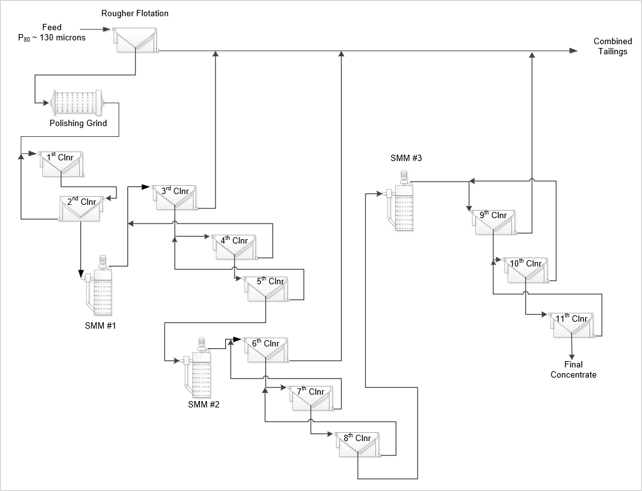
Locked-cycle flotation testing produced a
Engineering of the concentrator continues to advance, with vendor testing underway to finalize equipment sizing. In parallel, the Empire State Mine demonstration plant continues producing graphite concentrate to support downstream pilot campaigns and customer qualification activities.
Table 1: Locked Cycle Flotation Test Mass Balance
| Product | Weight | Assays, %, | Dist. % |
| % | C(t) | C(t) | |
| 11th Cleaner Concentrate | 2.81 | 95.9 | 91.4 |
| Combined Cleaner Tails | 22.0 | 0.56 | 4.15 |
| 9th Cleaner Tail | 0.14 | 5.22 | 0.25 |
| 6th Cleaner Tail | 0.57 | 12.6 | 2.42 |
| 3rd Cleaner Tail | 3.04 | 0.35 | 0.35 |
| 1st Cleaner Tail | 18.3 | 0.18 | 1.13 |
| Rougher Tail | 75.2 | 0.18 | 4.48 |
| Head | 100 | 2.96 | 100 |
Table 2: Size Fraction Analysis on Combined Concentrate
| Size Fraction | Weight | Assays, % | % Distr. |
| % | C(t) | C(t) | |
| +48 mesh | 0.0 | 0.0 | 0.0 |
| +80 mesh | 3.2 | 91.4 | 3.0 |
| +100 mesh | 3.6 | 94.0 | 3.5 |
| +200 mesh | 33.3 | 96.3 | 33.5 |
| +325 mesh | 30.5 | 97.0 | 30.8 |
| +400 mesh | 10.6 | 96.8 | 10.7 |
| -400 mesh | 19.0 | 91.5 | 18.4 |
| Total Concentrate | 100.0 | 95.9 | 100.0 |
The downstream engineering program continues to advance in parallel with the Kilbourne Feasibility Study.
Metallurgical test work has confirmed the preferred purification flowsheet for the Secondary Transformation Plant, consistently producing ≥
The program also demonstrated an approximate
Representative SPG products have been dispatched for specialist coating and electrochemical testing as part of ongoing customer qualification activities. In parallel, three tonnes of representative Kilbourne graphite concentrate are being prepared for shipment to Dorfner Anzaplan in Germany for the next pilot-scale production campaign. Engineering of the Secondary Transformation Plant and evaluation of its preferred site location continue as part of the Feasibility Study.
The Company also continues to progress the evaluation of the preferred site location for the Secondary Transformation Plant, as outlined in its June 25, 2026 news release.
Qualified Persons
The scientific and technical information contained in this news release (other than in respect of the secondary transformation site) has been reviewed and approved by Oliver Peters, P.Eng., M.Sc., MBA, a Qualified Person as defined by National Instrument 43-101 – Standards of Disclosure for Mineral Projects ("NI 43-101").
The scientific and technical information contained in this news release related to the secondary transformation site has been reviewed and approved by Derick de Wit, FAusIMM, a Qualified Person as defined by NI 43-101.
The Qualified Person has verified the metallurgical data disclosed in this news release, including sampling information, laboratory test procedures, analytical results, calculations, and interpretations underlying the technical information presented. Verification activities included a review of sample selection and compositing procedures, chain-of-custody records, laboratory certificates, test protocols, analytical methodologies, mass balance calculations, and the reported metallurgical results. The Qualified Person also reviewed the consistency of the reported results with the underlying laboratory data and confirmed that the conclusions presented are supported by the testwork completed.
The metallurgical testwork program was conducted under a quality assurance and quality control ("QA/QC") program designed by SGS Lakefield to ensure the reliability of the results. Test procedures were developed and executed in accordance with industry-standard laboratory practices. Equipment calibration, procedural checks, duplicate analyses, and internal laboratory quality control measures were utilized, where appropriate, throughout the program. Sample preparation, handling, and testing were conducted under controlled laboratory conditions, and all analytical results were reviewed for reasonableness and internal consistency.
The metallurgical samples utilized for testing were selected to be representative of the mineralization and material types under evaluation; however, metallurgical performance can vary throughout a deposit due to changes in mineralogy, grade, weathering, and other geological factors. As with all laboratory-scale testwork, the results reported herein may not be fully representative of future plant-scale performance. Factors that may materially affect the accuracy or reliability of the reported results include sample representativity, variability in feed characteristics, analytical precision, test conditions, scale-up assumptions, and process operating parameters.
The metallurgical testwork was conducted by SGS in Lakefield, Ontario, Canada. The laboratory is independent of the Company. Testing was performed on a Master composite weighing approximately 200 kg. The test program included comminution testing and laboratory flotation testing. Analytical determinations were completed using industry-standard methods appropriate for the material and products under evaluation, including carbon analysis, sulphur analysis, ICP-OES, XRF, and particle size analysis. The Qualified Person considers the analytical and metallurgical procedures used in the program to be appropriate for the objectives of the testwork and the nature of the mineralization being evaluated.
About Titan Mining Corporation
Titan is an Augusta Group company which produces zinc concentrate at its
Investor Relations Contact
Irina Kuznetsova
Director, Investor Relations
Phone: (778) 870-7735
Email: info@titanminingcorp.com
Media Relations Contact
KCSA Strategic Communications
Email: TitanMining@KCSA.com
Cautionary Note Regarding Forward-Looking Information
Certain statements and information contained in this news release constitute “forward-looking statements”, and “forward-looking information” within the meaning of applicable securities laws (collectively, “forward-looking statements”). These statements appear in a number of places in this news release and include, but are not limited to, statements regarding Titan's plan to build the first fully integrated U.S. graphite supply chain in over 70 years; that we're now focused on completing customer qualification and advancing toward construction; and future potential results of the Feasibility Study. When used in this news release, words such as “to be”, “believe”, “targeted”, “could”, “will”, “planned”, “expected”, “potential”, and similar expressions are intended to identify these forward-looking statements. Although the Company believes that the expectations reflected in such forward-looking statements and/or information are reasonable, undue reliance should not be placed on forward-looking statements since the Company can give no assurance that such expectations will prove to be correct. These statements involve known and unknown risks, uncertainties and other factors that may cause actual results or events to vary materially from those anticipated in such forward-looking statements, including risks relating to cost increases for capital and operating costs; risks of shortages and fluctuating costs of equipment or supplies; risks relating to fluctuations in the price of zinc and graphite; the inherently hazardous nature of mining-related activities; potential effects on our operations of environmental regulations in New York State; risks due to legal proceedings; and risks related to operation of mining projects generally; risks that the new antidumping and countervailing duties do not receive final affirmative determination by the ITC; and the risks, uncertainties and other factors identified in the Company's periodic filings with Canadian securities regulators and the United States Securities and Exchange Commission. Such forward-looking statements are based on various assumptions, including assumptions made with regard to our forecasts and expected cash flows; our projected capital and operating costs; our expectations regarding mining and metallurgical recoveries; mine life and production rates; that laws or regulations impacting mining activities will remain consistent; our approved business plans; our mineral resource estimates and results of the preliminary economic assessment; our experience with regulators; political and social support of the mining industry in New York State; our experience and knowledge of the New York State mining industry and our expectations of economic conditions and the price of zinc and graphite; demand for graphite; exploration results; the ability to secure adequate financing (as needed); the Company maintaining its current strategy and objectives; study results; permitting progress; and the Company’s ability to achieve its growth objectives. While the Company considers these assumptions to be reasonable, based on information currently available, they may prove to be incorrect. Except as required by applicable law, we assume no obligation to update or to publicly announce the results of any change to any forward-looking statement contained herein to reflect actual results, future events or developments, changes in assumptions or changes in other factors affecting the forward-looking statements. If we update any one or more forward-looking statements, no inference should be drawn that we will make additional updates with respect to those or other forward-looking statements. You should not place undue importance on forward-looking statements and should not rely upon these statements as of any other date. All forward-looking statements contained in this news release are expressly qualified in their entirety by this cautionary statement.
A photo accompanying this announcement is available at https://www.globenewswire.com/NewsRoom/AttachmentNg/b781b66e-2b45-4fad-bc9b-50232cc06fbd

FAQ
AI-generated questions and answers. How Rhea-AI works. Not financial advice.