
Tiziana Announces New Positive Clinical Data for Intranasal Foralumab in Non-Active Secondary Progressive Multiple Sclerosis
Tiziana (Nasdaq: TLSA) reported updated clinical data from its Expanded Access Program of intranasal foralumab in 14 patients with non-active secondary progressive multiple sclerosis as of March 2026.
Rhea-AI Summary
Tiziana (Nasdaq: TLSA) reported updated clinical data from its Expanded Access Program of intranasal foralumab in 14 patients with non-active secondary progressive multiple sclerosis as of March 2026.
Foralumab remained well tolerated, with trends toward disability stabilization on EDSS and 64% of patients achieving clinically meaningful fatigue improvement on MFIS (≥4-point reduction), though results are not statistically significant.
Positive
- Intranasal foralumab remained well tolerated with no new safety signals over extended use
- Cohort showed a favorable trend toward reduced confirmed disability progression on EDSS
- 64% of patients (9 of 14) achieved ≥4-point clinically meaningful MFIS fatigue improvement
- Only one disability progression event observed versus HERCULES placebo and tolebrutinib reference arms
- Longer-term Expanded Access data support further investigation of intranasal foralumab in na-SPMS
Negative
- Expanded Access dataset includes only 14 patients, limiting robustness of conclusions
- Foralumab outcomes are described as trend analysis only and not statistically significant
- Program design is non-randomized versus external reference arms, which may introduce bias
- Regulatory approval is still pending, and further clinical studies will be required
Details
News Market Reaction – TLSA
In the May 19 session, TLSA gained 2.22%, reflecting a moderate positive market reaction.
Data tracked by StockTitan Argus on the day of publication.
Key Figures
- Expanded Access patients
- 14 patients
- na-SPMS intranasal foralumab Expanded Access program
- MFIS improvement rate
- 64%
- Patients with ≥4-point MFIS improvement (9 of 14)
- MFIS threshold
- ≥4 points
- Clinically meaningful MFIS improvement per Rooney et al.
- EDSS event definition (low baseline)
- ≥1.0 point increase
- If baseline EDSS <5.0 per HERCULES criteria
- EDSS event definition (high baseline)
- ≥0.5 point increase
- If baseline EDSS ≥5.0 per HERCULES criteria
- Disability events in EA cohort
- Single event
- Cumulative disability progression events vs HERCULES reference arms
- Pre-news price change
- -1.46%
- TLSA move vs prior close before this release
- 52-week range position
- -48.08% vs high; 18.42% vs low
- Price <b>$1.35</b> relative to 52-week range
Previous Clinical trial Reports
-
Peer-reviewed publication of open-label na-SPMS foralumab study with multi-modal data.
-
First patient dosed in randomized Phase 2 for early Alzheimer’s disease.
-
Announcement that Phase 2 Alzheimer’s trial enrollment has begun and dosing imminent.
-
ALS Phase 2 accepted into Healey ALS MyMatch Program with multi-center U.S. enrollment.
-
ECTRIMS poster on Phase 2a trial design for nasal foralumab in na-SPMS.
24h Move is the share-price change in the day after each event; other market factors may also have contributed.
Key Terms
expanded access program regulatory
secondary progressive multiple sclerosis medical
expanded disability status scale (edss) medical
modified fatigue impact scale (mfis) medical
confirmed disability progression (cdp) medical
AI-generated analysis. How Rhea-AI works. Not financial advice.




- Favourable trends seen in stability of disability and clinically meaningful improvements in fatigue.
BOSTON, May 19, 2026 (GLOBE NEWSWIRE) -- Tiziana Life Sciences, Ltd. (Nasdaq: TLSA) ("Tiziana"), a biotechnology company developing its lead candidate, intranasal foralumab, a fully human, anti-CD3 monoclonal antibody, announces updated clinical data from its ongoing Expanded Access ("EA") Program evaluating intranasal foralumab in 14 patients with non-active Secondary Progressive Multiple Sclerosis (na-SPMS). The data, updated from March 2025 to as of March 2026, demonstrate that intranasal foralumab continues to be extremely well tolerated over extended treatment durations. Patients showed encouraging trends in stabilization of disability as measured by the Expanded Disability Status Scale (EDSS) and meaningful improvements in fatigue as measured by the Modified Fatigue Impact Scale (MFIS).
Study Highlights:
- Safety: Foralumab was well tolerated with no new safety signals identified.
- EDSS Stabilization: We observed a favorable trend toward disease stabilization (i.e., reduced Confirmed Disability Progression (CDP)).
- Fatigue Improvement:
64% of patients achieved a clinically meaningful improvement of ≥4 points in their MFIS score.
Figure 1. Foralumab Expanded Access Program vs. HERCULES Reference Arms
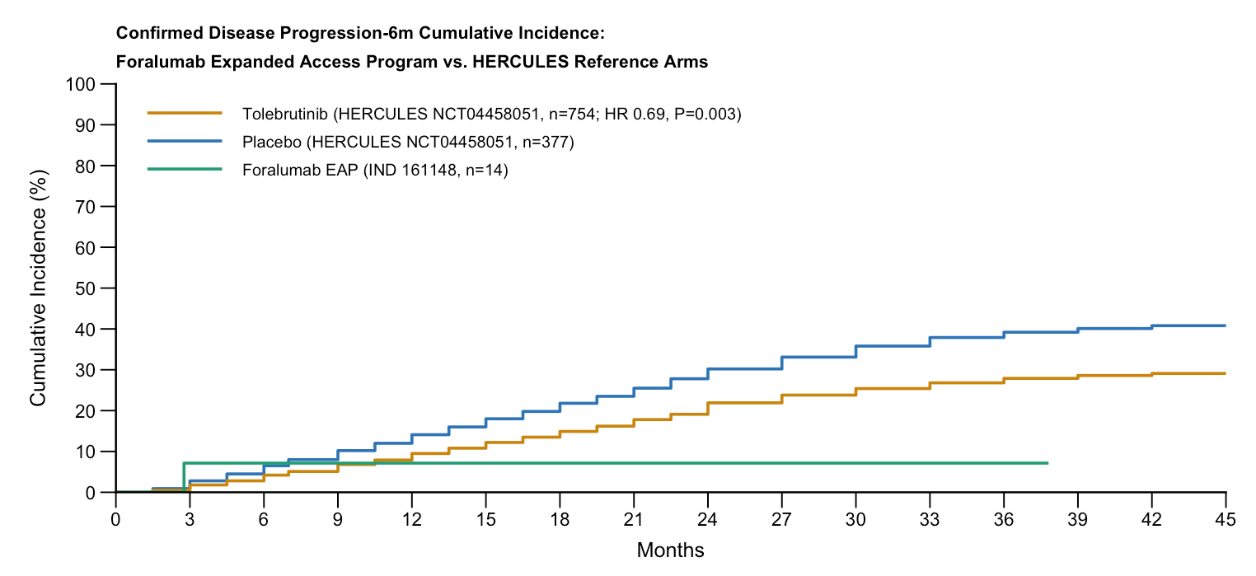
The graph titled "Foralumab Expanded Access Program vs Hercules Reference Arms" compares the cumulative incidence of disability progression events in the foralumab EA cohort against the placebo and tolebrutinib arms from the Phase 3 HERCULES non-relapsing SPMS trial (DOI: 10.1056/NEJMoa2415988). The foralumab line shows only a single event, indicating strong stabilization in the majority of treated patients. An "event" is defined per the Sanofi NEJM publication as a sustained increase in EDSS of ≥1.0 point if baseline EDSS <5.0, or ≥0.5 points if baseline EDSS ≥5.0.
Figure 2. Modified Fatigue Impact Scale (MFIS) Score
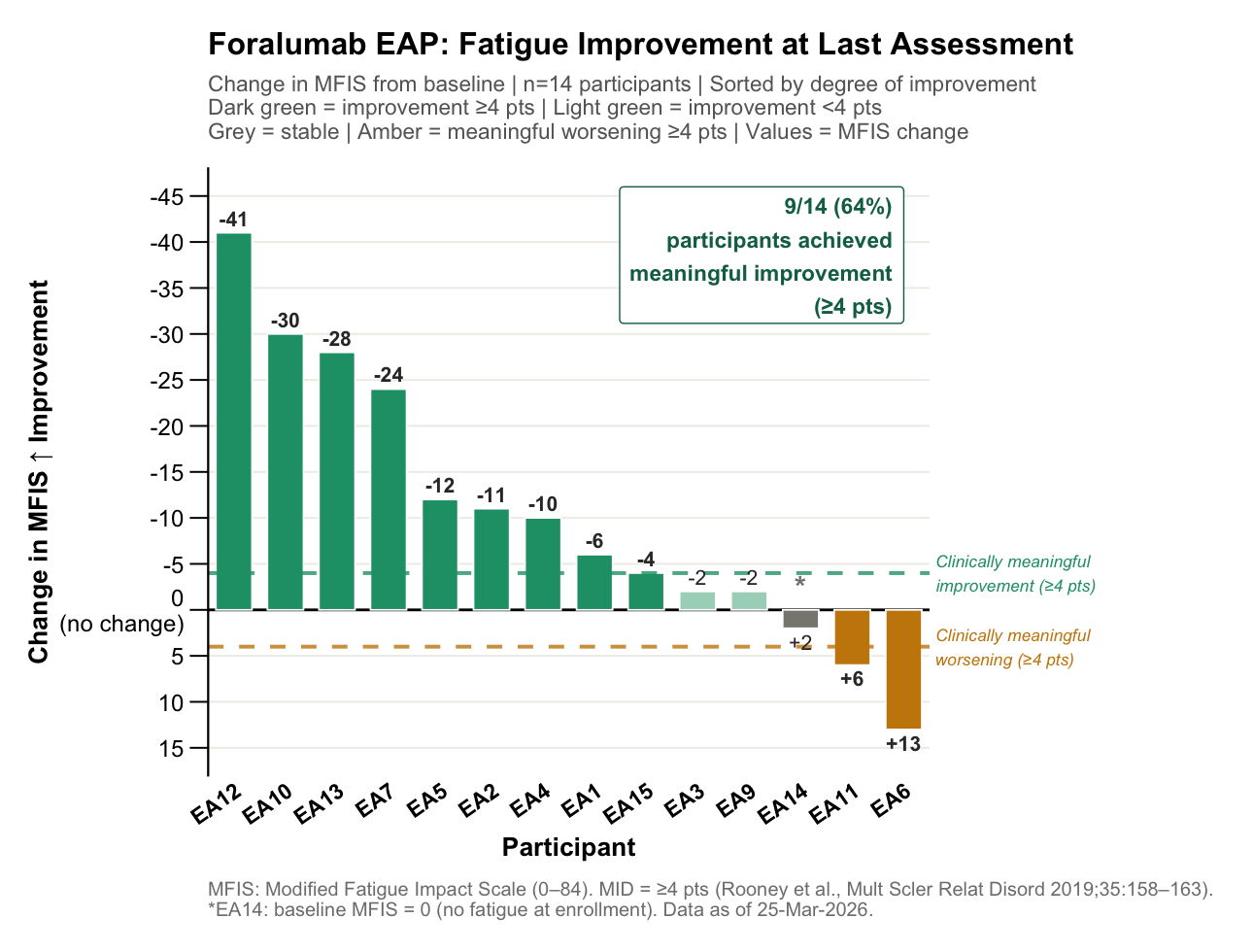
The graph titled "Modified Fatigue Impact Scale (MFIS) Score" shows 9 out of 14 participants (
Due to the small sample size in the Expanded Access Program, foralumab data shown in Figs 1 and 2 are not statistically significant and represent a trend analysis only.
Dr. Howard L. Weiner, Director of the Ann Romney Center for Neurologic Diseases at Brigham and Women’s Hospital, and Chair of the Scientific Advisory Board of Tiziana Life Sciences, commented: "These longer-term results from the Expanded Access SPMS Program continue to support the potential of intranasal foralumab as a novel, immunomodulatory therapy for patients with non-active SPMS. The excellent tolerability profile combined with trends toward disability stabilization and fatigue improvement is highly encouraging and warrants further investigation."
Ivor Elrifi, CEO of Tiziana Life Sciences, added: "We are pleased with the continued positive safety and clinical trend data from our Expanded Access Program. Intranasal foralumab's unique mechanism, which reduces neuroinflammation, positions it as a potential new treatment paradigm for progressive forms of multiple sclerosis where treatment options remain limited. We look forward to advancing this program to approval."
About Foralumab
Foralumab, a fully human anti-CD3 monoclonal antibody, is a biologic candidate that has been shown to stimulate T regulatory cells when dosed intranasally. Currently, 14 patients with Non-Active Secondary Progressive Multiple Sclerosis (na-SPMS) have been dosed in an open-label intermediate sized Expanded Access (EA) Program (NCT06802328) with either an improvement or stability of disease seen within 6 months in all patients. In addition, intranasal foralumab is currently being studied in a Phase 2a, randomized, double-blind, placebo-controlled, multicenter, dose-ranging trial in patients with non-active secondary progressive multiple sclerosis (NCT06292923).
Foralumab is the only fully human anti-CD3 monoclonal antibody (mAb) currently in clinical development. Immunomodulation by intranasal foralumab represents a novel avenue for the treatment of neuroinflammatory and neurodegenerative human diseases.[1],[2],[3]
About Tiziana Life Sciences
Tiziana is a clinical-stage biopharmaceutical company developing breakthrough therapies using transformational drug delivery technologies to enable alternative routes of immunotherapy. Tiziana’s innovative nasal approach has the potential to provide an improvement in efficacy as well as safety and tolerability compared to intravenous (IV) delivery. Tiziana’s lead candidate, intranasal foralumab, which is the only fully human anti-CD3 mAb currently in clinical development, has demonstrated a favorable safety profile and clinical response in patients in studies to date. Tiziana’s technology for alternative routes of immunotherapy has been patented with several applications pending and is expected to allow for broad pipeline applications.
For more information about Tiziana and its innovative pipeline of therapies, please visit www.tizianalifesciences.com.
Forward-Looking Statements
Certain statements made in this announcement are forward-looking statements. These forward-looking statements are not historical facts but rather are based on the Tiziana's current expectations, estimates, and projections about its industry, its beliefs, and assumptions. Words such as 'anticipates,' 'expects,' 'intends,' 'plans,' 'believes,' 'seeks,' 'estimates,' and similar expressions are intended to identify forward-looking statements. These statements are not guarantees of future performance and are subject to known and unknown risks, uncertainties, and other factors, some of which are beyond the Tiziana's control, are difficult to predict, and could cause actual results to differ materially from those expressed or forecasted in the forward-looking statements. Tiziana cautions security holders and prospective security holders not to place undue reliance on these forward-looking statements, which reflect the view of Tiziana only as of the date of this announcement. Actual results may differ materially from those indicated by such forward-looking statements as a result of various important factors, including: the uncertainties related to market conditions and other factors described more fully in the section entitled ‘Risk Factors’ in Tiziana’s Annual Report on Form 20-F for the year ended December 31, 2025, and other periodic reports filed with the Securities and Exchange Commission. The forward-looking statements made in this announcement relate only to events as of the date on which the statements are made. Tiziana will not undertake any obligation to release publicly any revisions or updates to these forward-looking statements to reflect events, circumstances, or unanticipated events occurring after the date of this announcement except as required by law or by any appropriate regulatory authority.
For further inquiries:
Tiziana Life Sciences Ltd
Paul Spencer, Business Development, and Investor Relations
+44 (0) 207 495 2379
email: info@tizianalifesciences.com
[1] https://www.pnas.org/doi/10.1073/pnas.2220272120
[2] https://www.pnas.org/doi/10.1073/pnas.2309221120
[3] https://www.neurology.org/doi/10.1212/NXI.0000000000200543
Photos accompanying this announcement are available at
https://www.globenewswire.com/NewsRoom/AttachmentNg/4621ceef-fd52-40d4-a109-6de0710304f4
https://www.globenewswire.com/NewsRoom/AttachmentNg/3b687349-d6bc-43e7-b04d-d2091c1100f3
