
Taranis Identifies Widescale Geochemical Zonation Characteristic of an Intrusive over the I-1 & Z-900/1300 Geophysical Targets
Taranis Resources (TNREF) has completed comprehensive geochemical studies at their Thor project, revealing significant evidence of a deep mineralized intrusive body.
Sentiment and the balance of points
Rhea-AI Sentiment reads the wording of the document, how positive or negative its language is on a 1 to 5 scale. The balance of points shown with the takes weighs what the document actually discloses, so the two can disagree, for example when a trial that missed its main goal is described in upbeat language.
Rhea-AI Summary
Taranis Resources (TNREF) has completed comprehensive geochemical studies at their Thor project, revealing significant evidence of a deep mineralized intrusive body. The company identified widespread chemical alterations extending hundreds of meters around the intrusive body through Gresens method analysis of drill core samples.
The study revealed distinct alteration patterns including sericitization, chloritization, carbonatization, and albitization, with five different alteration zones identified. Key findings include the discovery of the I-1 and I-2 intrusive features, with I-1 showing highly anomalous levels of boron, gold, zinc, arsenic, and tungsten. The presence of a circular resistive body (I-1) beneath the epithermal deposit is consistent with geochemical patterns.
The company plans to utilize this geochemical data in conjunction with upcoming geophysical survey programs planned for summer 2025, having removed land constraints around the eastern side of the Thor project area.
Positive
- Discovery of highly anomalous gold, zinc, arsenic, and tungsten in I-1 intrusive body
- Removal of land constraints around eastern Thor project area enabling expanded exploration
- Clear identification of mineralization patterns supporting presence of significant intrusive body
Negative
- Intrusive mineralization has restricted spatial extent due to non-porous host rocks
- Target mineralization completely concealed with no surface exposure
Details
News Market Reaction – TNREF
The recorded move for TNREF in the trading session of this news was -22.61%.
Data tracked by StockTitan Argus. Session date unavailable.
AI-generated analysis. How Rhea-AI works. Not financial advice.




Getting Ready for Drilling!
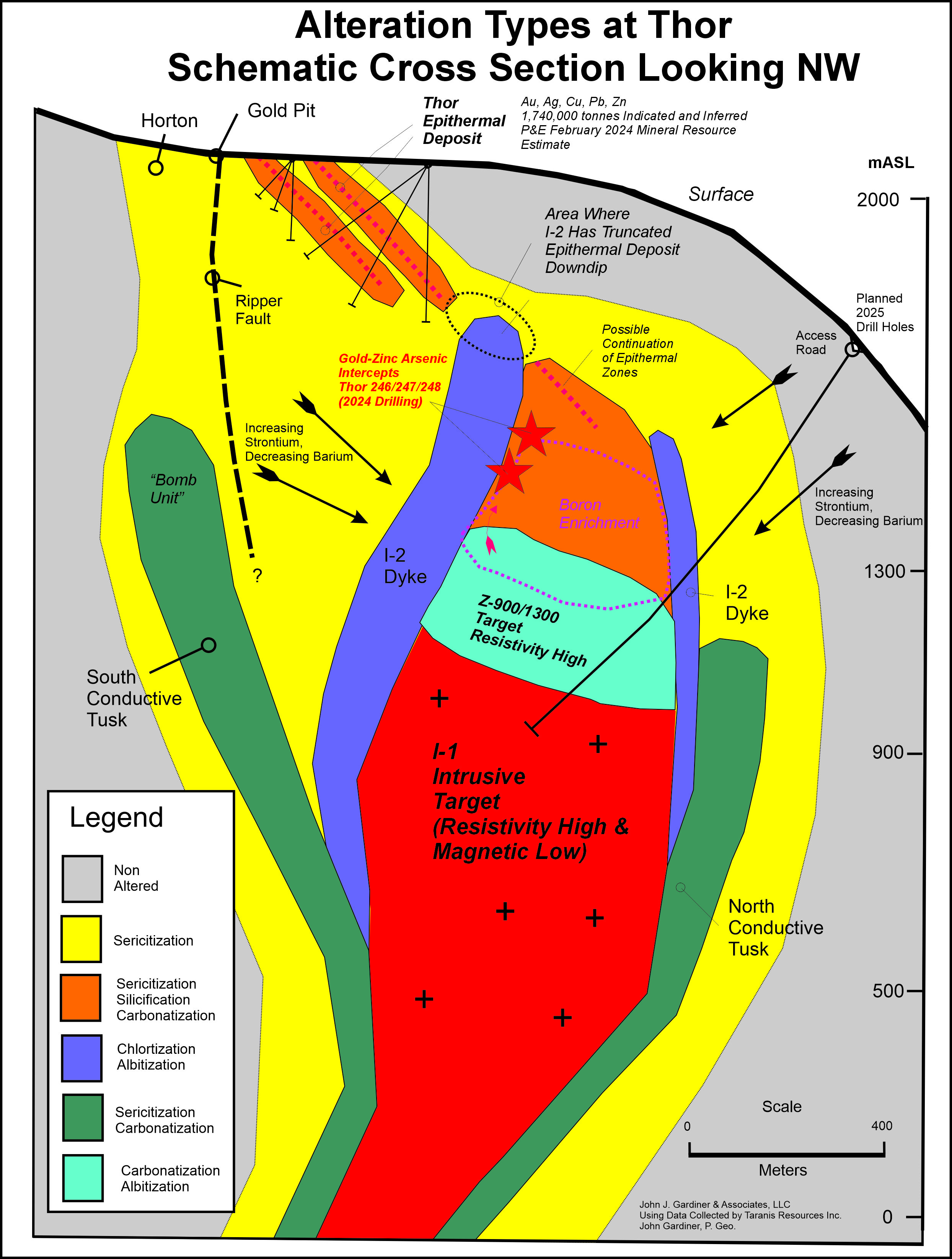
ESTES PARK, CO / ACCESS Newswire / March 11, 2025 / Taranis Resources Inc. ("Taranis" or the "Company") (TSX.V:TRO)(OTCQB:TNREF) is providing the third in a series of News Releases that detail exploration for a deep, underlying mineralized intrusive body at Thor. Taranis completed comprehensive geochemical studies of drill core using Gresens method. This method quantifies metasomatism (hydrothermal alteration) and the changes to the rock using immobile elements, typically rare earth elements. Intrusive bodies invoke widespread chemical changes in the host rocks that extend hundreds of meters around the intrusive body. As such, geochemical alteration studies are important guides to targeting a potentially mineralized intrusive body not exposed at surface. This News Release accompanies a schematic cross-section through the area that shows the alteration features in conjunction to the Z-900/1300 and I-1 geophysical targets.
Barren Host Rocks at Thor (Non-Altered)
Most of the host rocks at Thor are barren of mineralization, and consist of metagreywackes and metavolcaniclastics of regional greenschist metamorphic grade. These rocks were analyzed to establish baseline geochemistry for the rocks distal to the mineralized area at Thor. They contain on average:
Altered Host Rocks
Weak to Distal Alteration of Host Rocks (Sericitization) - Some of the effects of alteration in metasediments and metavolcaniclastics are the introduction of small amounts of cesium, tin, niobium and tantalum. P2O5 is also introduced into the rock where it is weakly altered. Na2O and CaO is depleted relative to the unaltered rocks, and this is indicative that these rocks have sericitic alteration. The weakly sericitized rocks contain small amounts of graphite (<
Intense Alteration of Host Rocks (Intense Sericitization) - Host rocks more proximal to the I-1 and Z-900/1300 Target are intensely altered and start to exhibit widespread introduction of low-levels of zinc and lead, P2O5 and niobium. Highly-altered rocks show depletion of Na2O and CaO. Many of the other trace metals such as arsenic, nickel, copper, barium and tungsten are depleted. These rocks contain <
Bomb Unit (Carbonatization, Sericitization) - This unit was evaluated with a deep drill hole (Thor-242) as it forms a major geophysical feature at Thor, and occurs at a depth of 500m below the surface. The Bomb Unit is suspected to be an alteration halo around a deep-seated intrusive (I-1). These rocks are intensely altered and contain pyritic clasts. Its most distinctive feature is the amount of graphitic carbon (average of
Intrusive and Contact-Related Rocks
I-2 "Dyke" Intrusive Rocks (Chloritization & Albitization) - These rocks included a series of units that are related to two linear magnetic highs that trend NNW across the property. The presence of magnetite makes this unit easily identifiable on magnetic surveys. This intrusive unit is zoned from intrusive breccia in the center, to albite-grossular-andradite, and finally into massive chlorite along the edges of the dyke. The core of the dyke is enriched in strontium, vanadium, chromium, niobium, zinc, nickel, cobalt and copper. I-2 is also enriched in P2O5, MgO, Na2O and Fe2O3, all diagnostic of the mafic composition of the unit. I-2does not contain any gold or arsenic (or metals contained in the Thor epithermal deposit), and it is very depleted in barium.
I-1 Intrusive Related Rocks (Carbonatization & Albitization) - The I-1 intrusive-related rocks are found below and east of the I-2 Intrusive in the bottom of drill holes Thor-246, 247 and 248. I-1 is anomalous in the same metals found in I-2, but is also enriched in carbonate (CaCO3), P2O5, CaO, MgO, Fe2O3 and Na2O. Most important, it has highly anomalous boron, gold, zinc, arsenic and tungsten.
Widescale Strontium and Barium Zonation
The alteration study of the deep drilling has shown that strontium occurs in elevated concentration around, and within the I-1 and I-2 intrusive rocks. Strontium has the most persistent and widescale alteration pattern found in the mass balance modeling. Strontium becomes more enriched with depth (getting closer to the concealed I-1 intrusive body) and an analogous situation is documented at the Lornex Copper Mine in British Columbia. Conversely, barium is very depleted within and around the I-1 and I-2 intrusive features, and this is consistent with what has been seen in other porphyry deposits in British Columbia (Valley Copper).
Comment
John Gardiner, President and CEO of Taranis comments "Thor is a different animal than other intrusive-hosted ore deposits in British Columbia because it is not hosted within volcanic rocks. The intrusive part is totally concealed, and the alteration system has restricted spatial extent due to the presence of non-porous metasedimentary/metavolcaniclastic rocks encasing the intrusive target. The rocks encountered in the 2024 drilling at Thor exposed four types of alteration including sericitization, chloritization, carbonatization and albitization. A fifth type of alteration (silicification accompanying sericitization) is widespread throughout the epithermal deposit. The presence of a circular resistive body (I-1) under the epithermal deposit that is interpreted to be an intrusive is consistent with the geochemical alteration patterns. Since I-2 has intruded and disrupted the epithermal deposit at Thor, it indicates I-1 was the important event that formed the epithermal deposit at Thor. The presence of garnet, albite, amphiboles and pyroxenes are indicative the host rocks have been exposed to contact-metamorphic alteration. Looking forward, we have some particularly good geochemical data that can be used in conjunction with the geophysical survey program plan for the summer of 2025. Most importantly, we have removed the land constraints around the eastern side of the Thor project area which will enable us to put this data to work to find the source of the Thor mineralization".
About Taranis and Thor
Taranis Resources is a Canadian mineral exploration company. The Thor Project is in southeast British Columbia. Taranis has completed upwards of 250 drill holes, linking all previously known mines into a single, near-surface epithermal deposit that has been recently updated into an NI 43-101 Mineral Resource Estimate (see Taranis News Release dated April 11, 2024). In the summer of 2024, Taranis initiated deep drilling aimed at finding the source of the 2 km long epithermal deposit.
Quality Control and Laboratory Methods
All samples for the Thor project were securely delivered to Actlabs in Kamloops, British Columbia. Analytical work was completed both at the Kamloops and Ancaster, Ontario locations. Actlabs is ISO 17025 accredited. Taranis completed two types of geochemical analysis on the drill core.
The first of these was for major oxide geochemistry and quantitative graphite and carbonate determinations. This sampling was completed systematically on drill holes to determine alteration of rock units. Major oxides and trace elements were determined by lithium metaborate/tetraborate fusion and analysis by Inductively Coupled Plasma ("ICP"), Optical Emission Spectrometry ("OES") and Mass Spectrometry ("MS"). Graphite and Carbonate determinations were made using Infrared ("IR") Spectrometry.
Secondly, visibly (or potentially mineralized sections of core) were systematically sampled after sawing the core in half onsite. Samples were analyzed for 42 elements by 4-Acid Digestion / Inductively Coupled Plasma - Mass Spectrometry ("ICP-MS") and for gold by 30g Fire Assay / Atomic Absorption Spectrophotometry ("AAS"). Where overlimit values were encountered in the analysis of these samples, ore-grade' determinations were made using subsequent ICP analysis and gravimetric methods. As a Quality Control ("QC") measure, Taranis also submitted analytical standards into the sample stream every tenth sample in addition to the laboratory's own quality control methods.
Qualified Person
Exploration activities at Thor were overseen by John Gardiner (P. Geo.), who is a Qualified Person under the meaning of Canadian National Instrument 43-101. John Gardiner is the principal of John J. Gardiner & Associates, LLC which operates in British Columbia under Firm Permit Number 1002256. Mr. Gardiner has reviewed and approved the comments contained within this News Release.
Taranis currently has 100,348,854 shares issued and outstanding (113,827,227 shares on a fully-diluted basis).
TARANIS RESOURCES INC.
Per: |
| John J. Gardiner (P. Geo.) |
|
| President and CEO |
For further information contact:
John J. Gardiner
681 Conifer Lane
Estes Park, Colorado 80517
Phone: (303) 716-5922
Cell: (720) 209-3049
johnjgardiner@earthlink.net
NEITHER THE TSX VENTURE EXCHANGE NOR ITS REGULATION SERVICES PROVIDER (AS THAT TERM IS DEFINED IN THE POLICIES OF THE TSX VENTURE EXCHANGE) ACCEPTS RESPONSIBILITY FOR THE ADEQUACY OR ACCURACY OF THIS NEWS RELEASE.
This News Release may contain forward looking statements based on assumptions and judgments of management regarding future events or results that may prove to be inaccurate as a result of factors beyond its control, and actual results may differ materially from expected results.
SOURCE: Taranis Resources, Inc.
View the original press release on ACCESS Newswire
FAQ
AI-generated questions and answers. How Rhea-AI works. Not financial advice.