
Volt Carbon Reports Second U.S. Patent and New High-Performance Lithium-Metal Battery Results
Volt Carbon (OTCQB: TORVF) announced a second U.S. patent (USPTO No. 12,491,538) to be issued on December 9, 2025, supporting its dry-separation air classification for graphite purification.
Sentiment and the balance of points
Rhea-AI Sentiment reads the wording of the document, how positive or negative its language is on a 1 to 5 scale. The balance of points shown with the takes weighs what the document actually discloses, so the two can disagree, for example when a trial that missed its main goal is described in upbeat language.
Rhea-AI Summary
Volt Carbon (OTCQB: TORVF) announced a second U.S. patent (USPTO No. 12,491,538) to be issued on December 9, 2025, supporting its dry-separation air classification for graphite purification. The company also reported new lithium-metal battery test results from its Guelph facility, including a single-layer pouch cell reaching 1600 cycles at 0.75C, a cathode loading projected to support ~340 Wh/kg with work toward 400 Wh/kg, and strong capacity retention at an extreme 10C discharge.
Volt Carbon released demonstrations for its air classifier and expandable graphite and disclosed low-temperature coin- and pouch-cell performance with operation down to -70°C in lab tests.
Positive
- USPTO patent No. 12,491,538 issued Dec 9, 2025
- 1600 cycles at 0.75C for a lithium-metal pouch cell
- Cathode loading projected to support ~340 Wh/kg (work toward 400 Wh/kg)
- Strong capacity retention at an extreme 10C discharge
- Stable low-temperature operation demonstrated down to -70°C
- Demonstration videos released for air classifier and expandable graphite
Negative
- Results are laboratory-scale; commercial-scale replication not demonstrated
- Energy-density figures are projected and not final validated product metrics
Details
News Market Reaction – TORVF
On Dec 3, the day this news came out, TORVF closed 0.35% below the previous close.
Data tracked by StockTitan Argus for the Dec 3 session.
Key Figures
- USPTO patent number
- 12,491,538
- Second U.S. patent issued on December 9, 2025
- Cycle life
- 1600 cycles
- Lithium-metal single layer pouch cell at 0.75C discharge
- Discharge rate
- 0.75C
- Long-duration cycling test for lithium-metal pouch cell
- Energy density target
- 340 Wh/kg
- Projected lithium-metal configuration for tested cathode loading
- Design goal
- 400 Wh/kg
- Parallel lithium-metal architecture under development
- High-rate discharge
- 10C
- Discharge rate showing strong capacity retention with low-temperature electrolyte
- Extreme cold testing
- -70°C
- Coin-cell operation for lithium-metal batteries in lab tests
- Cold comparison
- -20°C and -40°C
- Pouch cell benchmark versus commercial 21700 lithium-ion cell
Historical Context
-
Second U.S. patent issuance plus 1600-cycle lithium-metal battery results.
-
Second air classifier patent allowance, graphene oxide progress, and option grant.
-
Operations moved to Guelph with extensive trials and strong battery cycle data.
24h Move is the share-price change in the day after each event; other market factors may also have contributed.
Key Terms
lithium-metal battery technical
pouch cell technical
coin cells technical
graphite purification technical
expandable graphite technical
thermal runaway technical
lithium-ion technical
UAV technical
AI-generated analysis. How Rhea-AI works. Not financial advice.




Calgary, Alberta--(Newsfile Corp. - December 3, 2025) - Volt Carbon Technologies Inc. (TSXV: VCT) (OTCQB: TORVF) ("Volt Carbon" or the "Company") is pleased to confirm the issuance of a second United States patent supporting the Company's dry-separation graphite platform and reporting of new technical results from its lithium-metal battery development program. Recent work at the Company's Guelph facility includes long-duration cycling, high-rate discharge testing, and expanded low-temperature evaluations.

1. Second Patent Issued by the USPTO: "Method and System for Aerodynamic Air Classification."
Volt Carbon has received formal notification from the United States Patent and Trademark Office confirming that its patent allowance previously announced on October 2, 2025, will be issued as USPTO Patent Number 12491538 on December 9, 2025. This represents the Company's second issued patent for its air classification technology, further strengthening its intellectual property portfolio and supporting the aerodynamic separation method at the core of Volt Carbon's dry separation graphite purification technology. The Company has also released a new demonstration video showing the air classifier operating in real time. The video link is available on the Company's website. https://voltcarbontech.com/wp-content/uploads/2025/12/Air-Classifier.mp4.
2. Lithium Metal Results: High Cycle Life and High Discharge Capability
Volt Carbon has undertaken a series of evaluations across multiple li-metal loadings to determine the most effective configurations for both extended cycle life and high discharge performance. These studies form part of the Company's ongoing effort to refine its next generation lithium metal architecture.
Volt Carbon is pleased to report that its lithium metal battery has now achieved 1600 cycles at a 0.75C discharge rate, as illustrated in Figure 1. This long duration cycling result demonstrates stable behaviour over a significant number of cycles. The cathode loading used for this single layer pouch cell is projected to support a 340 Wh/kg lithium metal configuration with parallel testing underway to advance the company's 400 Wh/kg design. Cycle life determines real-world battery longevity. Maintaining stability for 1600 cycles indicates meaningful progress toward durable lithium-metal cells.
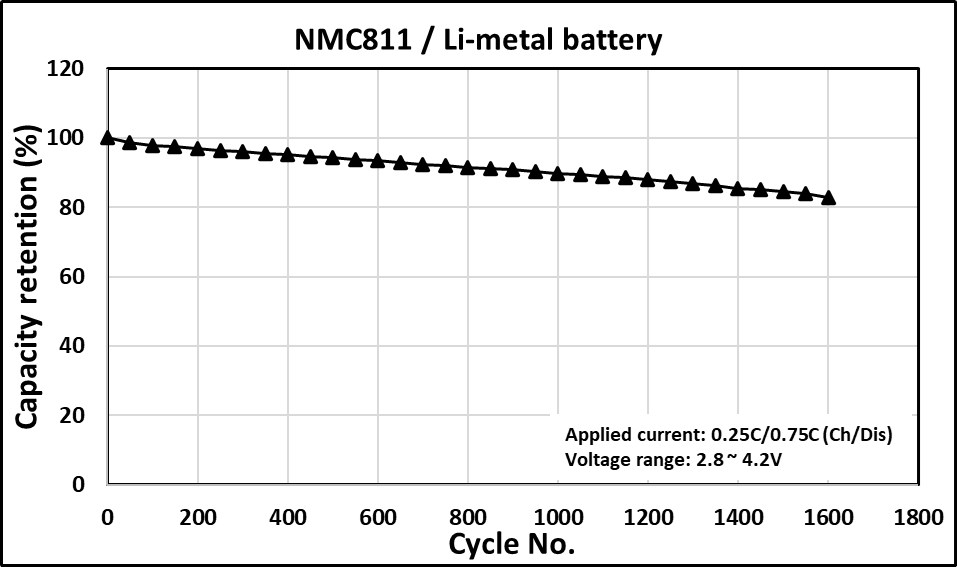
Figure 1: Capacity retention vs cycle life for a li-metal single layer pouch cell tested at 0.75C.
To view an enhanced version of this graphic, please visit:
https://images.newsfilecorp.com/files/9904/276749_4cae15612467aaa9_001full.jpg
As shown in Figure 2, cells tested at a 10C discharge rate using the Company's low temperature electrolyte formulation demonstrated strong capacity retention under high power demand. This result highlights the ability of the chemistry to deliver rapid discharge performance while maintaining stability. Together, these findings support ongoing refinement of Volt Carbon's lithium metal cell designs for applications requiring both high power capability and extended service life. 10C discharge is an extreme stress test. The retention shown below demonstrates the chemistry's ability to deliver rapid power without collapse.
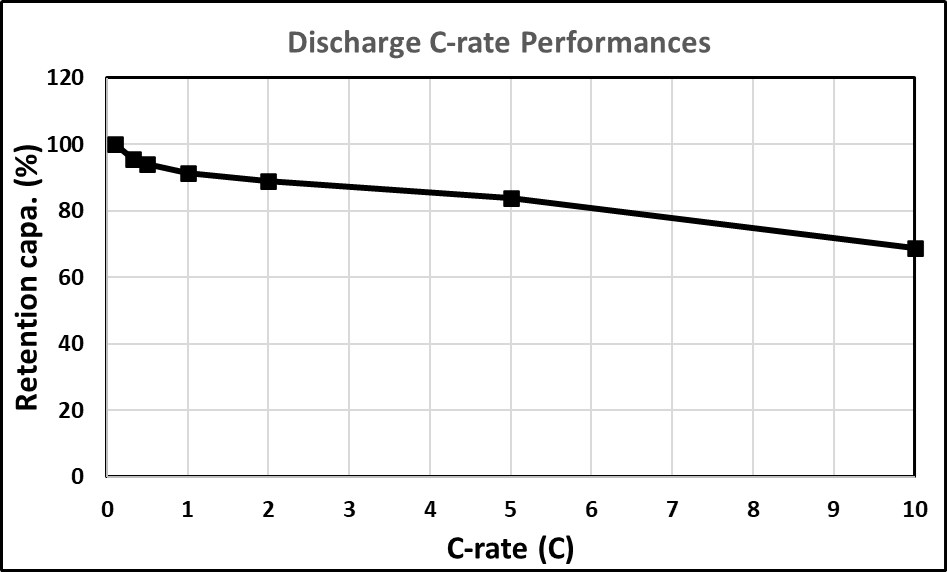
Figure 2: Capacity retention at a 10C discharge rate for li-metal cell.
To view an enhanced version of this graphic, please visit:
https://images.newsfilecorp.com/files/9904/276749_4cae15612467aaa9_002full.jpg
3. Li-Metal Battery Low Temperature Performance Update
Volt Carbon has completed a new series of cold-temperature evaluations on its lithium-metal coin cells at the Company's Guelph plant. As shown in Figure 3, the left panel presents the voltage profile of the updated 2025 cells during discharge at extreme sub-zero temperatures, demonstrating stable behaviour and strong operating characteristics under cold-load conditions; a region where conventional chemistries typically collapse.
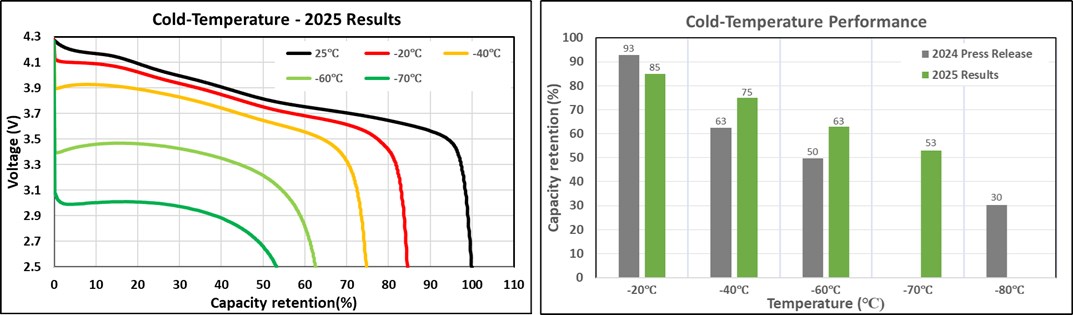
Figure 3: Capacity retention for Cell2025 vs Cell2024 at -40°C, -60°C, and -70°C.
To view an enhanced version of this graphic, please visit:
https://images.newsfilecorp.com/files/9904/276749_4cae15612467aaa9_003full.jpg
The right panel compares the 2025 results with the data disclosed in the Company's September 16, 2024, press release, showing clear gains at -40°C, -60°C, and -70°C, along with continued operation in temperature ranges where most lithium-ion architectures cease to function. Very few chemistries operate reliably below -40°C, and the combined panels highlight meaningful gains in extreme-cold stability, improved low-temperature discharge behaviour, and a clear advancement over the Company's previously reported performance.
In a separate evaluation using a different cell format, Volt Carbon also completed a comparative low-temperature test of its Solid UltraBattery pouch cell against a commercially available 21700 lithium-ion cell. As shown in Figure 4, the Solid UltraBattery pouch cell continues delivering usable performance at -20°C and -40°C, while the commercial 21700 cell shows a rapid decline at -20°C and complete failure at -40°C.
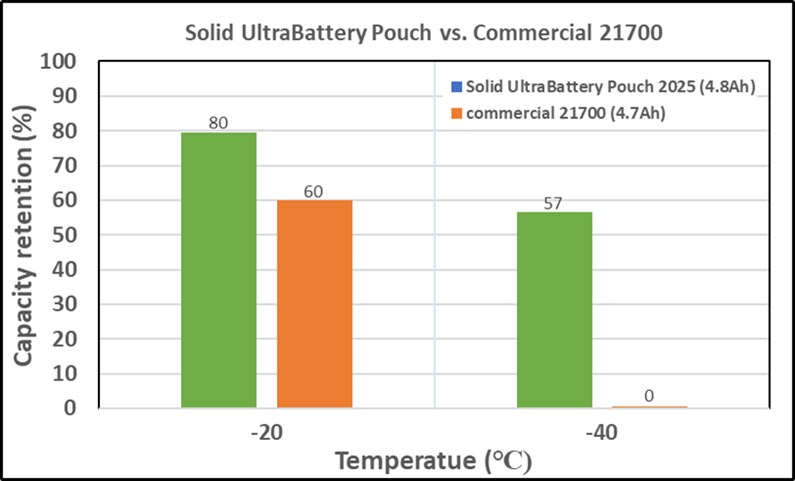
Figure 4: Benchmarking of Solid UltraBattery's Pouch Cell against Commercially Available Li-ion Cells.
To view an enhanced version of this graphic, please visit:
https://images.newsfilecorp.com/files/9904/276749_4cae15612467aaa9_004full.jpg
This pouch-cell benchmark illustrates the advantages of Volt Carbon's lithium-metal architecture in cold environments where conventional lithium-ion chemistries typically experience sharp performance loss. For aerospace, UAV systems, northern-climate EV platforms, and defense applications operating in deep-cold conditions, this separation in low-temperature capability is a differentiating engineering advantage.
4. Expandable Graphite Testing Video Release
Volt Carbon is releasing a new video demonstrating the behaviour of its dry separated expandable graphite under simulated battery thermal runaway conditions using high heat. The test illustrates the expansion characteristics of the material and highlights its potential suitability for applications in thermal management, fire protection, and other advanced carbon products where rapid heat exposure is a design consideration. The release of this video supports the Company's ongoing efforts to advance and scale its expandable graphite product line. Volt Carbon continues to evaluate material performance under multiple thermal conditions as part of its development and market readiness activities. A link to the video is available on the Company's website. https://voltcarbontech.com/wp-content/uploads/2025/12/2025-12-01-EG-Epoxy.mp4.
V-Bond Lee, President and Chief Executive Officer, stated: "Demonstrating strong retention at a 10C discharge rate is important for aerospace and UAV applications that require rapid power delivery. These performance levels are generally not seen together in lithium-metal systems, making the results important for engineering teams evaluating high-power or cold-weather platforms. Strengthening our IP portfolio alongside this technical progress remains an important part of our strategy."
Volt Carbon Technologies, headquartered in Calgary, is a publicly traded carbon science company focused on energy storage and green energy solutions. The company operates a lithium-ion battery plant and a graphite processing facility in Guelph Ontario. Volt Carbon also holds mining claims across Ontario, Quebec, and British Columbia, supporting its commitment to sustainable resource development. For the latest updates on Volt Carbon's projects and news, visit www.voltcarbontech.com.
On behalf of the Board of Directors,
Volt Carbon Technologies Inc.
V-Bond Lee, P. Eng.
CEO, President, Chairman of the Board and Director
Information Contact :
Email: info@voltcarbontech.com
Tel: (519-763-1197)
Neither TSX Venture Exchange nor its Regulation Services Provider (as that term is defined in the policies of the TSX Venture Exchange) accepts responsibility for the adequacy or accuracy of this release.
FORWARD-LOOKING STATEMENTS AND FUTURE ORIENTED FINANCIAL INFORMATION: This press release contains forward-looking statements and future oriented financial information, within the meaning of applicable securities legislation, concerning Volt Carbon's business and affairs. In certain cases, forward-looking statements or future oriented financial information can be identified by the use of words such as "plans", "expects" or "does not expect", "intends", "budget", "scheduled", "estimates", "forecasts", "anticipates" or variations of such words and phrases, or state that certain actions, events or results "may", "could", "would", "might" or "will be taken", "occur" or "be achieved". Such statements and information include, but are not limited to: (1) the expected benefits of the Company's second issued patent supporting Volt Carbon's dry-separation graphite purification platform; (2) the scalability, commercialization, and future deployment potential of the patented air classifier technology; (3) the anticipated processing, characterization, and use of graphite materials in ongoing development programs; (4) the advancement, testing, and performance targets of Volt Carbon's lithium-metal battery program, including cycle life, energy density, discharge-rate capability, and low-temperature results; (5) the expected outcomes of further lithium-metal pouch-cell optimization and related development activities; (6) the development and potential applications of materials derived from Volt Carbon's graphite processing operations; (7) the usefulness, performance, and reliability of newly added laboratory equipment and expanded testing capabilities; (8) the impact of granted patents, including U.S. Patent No. 12,491,538, on Volt Carbon's competitive positioning and commercialization efforts; (9) the Company's goal of further improving cycle life, discharge performance, and energy density in upcoming phases of lithium-metal development; and (10) the Company's intentions to advance next-generation lithium-metal cell chemistries and the potential demand for such products in aerospace, UAV, electric mobility, and cold-weather applications.
Statements of past performance should not be construed as an indication of future performance. Forward-looking statements and future oriented financial information involve significant risks, uncertainties, and assumptions, and should not be read as guarantees of future performance or results and will not necessarily be accurate indications of whether or not such results will be achieved. These assumptions and risks include, but are not limited to: the continued existence of the carbon credit program in Canada and future viability of same, regulatory and governmental changes, capital and operating costs varying significantly from estimates, the ability to replicate the results of the Study in a demonstrator unit and at a commercial production level, the ability to construct a demonstrator unit with reasonable construction and operating costs, the ability to construct units that can operate on a commercial scale, the data available at the time of the Study, the reliability of third-party sources, including the Study, the assumptions and limitations outlined in the Study, the preliminary in nature of the Study and the fact that estimates provided therein are subject to revisions in subsequent design phases or through more comprehensive assessments such as a Feasibility Study or Life Cycle Assessment. A number of factors, including those discussed above, could cause actual results to differ materially from the results discussed in the forward-looking statements. Any and all such forward-looking statements or future oriented financial information in this press release are expressly qualified in their entirety by these cautionary statements. Readers are cautioned not to place undue reliance on such forward-looking statements and future oriented financial information. Forward-looking information and future oriented financial information are provided as of the date of this press release, and Volt Carbon assumes no obligation to update or revise them to reflect new events or circumstances, except as may be required under applicable securities legislation.

To view the source version of this press release, please visit https://www.newsfilecorp.com/release/276749
FAQ
AI-generated questions and answers. How Rhea-AI works. Not financial advice.