
Bullion Gold Intersects 1.73 g/t Au Over 13.4 Metres Including 3.80 g/t Au Over 4.4 Metres in DDH TG-04 at Terragold
The two-hole results include gold, silver and molybdenum mineralization, while assays for 26 additional holes remain pending.
Sentiment and the balance of points
Rhea-AI Sentiment reads the wording of the document, how positive or negative its language is on a 1 to 5 scale. The balance of points shown with the takes weighs what the document actually discloses, so the two can disagree, for example when a trial that missed its main goal is described in upbeat language.
Rhea-AI Summary
Bullion Gold Discoveries (TTEXF) reported gold assays of 1.73 grams per tonne over 13.4 metres in hole TG-04 at Terragold.
Results cover two holes from the validation drilling campaign at the company's 100%-owned Quebec property. TG-04 intersected 0.60 grams of gold per tonne over 53.6 metres, including 3.80 grams per tonne over 4.4 metres within the highlighted interval. A nested 0.3-metre interval contained 22.00 grams of gold per tonne, 38.60 grams of silver per tonne and 257 parts per million molybdenum. TG-03 returned 0.68 grams of gold per tonne over 7.5 metres, including 3.68 grams per tonne over 0.8 metres. Reported lengths are drill-core lengths; true thicknesses remain unknown.
Bullion interprets the gold-silver-molybdenum association as evidence of an intrusion-related gold system. Assays for 26 remaining holes are pending, with disclosure planned over the coming weeks.
Positive
- Minor pointTG-04 returned 0.60 g/t gold over 53.6 metres, including 0.97 over 27.5 metres and 1.73 over 13.4 metres.
- Minor pointTG-04's nested intervals included 3.80 g/t gold over 4.4 metres and 22.00 g/t over 0.3 metres.
- Minor pointTG-04's 0.3-metre interval also contained 38.60 g/t silver and 257 ppm molybdenum.
- Minor pointTG-03 returned 0.68 g/t gold over 7.5 metres, including 0.92 over 4.9 metres and 3.68 over 0.8 metres.
- Minor pointTG-03's separate interval returned 0.45 g/t gold over 7.0 metres.
2 minor points
- Minor pointSheared basalt in TG-04 included 3.78 g/t gold and 16.70 g/t silver over 0.5 metres.
- Minor pointTG-03, 38 metres north of TG-04, showed lateral continuity of sheared structures and pyritized horizons.
Negative
- Minor point. Forward-looking: it has not happened yet and may not happen.26 drill holes remain awaiting assays; Bullion plans rolling disclosure over the upcoming weeks.
AI-generated analysis. How Rhea-AI works. Not financial advice.




Montreal, Quebec--(Newsfile Corp. - October 7, 2026) - Bullion Gold Discoveries Corp. (TSXV: BGD) ("Bullion" or the "Company") is pleased to announce the assay results of two (2) diamond drill holes ("DDH") of its validation drilling campaign at its
Click LINK to view the Terragold 2026 validation campaign 3D geological model.
DDH Assay Results Highlights:
- 1.73 g/t Au over 13.4 m, including 3.80 g/t Au over 4.4 m, including 22.00 g/t Au over 0.3 m (TG-04)
- High-grade interval of 22.00 g/t Au, 38.60 g/t Ag and 257 ppm Mo over 0.3 m (TG-04)
- Geochemical signature characterized by a correlation of gold (Au) with silver (Ag) and molybdenum (Mo)
- Silver (Ag) to gold (Au) ratio between 1:1 and 1.5:1 in mineralized zones
- 26 DDH still pending assays
Table 1: DDH Assay Results
| DDH | From (m) | To (m) | Width1 (m) | Au (g/t) | Ag (g/t) | Mo (ppm) | Zone |
| TG-03 | 33.7 | 40.7 | 7.0 | 0.45 | 0.33 | 19 | JJ Zone |
| 53.0 | 60.5 | 7.5 | 0.68 | 0.62 | 4 | ||
| including 54.0 | 58.9 | 4.9 | 0.92 | 0.72 | 4 | ||
| including 55.5 | 56.3 | 0.8 | 3.68 | 3.00 | 17 | ||
| TG-04 | 70.4 | 124.0 | 53.6 | 0.60 | 0.93 | 17 | JJ Zone |
| including 85.0 | 112.5 | 27.5 | 0.97 | 1.46 | 26 | ||
| including 89.0 | 102.4 | 13.4 | 1.73 | 2.64 | 48 | ||
| including 91.0 | 95.4 | 4.4 | 3.80 | 4.91 | 138 | ||
| including 95.1 | 95.4 | 0.3 | 22.00 | 38.60 | 257 |
1. The reported widths correspond to core lengths. At this stage of the program, true thicknesses remain unknown.
Simon Britt, president and CEO of Bullion, commented: "Multi-element assay results reveal a distinctive geochemical signature in which gold (Au) is correlated with silver (Ag) and molybdenum (Mo). The marked molybdenum enrichment (reaching up to 257 ppm in DDH TG-04 high-grade interval of 22.00 g/t Au and 38.60 g/t Ag over 0.3 m) suggests the mineralizing fluids were high-temperature and magmatic in origin. This intrusion-related gold signature confirms that the Uniacke deformation corridor, a deeply rooted Archean-age structural corridor of the Abitibi Greenstone Belt, hosts a mineralized system at depth. Evaluating the full geochemical signature of the mineralized system was one of three main goals of the validation campaign. Our understanding is growing with every new DDH assayed. Assay results of the remaining 26 DDH will be disclosed on a rolling basis in the upcoming weeks."
Figure 1: Plan View of Terragold DDH
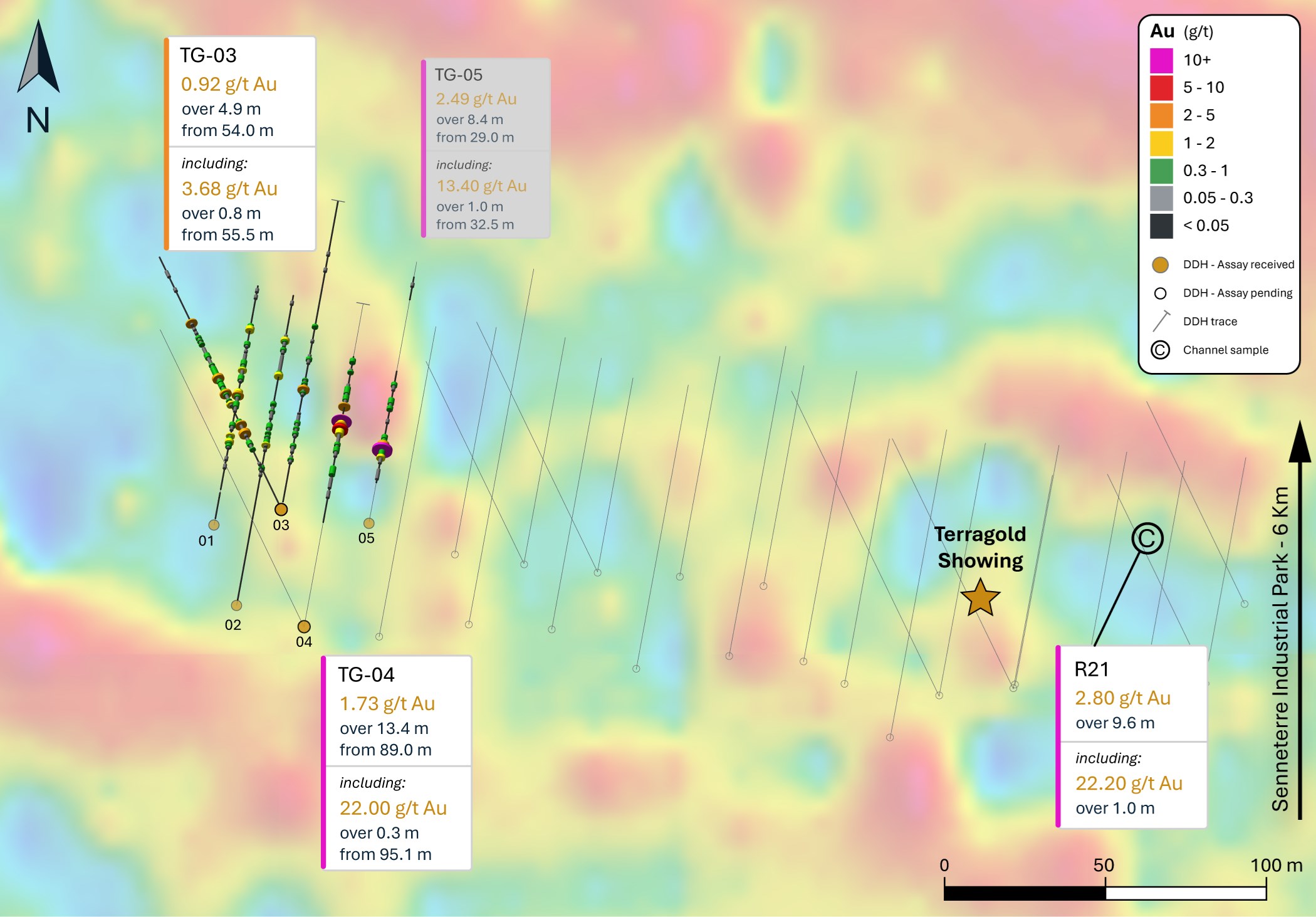
To view an enhanced version of this graphic, please visit:
https://images.newsfilecorp.com/files/10471/317851_3982d5a2b4a68830_002full.jpg
Table 2: DDH Collars
| DDH | Azimuth ° | Dip ° | Length (m) | UTM - East | UTM - North | Elevation (m) |
| TG-03 | 10 | -45 | 144 | 335825 | 5351755 | +320 |
| TG-04 | 10 | -45 | 150 | 335832 | 5351717 | +321 |
Geological Setting, Alteration, and Mineralization Model
1. Significance of the Au-Ag-Mo Signature:
Molybdenum (Mo) as a magmatic tracer: Molybdenum is a tracer of high-temperature magmatic-hydrothermal fluids associated with felsic intrusions (QFP dykes). Its correlation with gold in DDH TG-04 (peak of 257 ppm Mo with 22.00 g/t Au and 38.60 g/t Ag over 0.3 m) indicates an affiliation with an intrusion-related gold system (IRGS). The felsic intrusion played a role in the hydrothermal supply of the system.
Silver (Ag) and association with gold: The direct correlation between gold and silver (silver-to-gold ratio between 1:1 and 1.5:1) indicates that gold is likely present as electrum or associated with silver sulfosalts in quartz veinlets.
2. Structural Control and Lithological Trap:
Results from DDH TG-04 refine the metallogenic model of the Terragold project. Gold mineralization displays a magmatic-hydrothermal affinity linked to a competency (rheology) contrast within the Uniacke deformation corridor.
The system is located within a network of felsic intrusions (QFP dykes) injected into an andesitic basalt sequence. During regional deformation, the basalts responded in a ductile manner (shear zones/mylonitization), whereas the more rigid QFP dykes responded in a brittle manner. This fracturing created open-space volume serving as a structural trap (stockwork) for the precipitation of hydrothermal fluids, corresponding to the 53.6 m mineralized envelope.
3. Alteration Zoning and Mineralization
The hydrothermal system displays defined zonation:
QFP Intrusions (79.0 m to 95.4 m): Major QFP dyke with a drilled length of 16.4 m (
15% to25% plagioclase phenocrysts and quartz eyes). Alteration includes silicification and moderate to strong sericitization with5% to15% quartz-carbonate veinlets. Mineralization consists of1% to3% fine- to medium-grained pyrite, disseminated and along veinlet selvages.Sheared Basalts (97.5 m to 102.4 m): Beneath the QFP intrusion, the sheared basalt displays chlorite, carbonate, and fuchsite (chromium-bearing mica) alteration. This interval carries
1% to2% pyrite as bands (including 0.5 m at 3.78 g/t Au and 16.70 g/t Ag).
In DDH TG-04, mineralization is primarily hosted within a QFP intrusion showing silica-sericite alteration (from 79.0 m to 95.4 m), with sulphides disseminated and concentrated along vein selvages (
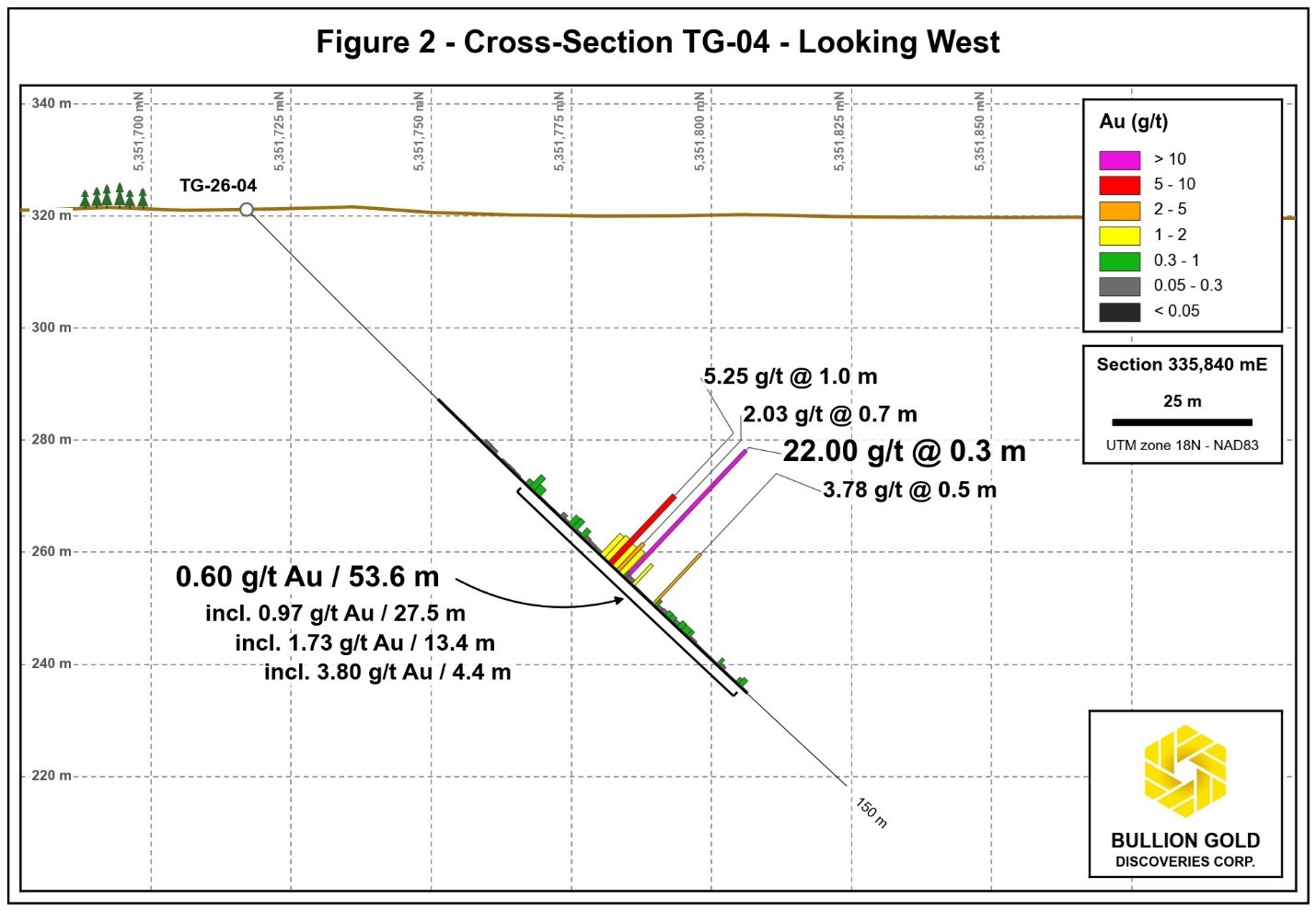
To view an enhanced version of this graphic, please visit:
https://images.newsfilecorp.com/files/10471/317851_3982d5a2b4a68830_003full.jpg
DDH TG-03, located 38 m north of DDH TG-04, shows the lateral continuity of sheared structures and pyritized horizons associated with thin secondary felsic dykes, intersecting 7.5 m at 0.68 g/t Au (including 4.9 m at 0.92 g/t Au and 0.8 m at 3.68 g/t Au).
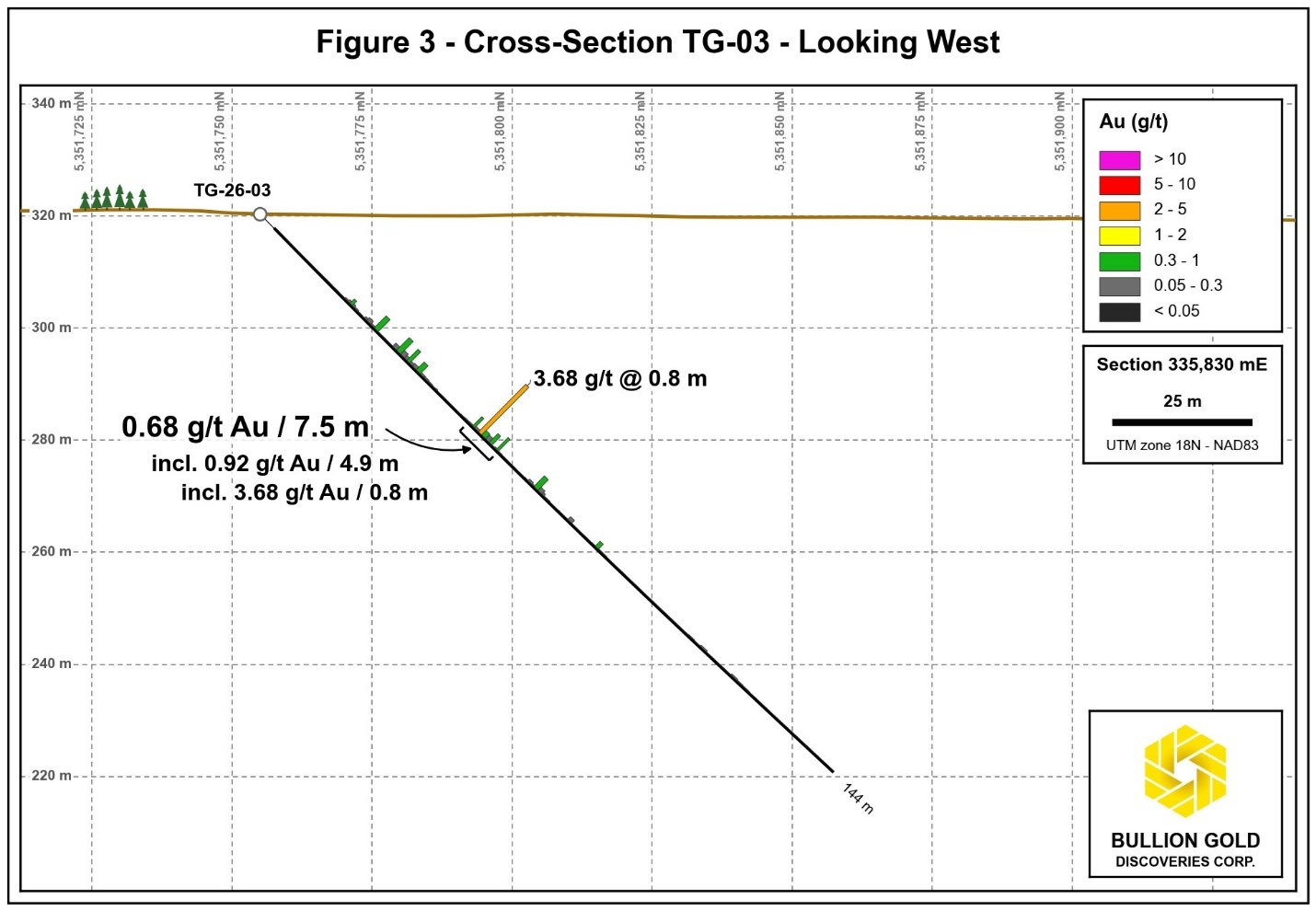
To view an enhanced version of this graphic, please visit:
https://images.newsfilecorp.com/files/10471/317851_3982d5a2b4a68830_004full.jpg
About the Terragold Project
The Terragold project (38 claims - 2,058 ha) is located approximately 12 km south of the municipality of Senneterre in Abitibi (Québec, Canada) within a major, deeply rooted Archean-age structural corridor of the prolific Abitibi Greenstone Belt. The Terragold showing, discovered in the early 1960s, has been intersected by drilling over a strike length exceeding 2 kilometres and to a depth of approximately 250 metres and has seen very limited exploration activity since 1984. The gold mineralized corridor, associated with a quartz-feldspar porphyry system, remains open in all directions. The potential of the system is supported by a historical 245 kg bulk sample grading 4.84 g/t Au, confirming the presence of gold mineralization at surface.
Technical Disclosure
The drilling program was managed by Explo-Logik of Val-d'Or, Québec. Core samples were split in half, and one half was sent for analysis to AGAT Laboratories in Val-d'Or, Québec, an independent commercial laboratory certified under ISO/IEC 17025 standards. Sample preparation includes crushing to
Qualified Person
The scientific and technical information disclosed in this news release has been reviewed and approved by Ms. Suzie Tremblay, a member in good standing of the Ordre des géologues du Québec (OGQ No. 10664), who is a "Qualified Person" within the meaning of National Instrument 43-101 - Standards of Disclosure for Mineral Projects. All geoscientific activities related to the Terragold Project are carried out under the supervision of Ms. Suzie Tremblay, Vice-President of Explo-Logik.
About Bullion Gold Discoveries Corp.
Bullion Gold Discoveries Corp. (TSXV: BGD) is a Québec-focused mineral exploration company advancing a portfolio of gold and polymetallic projects located in some of the province's most prospective mining districts. The Company's strategy is centered on creating shareholder value through discovery success by applying modern geological interpretation, disciplined exploration practices and strategic partnerships.
The Company holds a
Additional information is available on the Company's website bulliongold.ca.
For further information, please contact:
Simon Britt
President and CEO
Bullion Gold Discoveries Corp.
sbritt@bulliongold.ca
Cautionary Note Regarding Forward-Looking Statements
This news release includes certain information and statements that may constitute "forward-looking information". Forward-looking statements are statements that are not historical facts and are generally, but not always, identified by the use of words such as "plans", "expects", "is expected", "budget", "scheduled", "estimates", "continues", "forecasts", "projects", "predicts", "intends", "anticipates", "aims", "targets" or "believes", or variations of, or the negatives of, such words and phrases or state that certain actions, events or results "may", "could", "would", "should", "might" or "will" be taken, occur or be achieved. Inherent in forward-looking statements are risks, uncertainties and other factors beyond the Company's ability to predict or control. All statements, other than statements of historical facts, included in this news release that address future events, developments or performance that Bullion expects to occur are forward-looking statements.
Neither TSX Venture Exchange nor its Regulation Services Provider (as that term is defined in the policies of the TSX Venture Exchange) accepts responsibility for the adequacy or accuracy of this release.

To view the source version of this press release, please visit https://www.newsfilecorp.com/release/317851
FAQ
AI-generated questions and answers. How Rhea-AI works. Not financial advice.
What gold grades did Bullion Gold report in Terragold hole TG-04?
TG-04 returned 1.73 g/t gold over 13.4 metres, within a broader interval of 0.60 g/t over 53.6 metres. Nested intervals included 3.80 g/t over 4.4 metres and 22.00 g/t over 0.3 metres. These measurements are drill-core lengths, not established true thicknesses.
When will Bullion Gold release the remaining Terragold drilling results?
Bullion plans to disclose assays for the remaining 26 drill holes on a rolling basis over the upcoming weeks. Those assays are still pending.
What does Bullion Gold's Terragold gold-silver-molybdenum association suggest?
Bullion interprets the association as indicating an intrusion-related gold system, with molybdenum suggesting high-temperature fluids of magmatic origin. The geological model links mineralization to fractures in felsic intrusions within the Uniacke deformation corridor.