LONDON--(BUSINESS WIRE)--
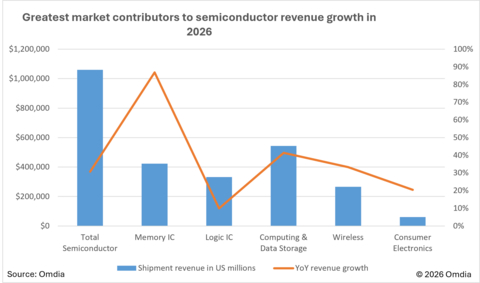
Global semiconductor revenues will exceed $1tn in 2026, marking a historic milestone for the industry, according to Omdia’s latest market analysis. This growth is being driven by the rapid surge in memory and logic IC revenues, generated by massive demand from AI market. The semiconductor revenue forecast for 2025 increased significantly to 20.3% year-over-year (YoY), reflecting stronger-than-anticipated 3Q25 results, and robust growth expected in 4Q25. Revenue growth in DRAM and NAND memory ICs will remain unprecedented, supported by strong expansion in Logic ICs, bringing the 2026 market forecast to 30.7% YoY.
Greatest market contributors to semiconductor revenue growth in 2026
Computing & Data Storage will lead all segments in semiconductor revenue growth rising 41.4% YoY in 2026 to exceed $500bn, due to high demand in data center servers and other memory–intensive applications, as well as higher memory IC pricing. Notebook PC growth is being fueled by AI-capable adoption and a large-scale enterprise refresh cycle. Collectively, the top four hyperscalers are expected to spend approximately $500bn on capital expenditures this year, with further growth expected. Capital spending is being reallocated toward AI infrastructure, model development, and emerging applications, highlighting the transformative impact of AI across sectors.
Consumer electronics and wireless applications also present a strong outlook for semiconductor revenue growth in 2026. Contributing factors include inflated memory pricing, the launch of next-generation foldable smartphones, and renewed strength in connected consumer devices. Upgrades in AI photography and flagship smartphone refreshes from Apple, Samsung, and other manufacturers will further support growth. Wearables, smart speakers, and virtual reality (VR) headsets are also projected to see meaningful revenue gains.
Looking Ahead
“Semiconductor revenue growth in 2026 is being driven by highly concentrated, AI-related demand, rather than broad-based consumer behavior or industrial production trends that have historically influenced the market. Without the contributions of memory and logic ICs, overall semiconductor revenue growth would fall from 30.7% to only 8%, highlighting the nature of the demand driving recent market surges,” said Myson Robles-Bruce, Senior Principal Analyst at Omdia.
To provide a balanced forecast, Omdia has identified several macroeconomic risk factors that could temper growth in 2026. While inflation in China and the Eurozone remains largely under control, it continues to be a concern in the US. Additional challenges this year are expected to include rising labor and energy costs, supply chain disruptions from reorganization and governmental policies, and shortages or price volatility resulting from large-scale AI-related investments.
ABOUT OMDIA
Omdia, part of Informa TechTarget, Inc. (Nasdaq: TTGT), is a leading technology research and advisory group. With deep expertise in technology markets, grounded in insightful conversations with industry leaders and supported by hundreds of thousands of data points, Omdia's strategic market intelligence is our clients' competitive advantage. From R&D to ROI, we identify the most promising opportunities to drive the industry forward.
A dram is a small, traditional unit used to measure either mass or liquid volume in manufacturing and pharmaceuticals — roughly 1.77 grams for a weight dram or about 3.7 milliliters for a fluid dram, similar to a small teaspoon or a couple of drops. Investors care because dram-based measurements affect drug dosing, packaging sizes, labeling compliance and raw-material usage, which in turn influence production costs, inventory counts and regulatory risk.
nandtechnical
NAND is a type of non-volatile memory used to store data in electronic devices such as phones, SSDs, and tablets; it keeps information even when power is off. Think of it as a digital filing cabinet made of tiny cells where data is written, erased and rewritten. Investors watch NAND because its supply, demand and manufacturing costs drive prices, company revenues and profit margins across the semiconductor and consumer electronics industries.
hyperscalerstechnical
Hyperscalers are large technology companies that operate massive computing networks and data centers to provide cloud services, data storage, and online infrastructure at an enormous scale. They are essential to the digital economy because they enable businesses and organizations to handle vast amounts of data and run complex applications efficiently. For investors, hyperscalers represent powerful engines of growth and innovation in the technology sector.
capital expendituresfinancial
Capital expenditures are the money a company spends to buy or improve big assets like buildings, equipment, or machines that will last a long time. These investments matter because they help the company grow and operate more efficiently, similar to how upgrading a home’s appliances or adding a new room can make it better and more valuable.
A supply chain is the series of steps involved in producing and delivering a product or service, from raw materials to the final customer. It includes all the processes, such as sourcing materials, manufacturing, and distribution, that ensure products reach consumers. For investors, understanding the supply chain helps gauge how efficiently a company can meet demand and manage costs, impacting its profitability and stability.
Virtual reality (VR) is a technology that creates a simulated environment, allowing users to experience and interact with a three-dimensional world through specialized headsets or devices. For investors, VR represents a rapidly growing industry with potential applications in entertainment, training, and communication, which could influence the development of new markets and business opportunities.