Omdia: Global PC Shipments Grew 3% in 1Q26 as Supply Chain Impacts Emerged
Omdia: Global PC Shipments Grew 3% in 1Q26 as Supply Chain Impacts Emerged
Omdia reports global PC shipments rose 3.2% YoY in 1Q26 to 64.8 million units, with notebooks at 50.8M and desktops at 14.0M. Cost pressures—memory, storage and CPU—are expected to increase from Q2, prompting vendors and channels to pull orders forward.
Rhea-AI Sentiment reads the wording of the document, how positive or negative its language is on a 1 to 5 scale. The balance of points shown with the takes weighs what the document actually discloses, so the two can disagree, for example when a trial that missed its main goal is described in upbeat language.
LONDON--(BUSINESS WIRE)--
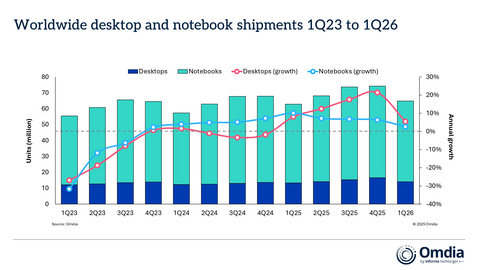
According to the latest research from Omdia, total shipments of desktops, notebooks, and workstations in 1Q26 increased by 3.2% year-over-year to 64.8 million units. Notebooks (including mobile workstations) saw a modest year-over-year increase of 2.6% in Q1 to 50.8 million units. Meanwhile, desktops (including desktop workstations) performed slightly better, up 5.4% to 14.0 million units. Growth was supported by vendors and channel partners pulling orders forward ahead of a widely anticipated increase in component costs, the continuation of the Windows 10 replacement cycle that is still driving commercial refresh budgets, and by a heavier than usual slate of spring product launches across both Windows OEMs and Apple.
Worldwide desktop and notebook shipments, 1Q23 to 1Q26
“With supply-chain pressures still building, Q1’s modest growth is likely to mark the high point for the year,” said Ben Yeh, Principal Analyst at Omdia. “Memory and storage costs are expected to rise further and more steeply than previously assumed from Q2, squeezing PC vendor gross margins and forcing them to pass costs through to channel partners and end-customers. AI data center build-outs are crowding consumer categories out of memory and storage supply, which have already seen roughly five-fold and three-fold cost increases respectively since Q1 2025. CPU prices are a smaller but compounding pressure, with Intel and AMD projecting increases of 10-25% into Q2.”
With costs set to rise across the bill of materials, vendors have every incentive to protect shipments, revenue and gross margin by pulling deliveries forward, and Omdia’s regional analysis is consistent with that behavior across most of Q1. Preliminary regional data suggest that channel partners in North America have already absorbed as much as they can before end‑user prices rise. In Japan, the market has begun to show a more pronounced downturn, weighed down by the high shipment volume base in 1Q25 and by more severe cost and component supply pressures in the education segment. Given the education-driven surge throughout 2025, fading policy momentum could also become one of the main drivers of contraction in 2026.
Worldwide desktop and notebook shipments (market share and annual growth)
Omdia PC Market Pulse: 1Q26
Vendor
1Q26
shipments
1Q26
market share
1Q25
shipments
1Q25
market share
Annual
growth
Lenovo
16,529
25.5%
15,205
24.2%
8.7%
HP
12,142
18.7%
12,761
20.3%
-4.9%
Dell
10,291
15.9%
9,548
15.2%
7.8%
Apple
7,112
11.0%
6,750
10.7%
5.4%
Asus
4,622
7.1%
4,014
6.4%
15.1%
Others
14,149
21.8%
14,570
23.2%
-2.9%
Total
64,844
100.0%
62,848
100.0%
3.2%
Note: Unit shipments in thousands. Percentages may not add up to 100% due to rounding.
Source: Omdia PC Horizon Service (sell-in shipments),
April 2026
Lenovo remained firmly in the top spot in 1Q26, further expanding its market share with year-over-year growth of 8.7%. Shipments reached 16.5 million units, and its share surpassed 25%. HP remained in second place, but weak performance in Europe and the United States resulted in a 4.9% decline, with shipments falling to 12.1 million units. Dell continued its strong momentum from 4Q25, posting 7.8% year-over-year growth as shipments reached 10.3 million units. Apple reached a market share of 11% with shipments growing 5.4% due to solid MacBook Air sales performance and the initial sell-in of the MacBook Neo. Asus maintained its double-digit shipment growth, with shipments climbing to 4.6 million units and market share reaching 7.1%.
ABOUT OMDIA
Omdia, part of TechTarget, Inc. d/b/a Informa TechTarget (Nasdaq: TTGT), is a technology research and advisory group. Our deep knowledge of tech markets grounded in real conversations with industry leaders and hundreds of thousands of data points, make our market intelligence our clients’ strategic advantage. From R&D to ROI, we identify the greatest opportunities and move the industry forward.
An AI data center is a specialized facility that houses powerful computers, networking gear, and cooling systems designed specifically to run and store artificial intelligence workloads, like training large models and serving real-time AI applications. Investors care because these centers are capital-intensive infrastructure that enable companies to offer advanced AI services, drive recurring revenue, and create competitive advantages, much like a factory that determines how quickly and cheaply a business can produce its product.
gross marginsfinancial
Gross margins measure the portion of sales a company keeps after paying the direct costs to make its products or deliver services, expressed as a percentage of revenue. Think of it as the money left from each sale after paying the ingredients — it signals how efficiently a business produces and prices goods, and matters to investors because higher margins generally mean more room to cover other expenses, invest, and generate profit.
bill of materialsfinancial
A bill of materials is a detailed checklist that lists every part, raw material and subassembly needed to build a product, like a recipe listing ingredients and quantities for a dish. Investors use it to gauge how much it costs and how complex production is, because the items and quantities affect profit margins, supply‑chain risks and the company’s ability to scale or meet demand.
sell-in shipmentstechnical
Sell-in shipments are the products a manufacturer or supplier sends to distributors, wholesalers or retailers during a reporting period; they count as sales to the channel but not yet as purchases by end customers. Investors watch sell-in because it shows how much stock is moving into the sales pipeline—like a factory delivering boxes to stores—which can signal future revenue growth but may overstate demand if retailers are simply building up inventory rather than selling to consumers.