
Stateline Project - Metallurgical collaboration and Targeting Work Advancing
Sentiment and the balance of points
Rhea-AI Sentiment reads the wording of the document, how positive or negative its language is on a 1 to 5 scale. The balance of points shown with the takes weighs what the document actually discloses, so the two can disagree, for example when a trial that missed its main goal is described in upbeat language.
Rhea-AI Summary
Uranium American Resources (OTC: UARI) reports progress at the Stateline uranium-vanadium project: >60 historic drillholes digitized showing >3,000 ppm U3O8, mapping of a 700 ppm U3O8 cut-off envelope defining multiple mineralised trends, and historic assays up to 0.45% U3O8 and 3.45% V2O5. UAR authorised sub-meter GPS collar surveys, integration of depth/thickness data, and GIS 3-D targeting ahead of a March field program. UAR entered a non-binding collaboration with DISA Technologies for bench-scale metallurgical testing and non-invasive site surveys at no cost to UAR; results will be reported when available.
Positive
- >60 historic drillholes digitised reporting >3,000 ppm U3O8
- Historic assays up to 0.45% U3O8 and 3.45% V2O5
- 2024 rock sampling returned >1% uranium and >1% vanadium assays
- DISA to perform bench-scale metallurgical tests and site surveys at no cost
Negative
- Collar coordinate accuracy in high-grade cluster is uncertain and requires verification
- DISA collaboration is non-binding and not a committed processing agreement
Details
News Market Reaction – UARI
On Dec 8, the day this news came out, UARI closed 1.16% above the previous close.
Data tracked by StockTitan Argus for the Dec 8 session.
Key Figures
- Historic drillholes >3,000 ppm U3O8
- More than 60 drillholes
- Stateline historic drilling database
- Cut-off envelope
- 700 ppm U3O8
- Initial targeting maps at Stateline
- Historic uranium grade
- Up to 0.45% U3O8
- Northwest target zone historic assays
- Historic vanadium grade
- Up to 3.45% V2O5
- Northwest target zone historic assays
- 2024 rock chip assays
- Above 1% uranium and 1% vanadium
- Stateline 2024 sampling campaign
- Scintillometer readings
- Up to 45,200 cps
- Zones of anomalous response at Stateline
- Project area
- 2.75 square miles
- Stateline project footprint (historical update)
- Historic mines
- Over 19 historic mines
- La Sal District operations within Stateline area
Historical Context
-
Stateline targeting progress and DISA metallurgical collaboration at no cost to UAR.
-
CEO presentation at Emerging Growth Conference with live webcast and Q&A.
-
Technical update on high-grade Stateline U-V targets and historic mine grades.
24h Move is the share-price change in the day after each event; other market factors may also have contributed.
Key Terms
u3o8 medical
v2o5 medical
carnotite medical
scintillometer technical
radiological medical
bench-scale technical
nrc license regulatory
AI-generated analysis. How Rhea-AI works. Not financial advice.




HIGHLIGHTS
More than 60 historic drillholes digitised to date record >3,000 ppm U₃O₈, confirming the district's strong uranium-vanadium signature.
Mapping of a 700 ppm U₃O₈ cut-off envelope underway, defining multiple coherent mineralised trends.
A distinct northwest target zone (Dakota/Burro Canyon) identified, with historic assays up to
0.45% U₃O₈ and3.45% V₂O₅.UAR enters a collaboration with DISA Technologies to undertake bench-scale metallurgical test work and site surveys at no cost to UAR.
WOODLAND HILLS, CALIFORNIA / ACCESS Newswire / December 8, 2025 / Uranium American Resources, Inc. (OTC:UARI) is pleased to provide an update on work underway at the Stateline Uranium-Vanadium Project, located in the La Sal Creek mining district.
Following a comprehensive data-recovery trip to Denver, the Company has digitized a substantial volume of historic drilling, including assay sheets, drill logs, maps and geological plates. Early outcomes confirm more than 60 historic drillholes report uranium grades above 3,000 ppm, supporting the robust mineralization historically mined in the district.
Interpretation is progressing, with initial 700 ppm U₃O₈ cut-off maps outlining multiple mineralized trends across the north and south rims of the property. A separate cluster of historic holes nearby reports uranium grades up to
To complete dataset validation and prepare for modern 3-D modelling, UAR has authorised the next phase of technical work, including:
Sub-meter GPS surveying to confirm historic collar positions,
Integration of depth, thickness and interval type, now in progress,
GIS-based target mapping, incorporating structure, cut-off envelopes and mineralized trends.
During the survey, field crews will collect additional rock samples from any zones of visible carnotite or anomalous scintillometer response, extending on the Company's 2024 sampling campaign that yielded assays above
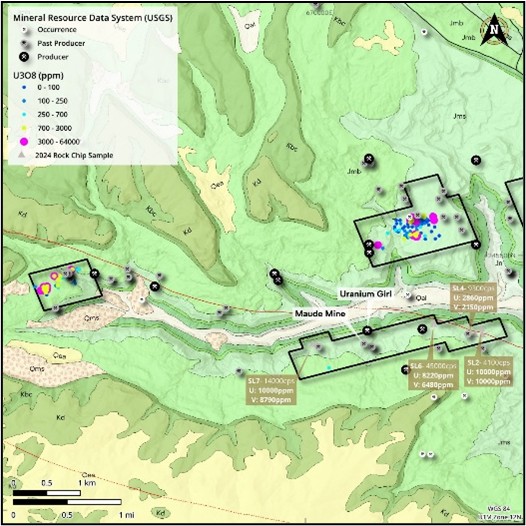
Figure 3: Stateline Project, drillhole assay digitizing [U3O8 (ppm)] UAR 2024 rock chip samples, over USGS Uranium-Vanadium deposits of the La Sal Quadrangle, pp508.1
Collaboration to Support Metallurgical Test Work
UAR also advises that it has entered into a non-binding agreement with DISA Technologies Inc. to support preliminary metallurgical test work on Stateline material. Under this collaboration, DISA will undertake bench-scale testing on a bulk sample of mineralized material and carry out non-invasive site surveys, including radiological scanning, mapping and characterisation.
This work is intended to evaluate the suitability of DISA's processing technology for Stateline-style uranium-vanadium mineralisation and will be completed at no cost to UAR. The metallurgical sampling will be undertaken in parallel with UAR's upcoming field program. The Company will provide further updates as results become available.
DISA may also seek to apply its technology to the remediation and recovery of legacy uranium & vanadium site materials, following completion of its characterization program and in accordance with the requirements of DISA's NRC license.
CEO Bill Hunter commented:
"Stateline continues to show the hallmarks of a high-grade historic uranium-vanadium system. Our data integration work is rapidly bringing the project onto a modern technical footing, and the support from DISA Technologies adds meaningful depth to this effort. We appreciate DISA's collaborative approach and their commitment to completing metallurgical test work and site surveys at their cost. Partnerships like this strengthen our understanding of Stateline's potential and help advance the project efficiently and intelligently."
Field surveying is expected to commence in March, subject to weather conditions.
The Company continues to engage with external technical groups under confidentiality agreements, reflecting broad interest in UAR's uranium-vanadium portfolio.
Enquiries
For further information, please contact:
William Hunter
CEO, Uranium American Resources, Inc.
M: +1 203 856 7285
E:bhunter@uraniumamericanresources.com
SOURCE: Uranium American Resources, Inc.
View the original press release on ACCESS Newswire
FAQ
AI-generated questions and answers. How Rhea-AI works. Not financial advice.