
Uranium American Resources Advances High-Grade U-V Targeting at Stateline Project
Uranium American Resources (OTC:UARI) has provided a technical update on its Stateline Project in Colorado and Utah, part of its recent Jag Minerals acquisition.
Sentiment and the balance of points
Rhea-AI Sentiment reads the wording of the document, how positive or negative its language is on a 1 to 5 scale. The balance of points shown with the takes weighs what the document actually discloses, so the two can disagree, for example when a trial that missed its main goal is described in upbeat language.
Rhea-AI Summary
Uranium American Resources (OTC:UARI) has provided a technical update on its Stateline Project in Colorado and Utah, part of its recent Jag Minerals acquisition. The project, spanning 2.75 square miles, contains over 19 historic mines with exceptional vanadium grades ranging from 1% to 3% V₂O₅.
The project is located in the La Sal Uranium-Vanadium District, with mineralization hosted in the Salt Wash Member of the Morrison Formation. Notable historic mines include the Maud Mine (3.01% V₂O₅, 0.43% U₃O₈) and Morning Glory (2.56% V₂O₅, 0.26% U₃O₈).
The company is implementing advanced exploration techniques, including airborne EM surveys, passive seismic, and AI-driven drainage modeling to identify high-grade uranium-vanadium deposits beneath the surface.
Positive
- Project contains 19 historic mines with high-grade vanadium (1-3% V₂O₅), significantly above North American peer averages
- Strategic location in the prolific La Sal Uranium-Vanadium District, adjacent to the La Sal Complex
- Implementation of advanced exploration technologies including AI-driven modeling and airborne EM surveys
- Strong geological similarities to productive Athabasca-style deposits
Negative
- Exploration challenges due to clay-rich cover obscuring target zones
- Project is still in early exploration phase with no current production
- Requires significant investment in geophysical surveys and modeling
AI-generated analysis. How Rhea-AI works. Not financial advice.




Highlights
Stateline lies in the heart of the prolific La Sal Uranium-Vanadium District, adjacent to the La Sal Complex.
Hosts >19 historic mines with vanadium grades ranging from
1% to3% V₂O₅, averaging1.5% , significantly higher than North American peers.Geological setting consistent with roll-front uranium or paleochannel-style U-V systems.
Focus on advanced airborne EM and AI-driven modelling to target high-value channel bends and trap zones beneath cover.
WOODLAND HILLS, CA / ACCESS Newswire / September 3, 2025 / Uranium American Resources, Inc. (OTC PINK:UARI) is pleased to provide a technical update on its Stateline Project, located in Montrose County, Colorado and San Juan County, Utah. This project, part of the recently announced acquisition of Jag Minerals Pty Ltd, presents a rare opportunity to explore and develop a high-grade vanadium-rich uranium system in one of the most geologically favorable parts of the U.S. uranium belt.
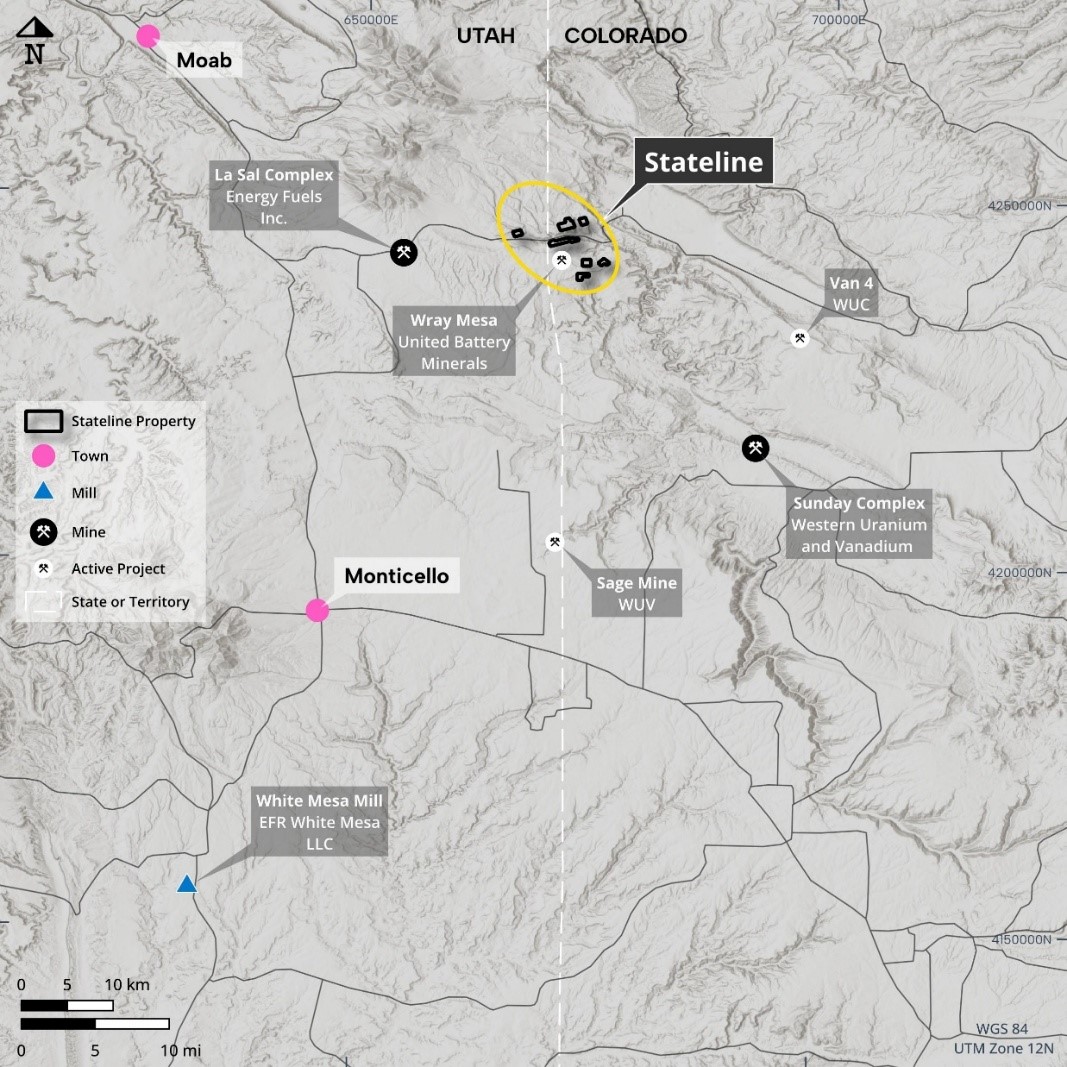
Figure 1: Stateline Project Location.
Geological Context and Deposit Model
Stateline is hosted within the Salt Wash Member of the Morrison Formation, a classic environment for roll-front or paleo-drainage U-V mineralisation. The project covers 2.75 mi² (7.12 km²) and includes over 19 historic mines, with grades such as:
Maud Mine:
3.01% V₂O₅ and0.43% U₃O₈Morning Glory:
2.56% V₂O₅ and0.26% U₃O₈
(see Table 2 on page 4 of acquisition document).
The favorable channel sands in this area were deposited in a meandering, dendritic system. Reducing environments-created when organic material settled in low-energy pools-led to the precipitation of uranium from oxidised fluids. This mechanism mirrors Athabasca-style deposits, where carbonaceous or graphitic host rocks act as chemical traps.
According to technical reviewers, these deposits are likely sourced from mafic volcanics, which explain the unusually high vanadium content and potential for associated metals. The presence of evaporites in the surrounding basin adds to the metal-leaching potential of circulating brines.
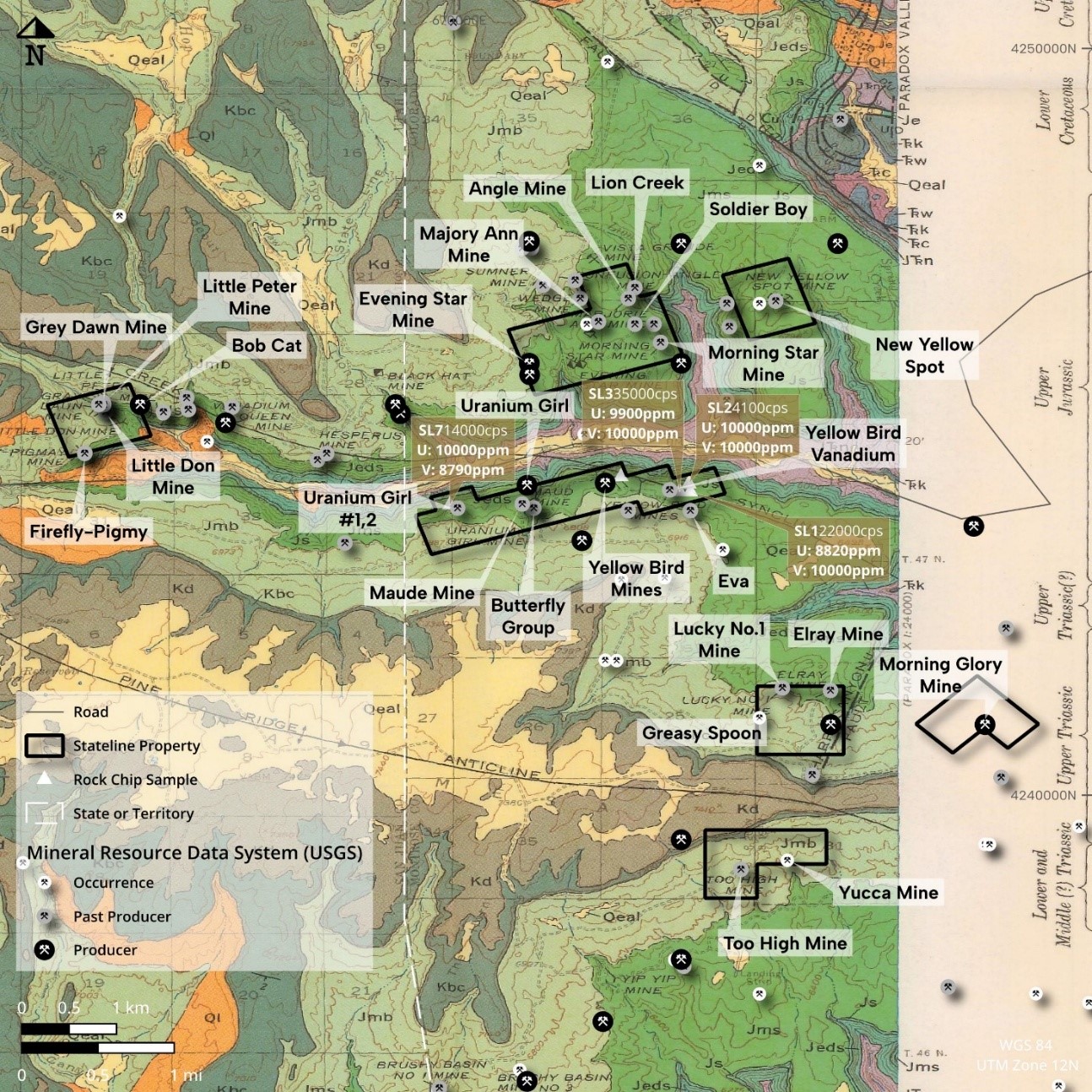
Figure 2: Stateline Project, UAR rock chip samples, over USGS Uranium-Vanadium deposits of the La Sal Quadrangle, pp508.1
Targeting Next-Gen Discovery
Past exploration relied heavily on intercept trend mapping. However, Uranium American Resources is now advancing a more modern, technology-driven exploration program that includes:
Airborne EM (AEM): To detect conductivity contrasts associated with alteration halos and carbon-rich lenses.
Passive Seismic: To model paleo-topography and channel systems in 3D, revealing likely trap zones.
AI Drainage Modelling: Use of genetic algorithms and fuzzy logic to predict sedimentary trends using historic drill data.
These efforts aim to identify tight meander bends, downstream fault-controlled basins, and organic-rich trap sites, all of which are prime depositional environments for high-grade U-V mineralisation.
"The challenge is targeting these channel-hosted reductant zones beneath clay-rich cover, but the upside is immense. Combining AEM, seismic, and AI modelling gives us a real edge," said CEO William Hunter.
Next Steps
The company is in discussions with geophysical contractors including SkyTEM and Expert Geophysics, and is preparing for fieldwork including:
Core sampling for conductivity modelling,
Forward-modelling of AEM responses through overlying units,
Prioritising seismic imaging and inversion modelling.
With strong shareholder support and a technically robust asset base, Uranium American Resources is positioned to become a leading developer of U.S.-based critical minerals for the clean energy transition.
Enquiries
For further information, please contact:
William Hunter
CEO, Uranium American Resources, Inc.
M: +1 203 856 7285
E: bhunter@uraniumamericanresources.com
SOURCE: Uranium American Resources, Inc.
View the original press release on ACCESS Newswire
FAQ
AI-generated questions and answers. How Rhea-AI works. Not financial advice.