
American Pacific Identifies New Geological Anomalies Revealed in Underground Workings in Advance of Drill Program at Madison Copper-Gold Project in Montana
American Pacific (OTCQX: USGDF) reports discovery of new geological anomalies at the Madison copper-gold project in Montana identified using an ultraviolet (black-light) "fugitive calcite" technique.
Sentiment and the balance of points
Rhea-AI Sentiment reads the wording of the document, how positive or negative its language is on a 1 to 5 scale. The balance of points shown with the takes weighs what the document actually discloses, so the two can disagree, for example when a trial that missed its main goal is described in upbeat language.
Rhea-AI Summary
American Pacific (OTCQX: USGDF) reports discovery of new geological anomalies at the Madison copper-gold project in Montana identified using an ultraviolet (black-light) "fugitive calcite" technique.
Field crews accessed an additional 150 feet of ramp exposure and detected at least one distinct fluorescing vein population that may help vector toward porphyry and CRD targets.
Details
News Market Reaction – USGDF
On Mar 10, the day this news came out, USGDF closed 4.00% above the previous close.
Data tracked by StockTitan Argus for the Mar 10 session.
AI-generated analysis. How Rhea-AI works. Not financial advice.




Vancouver, British Columbia--(Newsfile Corp. - March 10, 2026) - American Pacific Mining Corp. (CSE: USGD) (OTCQX: USGDF) (FSE: 1QC1) ("American Pacific", or the "Company") is pleased to announce a compelling new geological observation from ongoing exploration work at its Madison Copper-Gold Project ("Madison" or the "Project") in Montana resulting in the successful application of a "fugitive calcite" black-light technique in newly revealed underground workings, which has contributed to an increased understanding of the mineralizing system at Madison. Recent fieldwork has taken advantage of a short seasonal window of greater underground access made possible by lower water levels revealing an additional 150 feet of newly exposed ramp access.
American Pacific's geological team has successfully deployed ultraviolet (black-light) scanning to search for "fugitive calcite" a technique learned from renowned exploration geologist Dr. Peter Megaw. Under black light, certain calcite populations fluoresce, providing a powerful discriminator within a sea of visually similar non-fluorescent veins. At Madison, this work has already identified at least one distinct population of fluorescing veins (see Image 2) among numerous non-glowing vein sets. When these veins are plotted on stereonets, they offer an additional layer of structural information that can further refine vectors toward both porphyry and carbonite replacement deposit ("CRD") targets. This supports the working hypothesis that Madison may host a cluster of porphyries—multiple sources rather than a single "textbook" center—and provides a new toolset to help unravel this unique mineralizing system.
"The use of ultraviolet lights to detect fugitive calcite is a skill learned while working underground in Utah with Dr. Megaw," commented Managing Director of Exploration, Eric Saderholm. "The fluorescence in the calcite indicates the presence of trace amounts of manganese and lead, both of which are indicators of carbonate replacement that can be associated with skarn, CRD and the presence of distal porphyry mineralization. Fugitive calcite represents "exhaust" proximal to where sulfide mineralization has formed containing stronger metal concentrations. It is a simple and inexpensive, yet highly effective tool for this type of mineral exploration."
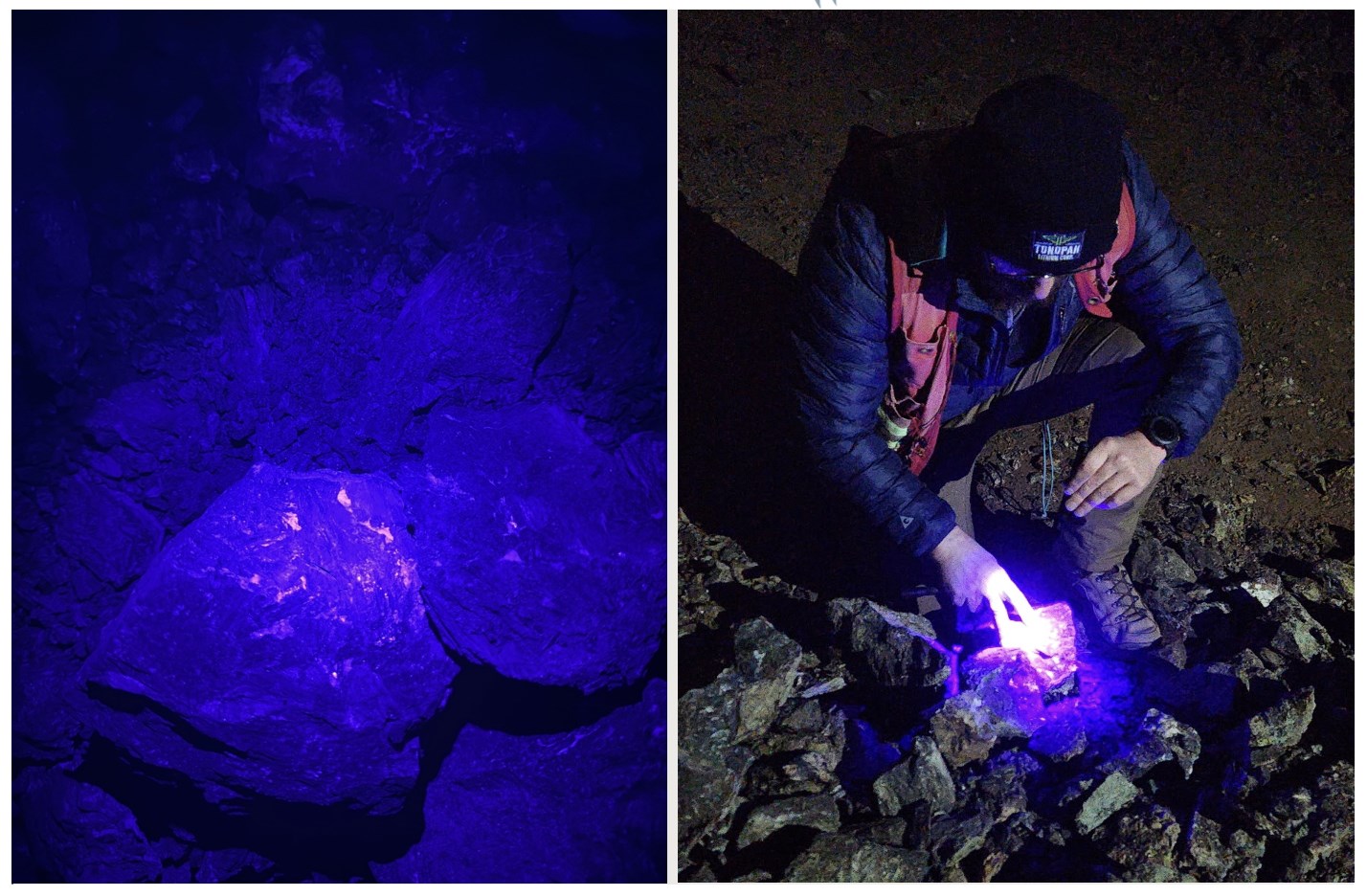
Image 1. Fugitive Calcite being illuminated by ultraviolet (black-light) (left); and Fugitive Calcite being illuminated by ultraviolet (black-light) in the newly exposed area of Madison's underground (right)
To view an enhanced version of this graphic, please visit:
https://images.newsfilecorp.com/files/10322/287783_eefce6b444c5e9ba_001full.jpg
American Pacific will provide further updates as additional data are collected, interpreted and integrated into the broader Madison exploration model.
Qualified Person
The scientific and technical content of this press release has been reviewed, prepared and approved by Eric Saderholm, P.Geo., and Managing Director of Exploration for American Pacific who is a "Qualified Person" as defined by NI 43-101.
About American Pacific Mining Corp.
American Pacific Mining Corp. is a precious and base metals explorer and developer focused on opportunities in the Western United States. The Company's flagship asset is the
American Pacific is incorporated pursuant to the laws of British Columbia and its head office is located at Suite 910 – 510 Burrard Street Vancouver, BC, V6C 3A8.
On behalf of the American Pacific Mining Corp Board of Directors:
Warwick Smith, CEO & Director
Corporate Office: Suite 910 - 510 Burrard Street
Vancouver, BC, V6C 3A8 Canada
Investor relations contact:
Kristina Pillon, High Tide Consulting Corp.
604.908.1695 / Kristina@americanpacific.ca
Media relations contact:
Adam Bello, Primoris Group Inc.
416.489.0092 / media@primorisgroup.com
Full disclosure can be found in our NI 43-101 Technical Report for the Madison Project at www.americanpacificmining.com.
The Canadian Securities Exchange has neither approved nor disapproved the contents of this news release.
FORWARD-LOOKING STATEMENTS
This news release includes certain statements and information that constitute forward-looking information within the meaning of applicable Canadian securities laws. All statements in this news release, other than statements of historical facts, are forward-looking statements. Such forward-looking statements and forward-looking information specifically include, but are not limited to, statements that relate to the completion of the transaction, and timely receipt of all necessary approvals.
Any statements or information that express or involve discussions with respect to predictions, expectations, beliefs, plans, projections, objectives, assumptions or future events or performance (often, but not always, using words or phrases such as "expects", "anticipates", "believes", "plans", "estimates", "intends", "targets", "goals", "forecasts", "objectives", "potential" or variations thereof or stating that certain actions, events or results "may", "could", "would", "might" or "will" be taken, occur or be achieved, or the negative of any of these terms and similar expressions) are not statements of historical fact and may be considered forward-looking information. The Company's forward-looking information is based on the assumptions, beliefs, expectations and opinions of management as of the date of this press release and include but are not limited to information with respect to, the transaction and receipt of all necessary approvals therefor. Other than as required by applicable securities laws, the Company does not assume any obligation to update forward-looking information if circumstances or management's assumptions, beliefs, expectations or opinions should change, or changes in any other events affecting such statements or information. For the reasons set forth above, investors should not place undue reliance on forward-looking information.

To view the source version of this press release, please visit https://www.newsfilecorp.com/release/287783
FAQ
AI-generated questions and answers. How Rhea-AI works. Not financial advice.