
GoldMining Drilling Intercepts Gold Mineralization at Depth, São Jorge Project Pará State, Brazil
GoldMining (NYSE American: GLDG) reported additional assays from the 2025 São Jorge drilling program on Jan 26, 2026, covering 9,533 m of drilling (3,862 m core, 3,528 m RC, 2,143 m auger) across its 100% owned 46,000 ha project in Pará, Brazil.
Sentiment and the balance of points
Rhea-AI Sentiment reads the wording of the document, how positive or negative its language is on a 1 to 5 scale. The balance of points shown with the takes weighs what the document actually discloses, so the two can disagree, for example when a trial that missed its main goal is described in upbeat language.
Rhea-AI Summary
GoldMining (NYSE American: GLDG) reported additional assays from the 2025 São Jorge drilling program on Jan 26, 2026, covering 9,533 m of drilling (3,862 m core, 3,528 m RC, 2,143 m auger) across its 100% owned 46,000 ha project in Pará, Brazil.
Key results include a deep intercept of 19 m at 1.00 g/t Au from 425 m (within 73 m at 0.54 g/t Au), shallow northwest intercepts of 3 m at 1.10 g/t Au from 10 m and 1 m at 1.15 g/t Au from 45 m, and the identification of a >1 km William South IP chargeability anomaly similar in scale to the Deposit signature. The company plans 2026 drilling to test the William South core and additional down-dip extensions.
Positive
- Deep intercept: 19 m at 1.00 g/t Au from 425 m
- Broader deep zone: 73 m at 0.54 g/t Au from 422 m
- William South IP anomaly >1 km, similar scale to Deposit
- 2025 program exceeded plan: 9,533 m drilled vs 9,000 m planned
- Project 100% owned over 46,000 hectares
Negative
- Many drill intervals returned low or no significant gold (NSR) results
- SJD-126-25 failed due to hole collapsing (operational setback)
- Deep mineralization sits below current pit shell, implying deeper drilling
- Some target zones tested showed only weak gold mineralization
Details
News Market Reaction – USGO
On Jan 26, the day this news came out, USGO closed 1.26% below the previous close.
Data tracked by StockTitan Argus for the Jan 26 session.
AI-generated analysis. How Rhea-AI works. Not financial advice.




Highlights:
- São Jorge Diamond Core Drilling Results:
- 19 m at 1.00 grams per tonne (g/t) gold (Au) from 425 m depth (SJD-136-25).
- Within a broader zone of 73 m at 0.54 g/t Au from 422 m depth.
- SJD-136-25 was drilled beneath the existing mineral resource estimate constraining pit shell and represents one of the deepest drill intercepts at the project to date.
- 3 m at 1.10 g/t Au from 10 m depth and 1 m at 1.15 g/t Au from 45 m depth (SJD-133-25) at São Jorge Deposit 'Northwest' Extension prospect.
- 19 m at 1.00 grams per tonne (g/t) gold (Au) from 425 m depth (SJD-136-25).
- Processing of Induced Polarisation ("IP") data collected in 2025 confirms a broad chargeability high anomaly at William South similar in scale to the known IP signature of the São Jorge Deposit.
- The IP anomaly extends more than 1km and is located approximately 2 km from the Deposit.
- Drilling over the highest chargeability core of the IP anomaly is planned in 2026.
- The Company has recently remobilized the geophysical survey team to continue expanding the IP survey to the east of the existing grid.
- Exploration results received to date support the broader potential for future extensions of the presently delineated São Jorge deposit through additional exploration work and delineation of potential new discoveries of gold mineralization across the 46,000 hectare
100% owned São Jorge Project.
Alastair Still, Chief Executive Officer of GoldMining, commented: "GoldMining is pleased with the results of the 2025 diamond core drilling program which has identified mineralization that may extend the known depth of the São Jorge gold deposit. We're encouraged by the potential for additional systematic drilling to potentially extend the mineral resource deeper. Drilling also provided additional indications of a potential continuation of mineralization along strike of the Deposit to the northwest. Furthermore, the 2025 IP survey expansion over targets that contain some of the largest, highest tenor and most continuous gold-in-soil anomalies on the property, has discovered the William South IP Anomaly, a large, high tenor chargeability feature with scale similar to the IP signature of the Deposit itself. The systematic approach by the technical team to building up multiple lines of evidence points towards an exciting emerging target area at William South which has yet to be tested systematically by drilling. We look forward to announcing 2026 exploration plans in due course. The excellent infrastructure at the Project helps facilitate our exploration activities to potentially deliver significant growth on a highly prospective regional-scale property in the rapidly emerging Tapajós gold district."
Project Overview
The São Jorge Gold Project is located in the Tapajós gold district (see Figure 1) in the south-central portion of the Amazon Craton. The São Jorge gold deposit is a granite-hosted, intrusion-related gold mineral system which is a similar style to the Tocantinzinho gold mine located approximately 80 km northwest of São Jorge. Exploration activities at the Project carried out by the Company over the past two years have successfully delineated several new exploration targets comprising gold ± copper ± molybdenum ± silver soil geochemical anomalies, which cumulatively outline a large mineral system (see news releases dated March 18 and April 14, 2025). The São Jorge mineral system is defined by a comprehensive exploration data set which the Company has developed over previous systematic exploration campaigns. Surrounding the currently delineated São Jorge deposit, which has a defined 1.4 km strike length, the broader mineral system comprises a zone of contiguous surface geochemical anomalies over an area of 12 km x 7 km, which the Company interprets to be the surface expression of a broad intrusion related gold system.
The 2025 São Jorge exploration program comprised a total of 9,533 m of drilling, which exceeded the total planned meterage of 9,000 m while remaining on–budget, including 3,862 m diamond core, 3,528 m RC and 2,143 m auger drilling.
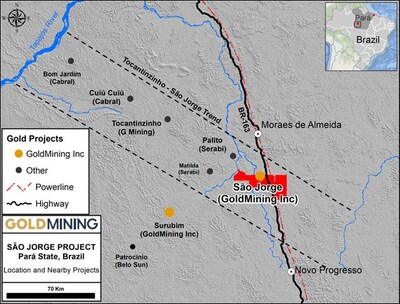
2025 São Jorge Diamond Core Drilling Program
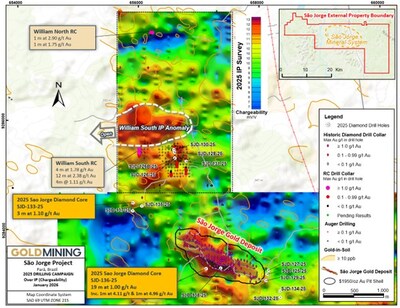
The objective of the 2025 diamond core drilling program was to test several target areas within 1-2 kilometres of the Deposit, including immediate wingspan extensions along strike and to depth, and an emerging target area at the William South Prospect, which is located 1.5 km north of the Deposit; see Figure 2.
Deposit Wingspan Expansion Drilling
Five diamond core holes were drilled on 2 x 200 metre step-out drill sections along trend to the southeast of the São Jorge Deposit. Drilling targeted the projected strike continuation of the Deposit and extended southwards across strike to test a broad deep IP chargeability anomaly. Drilling intersected intercalated syenogranite and volcanics in contact with monzogranite intrusives, with rare thin quartz veins and broad zones of 0.5 –
Three diamond core holes were drilled along trend to the northwest of the Deposit, located approximately 1 kilometre from the western limit of the currently delineated Deposit, to follow-up on 2024 core intercepts which returned 10 m at 0.66 g/t Au from 93 m depth (news release September 9, 2025). The 2025 diamond core drilling successfully intersected the monzogranite (host rock) - syenogranite contact, which is the focus of structural deformation and mineralization at the Deposit. The drilling returned encouraging intercepts of 3 m at 1.10 g/t Au from 10 m depth and 1 m at 1.15 g/t Au from 45 m depth (SJD-133-25). Additional drilling is warranted over the 1 kilometre of strike between the NW Extension and the Deposit, as well as further northwest along strike.
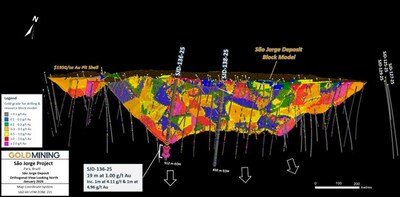
Two deep diamond core drill holes were drilled below the Deposit, testing the potential down-dip extension of mineralization below the depth of the current mineral resource estimate constraining pit shell (see Figure 3). Both holes were targeted to test pierce points on the plane of mineralization projected down plunge of discontinuous high-grade shoots evident in long section view.
SJD-136-25 drilled below a high grade zone of mineralization at the western end of the proposed pit shell, intersecting 19 m at 1.00 g/t Au from 425 m depth, within a broader zone of 73 m at 0.54 g/t Au from 422 m depth. Mineralization occurred within the expected down-dip projection of the mineralized plane, comprising quartz veins and sulphide mineralization within sheared and fractured monzogranite.
SJD-138-25 returned a best intercept of 1 m at 1.25 g/t Au from 175 m depth, which was above the targeted pierce point and hosted in syenogranite; whereas in the projected target zone deeper within the monzogranite host rock, drilling intersected quartz veining and sulphides with only low grade gold values. Gold grade distribution within the Deposit is interpreted to be a function of the intersection of cross-structures with the main WNW-ESE striking mineralized trend. Mineralization remains broadly open at depth below the currently delineated Deposit and therefore additional drilling is warranted to test for potential additional extensions of the mineral resource.
William South Prospect
The emerging William South target area was initially identified by gold-in-soil geochemistry sampling which returned high tenor results over a broad 2 km x 2 km area located approximately 2 kilometres north of the Deposit, with soil assays peaking at 2,163 ppb Au (2.163 g/t Au). Shallow auger drilling completed in 2024 returned encouraging intercepts including 1 m at 17.14g/t Au from 12 m depth, 1 m at 10.2 g/t Au from 14 m depth, 5 m at 2.78 g/t Au from 10 m depth and 3 m at 1.05 g/t Au from 12 m depth (news release November 11, 2024). The gold-in-auger intercepts were initially interpreted to be at the top of the saprolitic (weathered bedrock) horizon, but they could represent a colluvial layer at the base of the transported overburden as it is difficult to distinguish transported clay from in situ weathered bedrock clay within the saprolitic weathering profile that is typical in the district.
Diamond core drilling intersected monzogranite with rare thin quartz veins and minor sulphide mineralization, returning a best result of 1 m at 0.75 g/t Au from 87 m (SJD-130-25). The drilling was completed prior to completion of the 2025 IP survey which extended the geophysical data set northward from the Deposit over the William South and North prospect areas. IP image processing is now completed which has revealed that the 2025 diamond core drilling at William South tested an area of moderate-high but discontinuous IP chargeability, which is located on the southern flank of a larger, higher tenor and more continuous IP chargeability anomaly – the 'William South IP Anomaly' (see Figure 2) - which is similar in scale to the chargeability signature associated with the Deposit. Recently released RC drill results (January 6, 2026) for 2025 drilling also located on the southern flank of the main IP chargeability anomaly returned encouraging drill intercepts including 12 m at 2.38 g/t Au from 13 m depth, 4 m at 1.11 g/t Au from 46 m depth and 1 m at 1.23 g/t Au from 16 m depth. The core of the main William South IP anomaly has not yet been drill tested and remains a high priority for 2026 exploration programs.
Table 1 São Jorge 2025 DDH results at William South prospect (as of January 26, 2026).
Prospect Name | Drill Hole | Interval | Interval | Sample | Au Grade | Ag Grade | Cu Grade |
SE Extension | SJD-125-25 | 28 | 29 | 1 | 0.14 | 0.11 | 81 |
178 | 179 | 1 | 0.16 | 0.09 | 45 | ||
244 | 247 | 3 | 0.10 | 0.22 | 130 | ||
272 | 273 | 1 | 0.10 | 0.48 | 269 | ||
William South | SJD-126-25 | 2 | 9 | 7 | 0.20 | 1.22 | 30 |
including | 8 | 9 | 1 | 0.83 | 2.58 | 30 | |
13 | 14 | 1 | 0.37 | 5.20 | 49 | ||
54 | 55 | 1 | 0.10 | 0.03 | 32 | ||
William South | SJD-126B-25 | 8 | 9 | 1 | 0.17 | 0.83 | 18 |
20 | 21 | 1 | 0.20 | 0.63 | 18 | ||
73 | 77 | 4 | 0.14 | 0.04 | 3 | ||
including | 76 | 77 | 1 | 0.41 | 0.06 | 5 | |
85 | 86 | 1 | 0.20 | 0.07 | 25 | ||
SE Extension | SJD-127-25 | NSR | |||||
William South | SJD-128-25 | 134 | 138 | 4 | 0.10 | 0.04 | 8 |
including | 134 | 135 | 1 | 0.25 | 0.06 | 10 | |
146 | 151 | 5 | 0.11 | 0.05 | 6 | ||
including | 146 | 147 | 1 | 0.32 | 0.07 | 5 | |
194 | 195 | 1 | 0.11 | 0.16 | 34 | ||
196 | 197 | 1 | 0.10 | 0.02 | 3 | ||
200 | 201 | 1 | 0.11 | 0.04 | 5 | ||
SE Extension | SJD-129-25 | 2 | 3 | 1 | 0.90 | 0.85 | 11 |
7 | 8 | 1 | 0.15 | 3.64 | 66 | ||
45 | 46 | 1 | 0.24 | 0.13 | 99 | ||
William South | SJD-130-25 | 49 | 50 | 1 | 0.34 | 0.04 | 2 |
62 | 65 | 3 | 0.18 | 0.08 | 142 | ||
including | 62 | 63 | 1 | 0.39 | 0.20 | 294 | |
87 | 88 | 1 | 0.75 | 0.35 | 11 | ||
163 | 164 | 1 | 0.24 | 0.39 | 733 | ||
169 | 171 | 2 | 0.11 | 0.19 | 226 | ||
William South | SJD-131-25 | 189 | 190 | 1 | 0.11 | 0.04 | 10 |
SE Extension | SJD-132-25 | NSR | |||||
NW Extension | SJD-133-25 | 0 | 1 | 1 | 0.22 | 0.25 | 36 |
3 | 4 | 1 | 0.11 | 0.06 | 33 | ||
10 | 13 | 3 | 1.10 | 0.11 | 34 | ||
including | 10 | 11 | 1 | 2.20 | 0.14 | 29 | |
35 | 36 | 1 | 0.63 | 0.22 | 26 | ||
45 | 46 | 1 | 1.15 | 0.18 | 26 | ||
54 | 55 | 1 | 0.83 | 0.17 | 14 | ||
101 | 102 | 1 | 0.15 | 1.43 | 289 | ||
SE Extension | SJD-134-25 | 13 | 14 | 1 | 0.16 | 2.56 | 30 |
NW Extension | SJD-135-25 | NSR | |||||
Deposit Deeps | SJD-136-25 | 53 | 54 | 1 | 0.21 | --- | 76 |
74 | 75 | 1 | 0.28 | --- | 530 | ||
164 | 165 | 1 | 0.14 | 0.17 | 10 | ||
167 | 168 | 1 | 0.22 | 0.25 | 4 | ||
173 | 174 | 1 | 0.11 | 0.07 | 53 | ||
246 | 255 | 9 | 0.12 | 0.07 | 66 | ||
including | 253 | 254 | 1 | 0.52 | 0.15 | 56 | |
271 | 273 | 2 | 0.17 | 0.15 | 24 | ||
292 | 295 | 3 | 0.36 | 0.60 | 196 | ||
306 | 307 | 1 | 0.13 | 0.29 | 682 | ||
323 | 324 | 1 | 0.15 | 9.63 | 3,466 | ||
328 | 329 | 1 | 0.12 | 0.29 | 292 | ||
342 | 343 | 1 | 0.14 | 0.15 | 15 | ||
344 | 345 | 1 | 0.12 | 0.29 | 6 | ||
346 | 347 | 1 | 0.14 | 0.15 | 7 | ||
377 | 379 | 2 | 0.45 | 0.16 | 139 | ||
including | 377 | 378 | 1 | 0.81 | 0.22 | 83 | |
390 | 412 | 22 | 0.36 | 0.21 | 36 | ||
including | 394 | 397 | 3 | 0.99 | 0.24 | 2 | |
422 | 495 | 73 | 0.54 | 0.18 | 57 | ||
including | 425 | 444 | 19 | 1.00 | 0.22 | 1 | |
including | 435 | 436 | 1 | 4.11 | 0.29 | 1 | |
and | 454 | 455 | 1 | 2.26 | 0.13 | 1 | |
and | 481 | 482 | 1 | 4.96 | 0.35 | 9 | |
and | 492 | 493 | 1 | 0.22 | 0.57 | 2,330 | |
NW Extension | SJD-137-25 | 203 | 204 | 1 | 0.44 | 0.17 | 11 |
248 | 249 | 1 | 0.13 | 0.10 | 30 | ||
Deposit Deeps | SJD-138-25 | 4 | 6 | 2 | 0.12 | 5.23 | 52 |
74 | 75 | 1 | 0.12 | 0.08 | 2 | ||
87 | 91 | 4 | 0.36 | 0.09 | 28 | ||
including | 88 | 89 | 1 | 0.97 | 0.17 | 32 | |
103 | 107 | 4 | 0.80 | 0.35 | 222 | ||
120 | 121 | 1 | 0.15 | 0.06 | 14 | ||
132 | 137 | 5 | 0.17 | 0.17 | 179 | ||
including | 136 | 137 | 1 | 0.51 | 0.42 | 666 | |
150 | 151 | 1 | 0.64 | 0.45 | 31 | ||
158 | 163 | 5 | 0.14 | 0.51 | 637 | ||
172 | 176 | 4 | 0.41 | 0.34 | 15 | ||
including | 175 | 176 | 1 | 1.25 | 0.51 | 13 | |
240 | 241 | 1 | 0.16 | 0.07 | 27 | ||
251 | 252 | 1 | 0.38 | 0.25 | 240 | ||
264 | 265 | 1 | 0.13 | 0.28 | 5 | ||
268 | 269 | 1 | 0.27 | 0.20 | 6 | ||
278 | 282 | 4 | 0.16 | 0.23 | 2 | ||
304 | 305 | 1 | 0.10 | 0.26 | 103 | ||
306 | 307 | 1 | 0.12 | 0.23 | 305 | ||
390 | 392 | 2 | 0.23 | 0.30 | 4 | ||
411 | 412 | 1 | 0.18 | 0.12 | 7 | ||
420 | 422 | 2 | 0.19 | 0.12 | 14 | ||
437 | 443 | 6 | 0.19 | 0.15 | 9 | ||
including | 439 | 440 | 1 | 0.43 | 0.06 | 2 | |
Notes: NSR: 'No Significant Result'. True width of mineralization is estimated to be approximately two-thirds of downhole length, assuming primarily steeply dipping vein-hosted mineralization intersected by inclined (-60° dip) drill holes. Assays >1 g/t Au in bold; drill holes highlighted in this release are shaded. |
Table 2 São Jorge 2025 DDH drill hole collar location coordinates (as of January 26, 2026).
Hole Number | Easting | Northing | Elevation | Dip | Azimuth | Depth (m) | Status |
SJD-125-25 | 658134 | 9282526 | 211.43 | 60 | 180 | 399.63 | Reached Target Depth |
SJD-126-25 | 656604 | 9284453 | 213.87 | 50 | 360 | 65.93 | Hole failed - Collapsing |
SJD-126B-25 | 656605 | 9284456 | 213.85 | 50 | 360 | 167.67 | Reached Target Depth |
SJD-127-25 | 658161 | 9282596 | 216.74 | 60 | 180 | 220.66 | Reached Target Depth |
SJD-128-25 | 656601 | 9284550 | 211.60 | 50 | 360 | 201.23 | Reached Target Depth |
SJD-129-25 | 658116 | 9282427 | 210.84 | 60 | 180 | 364.49 | Reached Target Depth |
SJD-130-25 | 656584 | 9284596 | 210.50 | 50 | 010 | 201.05 | Reached Target Depth |
SJD-131-25 | 656793 | 9284403 | 213.45 | 50 | 360 | 200.22 | Reached Target Depth |
SJD-132-25 | 658352 | 9282153 | 226.46 | 60 | 360 | 204.29 | Reached Target Depth |
SJD-133-25 | 655904 | 9283712 | 216.72 | 50 | 360 | 200.13 | Reached Target Depth |
SJD-134-25 | 658345 | 9282247 | 221.63 | 60 | 360 | 201.69 | Reached Target Depth |
SJD-135-25 | 656053 | 9283657 | 222.89 | 50 | 360 | 200.57 | Reached Target Depth |
SJD-136-25 | 657128 | 9282624 | 255.31 | 60 | 360 | 511.79 | Reached Target Depth |
SJD-137-25 | 655911 | 9283578 | 227.63 | 50 | 360 | 270.29 | Reached Target Depth |
SJD-138-25 | 657365 | 9282632 | 226.90 | 70 | 360 | 449.81 | Reached Target Depth |
Data Verification
For drill core sampling, samples were taken from the NQ/HQ core by sawing the drill core in half, with one-half sent to SGS Geosol Laboratórios Ltda. ("SGS") in
SGS is a certified commercial laboratory located in Vespasiano,
Qualified Person
Paulo Pereira, P. Geo., Country Manager,
Visit www.goldmining.com for more information, including high-resolution figures, and to review the Technical Report titled "NI 43-101 Technical Report, São Jorge Project, Pará State,
About GoldMining Inc.
GoldMining Inc. is a public mineral exploration company focused on acquiring and developing gold assets in the
Notice to Readers
Technical disclosure regarding São Jorge has been prepared by the Company in accordance with NI 43-101. NI 43-101 is a rule of the Canadian Securities Administrators which establishes standards for all public disclosure an issuer makes of scientific and technical information concerning mineral projects. These standards differ from the requirements of the
Cautionary Statement on Forward-looking Statements
Certain of the information contained in this news release constitutes "forward-looking information" and "forward-looking statements" within the meaning of applicable Canadian and

 View original content to download multimedia:https://www.prnewswire.com/news-releases/goldmining-drilling-intercepts-gold-mineralization-at-depth-sao-jorge-project-para-state-brazil-302669755.html
SOURCE GoldMining Inc.
FAQ
AI-generated questions and answers. How Rhea-AI works. Not financial advice.