
VIAVI Introduces Industry's First Channel Emulator for 6G and Wi-Fi 7/8
VIAVI (NASDAQ: VIAV) introduced Vertex 6.0, an enhanced channel emulation platform designed for next‑generation 6G and Wi‑Fi 7/8 testing.
Rhea-AI Summary
VIAVI (NASDAQ: VIAV) introduced Vertex 6.0, an enhanced channel emulation platform designed for next‑generation 6G and Wi‑Fi 7/8 testing. The system offers 400 MHz instantaneous bandwidth, supports carrier frequencies up to 23.6 GHz, and natively supports new 6G waveform requirements while exceeding Wi‑Fi 7/8 bandwidth needs.
Vertex 6.0 uses field-replaceable RF modules in an existing 6U chassis and extends prior 5G FR1/FR2 capabilities to complex cellular, Wi‑Fi, military and aerospace RF use cases. Each chassis supports 36 RF ports, 256 digital links and up to 1.6 GHz bandwidth, with FR3 bands up to 1 GHz, MU‑MIMO, TDD/FDD, Wi‑Fi 7/8 320 MHz and 4096 QAM, and multiple land/air/NTN modes.
Positive
- First 6G/Wi‑Fi 7/8 channel emulator with 400 MHz instantaneous bandwidth and carrier support up to 23.6 GHz
- High-capacity chassis supporting 36 RF ports, 256 digital links and up to 1.6 GHz total bandwidth
- FR3 and 6G readiness with up to 1 GHz FR3 bandwidth and MU‑MIMO in TDD and FDD modes
- Advanced Wi‑Fi 7/8 support including 320 MHz channels, 4096 QAM and 2x2 to 8x8 configurations
- Expanded use cases covering cellular, Wi‑Fi, military, aerospace, NTN (LEO/MEO/GEO), mesh, drone and ISAC networks
Negative
- None.
Details
News Market Reaction – VIAV
On Aug 12, the day this news came out, VIAV closed 12.24% above the previous close. Argus tracked a peak move of +8.7% during that session. Our momentum scanner recorded 92 alerts for this stock that day. Relative volume reached 6.5x the daily average during tracking.
Data tracked by StockTitan Argus for the Aug 12 session.
Key Figures
- Instantaneous bandwidth
- 400 MHz
- Vertex 6.0
- Maximum carrier frequency
- 23.6 GHz
- Vertex 6.0
- RF ports
- 36 RF ports
- Per 6U Vertex chassis
- Digital links
- 256 digital links
- Per 6U Vertex chassis
- Chassis bandwidth
- Up to 1.6 GHz
- Per 6U Vertex chassis
- FR3 bandwidth
- Up to 1 GHz
- Cellular technologies
- Wi-Fi channel width
- 320 MHz
- Wi-Fi 7/8 support
- Quadrature amplitude modulation
- 4096 QAM
- Wi-Fi 7/8 support
Historical Context
-
Strong quarterly revenue, margins, earnings, and fiscal 2027 guidance
-
Announced August 5 release date and earnings conference call
-
Received $1.1 million funding for AI-driven 6G security testing
-
Launched Ultra Ethernet validation solution for AI data-center networks
-
Received PCI-SIG Gold Suite acceptance for compliance testing
24h Move is the share-price change in the day after each event; other market factors may also have contributed.
Key Terms
channel emulator technical
mimo technical
fdd technical
4096 qam technical
AI-generated analysis. How Rhea-AI works. Not financial advice.




New Vertex 6.0 recreates real-world wireless conditions in the lab for complex cellular, Wi-Fi, military and aerospace RF technologies
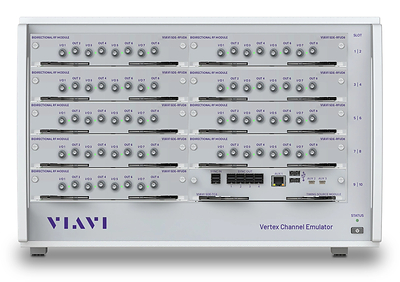
Vertex 6.0 extends VIAVI's wireless portfolio by bringing real-world RF propagation into the lab, complementing the industry-leading TM500 network emulation platform and TeraVM application and security validation solutions. It is the first Vertex upgrade following VIAVI's acquisition of Spirent Communications plc's high-speed Ethernet, network security and channel emulation testing business.
Available in field-replaceable RF modules that integrate seamlessly into an existing 6U Vertex chassis, Vertex 6.0 builds on the 5G FR1/FR2 capabilities of the previous generation and now includes emulation for complex cellular, Wi-Fi, military and aerospace RF technologies. Combined with the VIAVI FR3 MIMO converter and raytracing with Integrated Sensing and Communication (ISAC), the platform acts as a digital twin for RF propagation for use cases including FR3, Wi-Fi 7, AI-RAN and ISAC.
"As wireless technologies become more complex, late-stage issues can present significant risks. Engineers need test environments that can accurately replicate real-world conditions and validate performance from the earliest stages of development," said Ian Langley, Senior Vice President, Wireless, Security and Applications Business Unit, VIAVI. "Vertex has been the platform of choice for the world's leading chipset, device and network equipment manufacturers for over a decade, and Vertex 6.0 brings the next leap in capabilities that address the requirements of complex cellular, Wi-Fi and other specialized topologies."
Each 6U Vertex chassis supports 36 RF ports, 256 digital links and up to 1.6 GHz of bandwidth. For cellular technologies, the platform supports FR3 bands with up to 1 GHz of bandwidth to meet the increased requirements of 6G networks. This includes multiuser (MU) MIMO with phase alignment and support for both TDD and FDD modes.
For Wi-Fi 7/8, it includes native support for 320 MHz and 4096 QAM, supporting 2x2 up to 8x8 configurations. The channel emulator also includes a wide range of modes for land-to-land, land-to-air and air-to-air transmissions, including for anechoic and reverberation OTA chambers, as well as for NTN (LEO, MEO and GEO), mesh, drone and ISAC networks.
About VIAVI
VIAVI (NASDAQ: VIAV) is a global leader in test and measurement and optical technologies. Our test and measurement and resilient position, navigation and timing solutions enable and secure critical infrastructure ranging from data center ecosystems and communication networks to military, aerospace, railway and first responder communications. In addition, we develop and advance technologies used in high-volume optical applications across anti-counterfeiting, consumer electronics, aerospace, industrial and automotive end markets.
Learn more about VIAVI at www.viavisolutions.com. Follow us on VIAVI Perspectives, LinkedIn and YouTube.
Media Inquiries:
Grand Bridges
Emma Jenkins
emma@grandbridges.com
+1 415 800 4529
 View original content to download multimedia:https://www.prnewswire.com/news-releases/viavi-introduces-industrys-first-channel-emulator-for-6g-and-wi-fi-78-302846140.html
SOURCE VIAVI Solutions
FAQ
AI-generated questions and answers. How Rhea-AI works. Not financial advice.