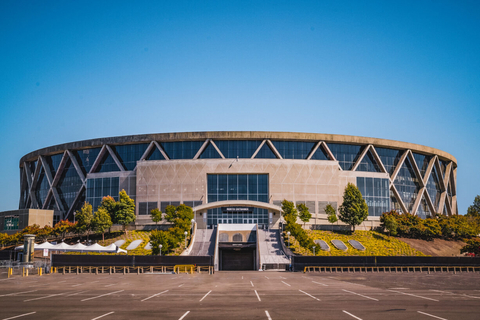
RUCKUS Networks and Fortis Solutions Deliver Wi-Fi 7 Transformation at Oakland Arena
RUCKUS Networks and Fortis Solutions Deliver Wi-Fi 7 Transformation at Oakland Arena
Vistance Networks (NASDAQ: VISN) announced that RUCKUS Networks and Fortis Solutions completed a full Wi‑Fi 7 network modernization at Oakland Arena in just thirteen days.
Rhea-AI Sentiment reads the wording of the document, how positive or negative its language is on a 1 to 5 scale. The balance of points shown with the takes weighs what the document actually discloses, so the two can disagree, for example when a trial that missed its main goal is described in upbeat language.
RICHARDSON, Texas--(BUSINESS WIRE)--
Vistance Networks (NASDAQ: VISN), a global provider of intelligent network solutions, today announced that RUCKUS Networks™, alongside Fortis Solutions, has deployed a full Wi-Fi 7 network infrastructure modernization at Oakland Arena. The deployment, which was completed in thirteen days, delivers a future‑ready connectivity experience for one of California’s premier concert venues.
Oakland Arena
The installation delivered a comprehensive, end‑to‑end transformation of the arena’s network, including the deployment of nearly 300 new RUCKUS® Hyper-Directional T670sn Wi‑Fi 7 access points, upgraded controllers, and a complete refresh of the routing and switching infrastructure. The project also incorporated RUCKUS® ICX® switches with multi‑gigabit and 10‑gigabit ports, creating a high‑performance wired backbone designed to support increasing data demands and future‑ready applications.
“The deployment delivered immediate impact for the venue; two back-to-back sold-out K‑pop concerts ran flawlessly, with 100% switch uptime and 8.22 terabytes of traffic handled over two days, without disruption,” said Bart Giordano, SVP and president, RUCKUS Networks. “Oakland Arena demonstrates what’s possible when purpose-built Wi‑Fi 7 solutions are paired with the right expertise - ten times faster speeds and zero downtime during a sold-out event. That’s the standard venues have come to expect.”
“While typical arena projects often take months, this implementation was completed in 13 days,” said Myron Duckens, CEO, Fortis Solutions. “To accelerate deployment and minimize disruption, Fortis Solutions’ patented Source of Truth automation tools were used to migrate legacy configurations into a RUCKUS‑compatible architecture. This approach reduces manual engineering effort and allows the arena to remain fully operational throughout the upgrade, demonstrating the efficiency of our solutions and the strength of RUCKUS’ enterprise‑grade Wi‑Fi platform solutions.”
By redesigning its network architecture with RUCKUS technology, Oakland Arena now delivers up to ten times faster connectivity while lowering infrastructure costs, simplifying operations, and significantly improving the efficiency of ongoing network management.
“Prior to the deployment of RUCKUS technology and Fortis’ network automation tools, the 19,500‑seat venue was operating on legacy infrastructure that lacked modern beamforming and MIMO capabilities—putting it at risk of high latency, buffering, and frequent disconnects during sold‑out events,” said Colby Tucker, Senior Director of Operations, Oakland Arena. “Today, the arena delivers a level of connectivity that rivals, and in many cases can outperform, newer venues, with superior coverage, capacity, and reliability even at peak demand.”
With the new Wi‑Fi 7 network infrastructure in place, ticketing, concessions, and food and beverage operations run on a high-performance network, enabling an uninterrupted service. Oakland Arena is positioned to meet the connectivity demands of the next decade—from high‑density live events to immersive fan experiences.
Vistance Networks, Aurora Networks, Ruckus Networks and their logos are trademarks of Vistance Networks, Inc. and/or its affiliates in the U.S. and other countries. For additional trademark information see https://www.vistancenetworks.com/trademarks. Wi-Fi and Wi-Fi 7 are trademarks of the Wi-Fi Alliance. Please see https://www.wi-fi.org/system/files/Wi-Fi_Alliance_Brand_Style_Guide_202306.pdf for a list of Wi-Fi Alliance trademarks. All other product names, trademarks and registered trademarks are property of their respective owners.
About Vistance Networks:
Vistance Networks (NASDAQ: VISN) shapes the future of communications technology, pushing past what is possible. We deliver solutions that bring reliability and performance to a world always in motion. Our global team of innovators and employees are trusted advisors who listen to customers first, then deliver value. Discover more at www.vistancenetworks.com.
This press release includes forward-looking statements that are based on information currently available to management, management’s beliefs, as well as on a number of assumptions concerning future events. Forward-looking statements are not a guarantee of performance and are subject to a number of uncertainties and other factors, which could cause the actual results to differ materially from those currently expected. In providing forward-looking statements, the company does not intend, and is not undertaking any obligation or duty, to update these statements as a result of new information, future events or otherwise.
Wi‑Fi 7 is the next generation of wireless networking technology that delivers much faster speeds, lower delay, and the ability to handle many more devices at once—think of it as a wider, smoother highway for internet traffic. It matters to investors because upgrades to phones, routers, smart-home gear, and business networks can drive hardware sales, service subscriptions, and demand for data-center or semiconductor capacity, affecting companies across the tech supply chain.
multi‑gigabittechnical
Multi-gigabit describes data transmission speeds measured in gigabits per second that are greater than one gigabit — for example, 2 Gbps, 5 Gbps or more. Think of it like a highway with multiple fast lanes: it allows much larger amounts of data to move quickly, reducing delays and enabling high-demand uses like cloud services, streaming and large-scale device connections. Investors care because products or networks supporting multi-gigabit speeds can command higher prices, open new markets, and require different capital and infrastructure decisions.
10‑gigabittechnical
10‑gigabit means a data transfer capacity of 10 gigabits per second, commonly used to describe network links, internet connections, or interfaces that move large amounts of digital information. For investors, it signals how quickly a company can send or receive data—like a wider highway that supports more cars—affecting product performance, customer experience, infrastructure costs and the ability to scale services.
routing and switchingtechnical
Routing and switching are the core functions that move data across networks: switching directs traffic inside a local network like lanes and traffic lights guiding cars on city streets, while routing connects different networks like road maps and highway signs sending cars between cities. Investors care because performance, reliability, and capacity of these functions affect a company’s operations, customer experience, capital spending and the sales potential for networking equipment and services.
beamformingtechnical
Beamforming is a technology that steers wireless signals in a focused direction so devices receive stronger, clearer connections instead of spreading radio waves everywhere. Think of it like aiming a flashlight beam at a specific person rather than lighting an entire room: it boosts speed, range, and reliability while reducing interference. For investors, beamforming matters because it can improve product performance, enable new services, lower network costs, and create competitive advantages for companies selling chips, equipment, or connectivity services.
mimotechnical
MIMO stands for multiple-input multiple-output, a wireless technology that uses multiple transmitters and receivers to send and receive data at the same time. Think of it like several lanes on a highway letting more cars travel simultaneously and avoiding traffic jams. For investors, MIMO matters because it improves network speed and reliability, which can drive demand for telecom equipment, services and devices and influence revenue growth in wireless-related companies.
network automationtechnical
Network automation is the use of software to make computer networks configure, run, and repair themselves with minimal human work, like turning manual setup and tinkering into a programmable routine. For investors, it matters because automation can cut operating costs, reduce outages and human errors, and allow a company to scale services faster—similar to how an automated assembly line increases production and reliability compared with doing everything by hand.