Mitsubishi Corporation Joins Starlab as Major Space Station Customer
Mitsubishi Corporation Joins Starlab as Major Space Station Customer
Starlab (VOYG) announced that Mitsubishi Corporation has reserved and pre-purchased payload capacity on Starlab's commercial space station, expanded its equity investment and joined Starlab's board via representative Issei Shinohara.
Rhea-AI Sentiment reads the wording of the document, how positive or negative its language is on a 1 to 5 scale. The balance of points shown with the takes weighs what the document actually discloses, so the two can disagree, for example when a trial that missed its main goal is described in upbeat language.
Japanese industrial leader expands partnership and reserves commercial capacity as Starlab advances toward Critical Design Review
HOUSTON--(BUSINESS WIRE)--
Starlab Space LLC today announced that Mitsubishi Corporation has reserved and pre-purchased capacity on Starlab's commercial space station, becoming a foundational customer while simultaneously increasing their investment in the company and joining Starlab's Board of Directors through representative Issei Shinohara.
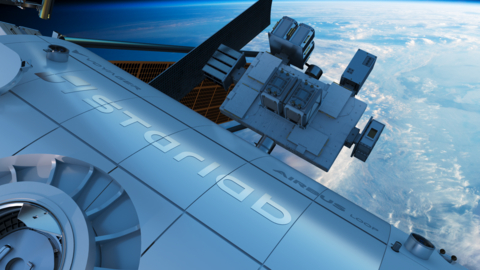
Mitsubishi Corporation joins Starlab as a major customer, expanding their current partnership to include reserved and pre-purchased payload capacity on Starlab's commercial space station. Image: Starlab space station in space with Earth in the background.
The expanded partnership includes acquisition of usage rights for designated payload volume and utilization of on orbit laboratory facilities on Starlab, positioning Mitsubishi to accelerate space-based research opportunities for Japanese institutions. This customer commitment is accompanied by an expanded equity partnership that brings additional investment to support Starlab's development.
The collaboration addresses the critical transition in space research as the International Space Station approaches retirement. Since 2008, Japan has operated the ISS Japanese Experiment Module "Kibo," under the leadership of the Japan Aerospace Exploration Agency (JAXA). Mitsubishi's long-standing relationship and legacy of supporting JAXA presents opportunities for future collaboration as Japan's space program transitions to commercial platforms.
"Mitsubishi Corporation's decision to reserve capacity on Starlab demonstrates the strong commercial demand for our next-generation platform," said Marshall Smith, CEO of Starlab. "Their commitment as a partner and customer validates our progress as we advance to full development and flight. Their decades of experience supporting Japan's space program, combined with their industrial expertise, makes them an invaluable partner as we work to complete our CDR that was conducted in December."
As a customer, Mitsubishi will support Japanese space development objectives while contributing to advancements in areas such as life sciences research, advanced materials development and next-generation manufacturing technologies that benefit from the unique space environment. The company’s research capacity will enable Japanese institutions to accelerate space-based research in drug discovery, nano-medicine applications, new material development and next-generation semiconductor manufacturing.
Starlab is the largest and most advanced commercial space station in development. To date, Starlab has achieved more than 27 development milestones and received $217.5 million from NASA through the Commercial LEO Destinations Phase 1 program and $15 million from the Texas Space Commission, plus backing from joint venture partners across the United States, Europe, Japan and Canada.
About Starlab
Starlab Space is a U.S.-led, global joint venture among Voyager Technologies (NYSE: VOYG), Airbus, Mitsubishi Corporation, MDA Space, Palantir Technologies and Space Applications Services, with strategic partners including Hilton, Journey, Northrop Grumman and The Ohio State University. Starlab is developing a next-generation, AI-enabled commercial space station, aiming to ensure continued human presence in low-Earth orbit and a seamless transition of microgravity science and research alongside the retirement of the International Space Station. Starlab's advanced, user-driven design and robust capabilities make it a premier platform for scientific discovery and technological advancement in space. For more information, visit starlab-space.com.
A critical design review (CDR) is a formal, high‑level assessment where engineers and independent reviewers confirm a product or system’s detailed plans meet required performance, safety and regulatory needs before committing to full-scale production or implementation. For investors it signals reduced technical and schedule risk—like approving a final blueprint before construction—so passing a CDR often increases confidence in a project’s timeline, budget predictability and likelihood of commercial success.
payload capacitytechnical
Payload capacity is the maximum weight or volume a vehicle, aircraft, satellite, drone, or transport system can carry safely and legally in addition to its own structure and operating equipment. For investors, it matters because higher payload capacity often means a product can move more goods, generate more revenue per trip, or host bigger instruments, much like a larger truck can haul more deliveries and reduce cost per item — affecting sales potential, operating costs and market competitiveness.
nano-medicinemedical
Nano-medicine uses extremely tiny engineered particles or devices—on the scale of billionths of a meter—to diagnose, deliver treatments, or interact with cells and tissues at a molecular level; think of it as targeted postal delivery inside the body. Investors care because it can make therapies more effective, reduce side effects, create new product categories and profit centers, but it also brings development complexity, long testing and approval paths, and uncertain commercial timelines.