Starlab Space and Auxilium Biotechnologies to Advance Life Sciences Research in Microgravity
Starlab Space and Auxilium Biotechnologies to Advance Life Sciences Research in Microgravity
Starlab (VOYG) announced a partnership with Auxilium Biotechnologies to host Auxilium’s AMP-1 orbital 3D bioprinter aboard the Starlab commercial space station.
Rhea-AI Sentiment reads the wording of the document, how positive or negative its language is on a 1 to 5 scale. The balance of points shown with the takes weighs what the document actually discloses, so the two can disagree, for example when a trial that missed its main goal is described in upbeat language.
Auxilium will provide orbital 3D bioprinting and biofabrication capabilities aboard the Starlab space station to enhance research and development in regenerative medicine, implantable medical devices and tissue engineering.
HOUSTON--(BUSINESS WIRE)--
Starlab Space LLC, the commercial space station developer expanding access to low Earth orbit research, today announced a partnership with Auxilium Biotechnologies. This agreement represents a significant advancement in 3D bioprinting and biofabrication in orbit and underscores Starlab's commitment to growing scientific discovery beyond the limits of Earth.
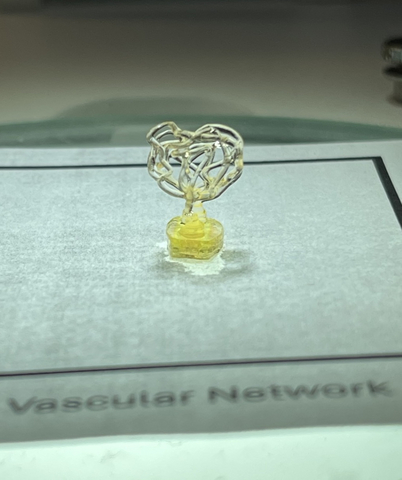
Auxilium will provide orbital 3D bioprinting and biofabrication capabilities aboard the Starlab space station to enhance research and development in regenerative medicine, implantable medical devices and tissue engineering. In November 2024, Auxilium successfully created tiny, functional blood vessels aboard the International Space Station using its AMP-1 platform. These vessels, which have wall thicknesses about the width of a human hair, were produced in under an hour—something not possible on Earth, where the process requires more time, materials, and complex steps. The achievement opens the door to on-demand tissue production to support astronaut health on long missions to the Moon and Mars, while also advancing solutions for patients on Earth. Photo credit: Auxilium
Auxilium will provide orbital 3D bioprinting and biofabrication capabilities aboard the Starlab space station to support advanced research, device development and manufacturing workflows in regenerative medicine, implantable medical technologies and complex tissue engineering applications. Auxilium’s proprietary AMP-1 3D bioprinter has demonstrated the mass production of implantable medical devices and other complex structures, such as perfusable blood vessels, in microgravity aboard the International Space Station. With Starlab, Auxilium will accelerate translation from experimental biology to manufacturable products, positioning AMP-1 as a production facility for the next generation of life science technologies in space.
“3D printing in microgravity enables tissue architectures and material properties not achievable under standard 1g manufacturing,” said Isac Lazarovits, director of engineering at Auxilium. “This biomanufacturing facility on board the future Starlab space station will expand access to low Earth orbit, lower barriers for industry and academia, and enable high-impact research and manufacturing that will benefit Earth.”
This announcement highlights one piece of Starlab’s expansive network dedicated to advancing life sciences research and biomanufacturing in orbit. Microgravity enables breakthroughs impossible on Earth by allowing enhanced protein crystallization for improved drug development, 3D cell growth and disease modeling that better replicates human biology, and advanced stem cell research with applications for treating conditions such as Parkinson's disease, diabetes and Alzheimer's.
"This partnership demonstrates Starlab's commitment to fostering innovation in life sciences," said Marshall Smith, CEO of Starlab. "By providing companies like Auxilium with the infrastructure to advance biomanufacturing in microgravity, we're creating pathways for breakthrough therapies that will improve lives on Earth."
Starlab's market-driven business model aims to reduce costs, complexity and risks for researchers and commercial partners. With its single-launch, no-assembly-required design enabling full certification and operation within weeks, Starlab minimizes delays and maximizes efficiency for payload customers. Through joint venture partners, customers can conduct research on the International Space Station today, ensuring a seamless transition to Starlab for future advancements.
About Starlab
Starlab Space is a U.S.-led, global joint venture among Voyager Technologies (NYSE: VOYG), Airbus, Mitsubishi Corporation, MDA Space, Palantir Technologies, and Space Applications Services, with strategic partners including Hilton, Journey, Northrop Grumman, and The Ohio State University. Starlab is developing a next-generation, AI-enabled commercial space station to ensure continued human presence in low Earth orbit and a seamless transition of microgravity science and research alongside the retirement of the International Space Station. Starlab's advanced, user-driven design and robust capabilities make it a premier platform for scientific discovery and technological advancement in space. For more information, visit starlab-space.com.
About Auxilium Biotechnologies
Auxilium Biotechnologies is a pioneering biotechnology company dedicated to developing innovative solutions to treat traumatic injuries to the nervous system. With a focus on innovation and collaboration, the company develops cutting-edge bioprinting and biomanufacturing solutions and implantable medical devices to improve lives worldwide. For more information, visit auxiliumbio.com.
Microgravity is a condition where objects experience almost no net weight because they are in continuous free-fall, such as aboard orbiting spacecraft; think of passengers feeling weightless in a smoothly falling elevator. For investors, microgravity matters because it enables scientific experiments and manufacturing processes that behave very differently than on Earth, potentially creating novel drugs, materials, or technologies, changing development timelines, costs, market opportunities and regulatory considerations.
3d bioprintingmedical
3D bioprinting is a manufacturing technique that uses printer-like equipment to place living cells and supportive materials layer by layer to create tissues or organ-like structures, similar to building a model one thin slice at a time. It matters to investors because successful bioprinted products could create new medical therapies, reduce lab time and costs, and open markets in drug testing and transplant alternatives, while also carrying long development timelines and regulatory risk.
biofabricationmedical
The creation of living tissues, cells or biological structures using controlled, often automated methods—think 3D printing but for biological material instead of plastic. Investors care because biofabrication aims to turn lab science into scalable products (like replacements for damaged tissue, drug-testing models, or biologically active implants), so success can open large markets but also carries long development timelines, regulatory hurdles and manufacturing risk.
implantable medical devicesmedical
Implantable medical devices are products placed inside the body to replace, support, monitor or deliver therapy—like tiny durable machines or sensors that perform medical tasks from within. They matter to investors because they typically involve long development and approval processes, long product lifecycles with steady revenue potential, and high sensitivity to safety issues, surgical adoption and insurance payment rules; any approval, recall or reimbursement change can significantly affect a company’s financial outlook.
tissue engineeringmedical
Tissue engineering is the lab-based process of growing or assembling living cells on supportive frameworks and using biochemical cues to create or repair body tissues, like building replacement parts from living materials. For investors, it matters because successful products can create entirely new markets for treating injuries and chronic diseases, but they also carry long development timelines, high manufacturing costs, and regulatory risk that affect potential returns.
international space stationtechnical
A permanently crewed laboratory and living platform orbiting Earth, assembled and operated by multiple countries to conduct scientific experiments, test space technologies, and host commercial activities. For investors, it matters because work done there can validate new products, create markets for space-based services, attract government and private contracts, and accelerate technologies that spin off to Earth — think of it as a shared, high‑cost testbed and partnership hub that can de‑risk and showcase future commercial opportunities.
low earth orbittechnical
Low Earth orbit (LEO) is the region of space close to Earth, roughly from about 160 to 2,000 kilometers above the surface, where satellites and spacecraft circle the planet quickly—think of it as a busy highway just overhead. It matters to investors because many communications, imaging and data services rely on satellites in LEO; their shorter lifespans, lower launch costs, crowded lanes and debris risks directly affect the cost, revenue potential and operational risks of companies that build, launch or use these satellites.
protein crystallizationmedical
Protein crystallization is the process of coaxing protein molecules to pack into a regular, repeating solid lattice so their detailed shape and interactions can be determined and studied. For investors, it matters because knowing a protein’s exact structure can speed drug design, support patent claims, and improve manufacturing quality and stability of biologic medicines, reducing development and regulatory risk much like having a clear blueprint speeds construction and fixes.