
Vertiv Expects Powering Up for AI, Digital Twins and Adaptive Liquid Cooling to Shape Data Center Design and Operations
Rhea-AI Summary
Vertiv (NYSE: VRT) published its Vertiv Frontiers report on Jan 8, 2026, outlining five data center trends driven by AI: powering up for AI via higher-voltage DC and on-site generation, distributed AI and private/hybrid deployments for regulated industries, energy autonomy with extended on-site generation and microgrids, digital twin-driven design to cut deployment time by up to 50%, and adaptive liquid cooling enhanced by AI for reliability. The report stresses gigawatt scaling, extreme densification, and treating the data center as a unit of compute as core forces shaping design, operations, and retrofits worldwide.
Positive
- None.
Negative
- None.
Details
News Market Reaction – VRT
In the Jan 8 session, VRT declined 6.27%, reflecting a notable negative market reaction.
Data tracked by StockTitan Argus on the day of publication.
Key Figures
- Number of key trends
- 5 trends
- Vertiv Frontiers data center report
- Conversion stages
- 3–4 stages
- Current hybrid AC/DC power distribution to IT racks
- Time-to-token reduction
- up to 50%
- Digital twin-driven modular deployment vs traditional builds
- Countries served
- more than 130
- Vertiv global operations footprint
- Current share price
- $171.54
- Pre-news market context
- 52-week range
- $53.60 – $202.45
- Low and high over past 52 weeks
- Market capitalization
- $66,890,087,859
- Equity value before this news
- Price change
- -1.95%
- 1-day move before publication
Historical Context
-
Completed $1.0B PurgeRite acquisition to expand liquid cooling services.
-
Energy optimization partnership with Caterpillar for AI data centers.
-
Raised annual dividend from $0.15 to $0.25 per share.
-
Announced intent to acquire PurgeRite for cash plus potential earn-out.
-
Introduced gigawatt-scale reference architectures for NVIDIA Omniverse DSX.
24h Move is the share-price change in the day after each event; other market factors may also have contributed.
Key Terms
digital twins technical
liquid cooling technical
microgrids technical
on-site energy generation technical
digital twin technical
AI-generated analysis. How Rhea-AI works. Not financial advice.




Forces including extreme densification, gigawatt scaling, and data center as unit of compute are driving these trends
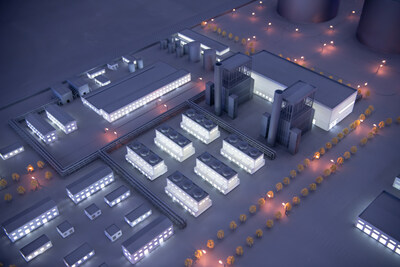
"The data center industry is continuing to rapidly evolve how it designs, builds, operates and services data centers, in response to the density and speed of deployment demands of AI factories," said Vertiv chief product and technology officer, Scott Armul. "We see cross-technology forces, including extreme densification, driving transformative trends such as higher voltage DC power architectures and advanced liquid cooling that are important to deliver the gigawatt scaling that is critical for AI innovation. On-site energy generation and digital twin technology are also expected to help to advance the scale and speed of AI adoption."
The Vertiv Frontiers report builds on and expands Vertiv's previous annual Data Center Trends predictions. The report identifies macro forces driving data center innovation: extreme densification—accelerated by AI and HPC workloads; gigawatt scaling at speed—data centers are now being deployed rapidly and at unprecedented scale; data center as a unit of compute—the AI era requires facilities to be built and operated as a single system; and silicon diversification—data center infrastructure must adapt to an increasing range of chips and compute.
The report details how these macro forces have in turn shaped five key trends impacting specific areas of the data center landscape.
1. Powering up for AI
Most current data centers still rely on hybrid AC/DC power distribution from the grid to the IT racks, which includes three to four conversion stages and some inefficiencies. This existing approach is under strain as power densities increase, largely driven by AI workloads. The shift to higher voltage DC architectures enables significant reductions in current, size of conductors, and number of conversion stages while centralizing power conversion at the room level. Hybrid AC and DC systems are pervasive, but as full DC standards and equipment mature, higher voltage DC is likely to become more prevalent as rack densities increase. On-site generation, and microgrids, will also drive adoption of higher voltage DC.
2. Distributed AI
The billions of dollars invested into AI data centers to support large language models (LLMs) to date have been aimed at supporting widespread adoption of AI tools by consumers and businesses. Vertiv believes AI is becoming increasingly critical to businesses but how, and from where, those inference services are delivered will depend on the specific requirements and conditions of the organization. While this will impact businesses of all types, highly regulated industries, such as finance, defense, and healthcare, may need to maintain private or hybrid AI environments via on-premise data centers, due to data residency, security, or latency requirements. Flexible, scalable high-density power and liquid cooling systems could enable capacity through new builds or retrofitting of existing facilities.
3. Energy autonomy accelerates
Short-term on-site energy generation capacity has been essential for most standalone data centers for decades, to support resiliency. However, widespread power availability challenges are creating conditions to adopt extended energy autonomy, especially for AI data centers. Investment in on-site power generation, via natural gas turbines and other technologies, does have several intrinsic benefits but is primarily driven by power availability challenges. Technology strategies such as Bring Your Own Power (and Cooling) are likely to be part of ongoing energy autonomy plans.
4. Digital twin-driven design and operations
With increasingly dense AI workloads and more powerful GPUs also come a demand to deploy these complex AI factories with speed. Using AI-based tools, data centers can be mapped and specified virtually, via digital twins, and the IT and critical digital infrastructure can be integrated, often as prefabricated modular designs, and deployed as units of compute, reducing time-to-token by up to
5. Adaptive, resilient liquid cooling
AI workloads and infrastructure have accelerated the adoption of liquid cooling. But conversely, AI can also be used to further refine and optimize liquid cooling solutions. Liquid cooling has become mission-critical for a growing number of operators but AI could provide ways to further enhance its capabilities. AI, in conjunction with additional monitoring and control systems, has the potential to make liquid cooling systems smarter and even more robust by predicting potential failures and effectively managing fluid and components. This trend should lead to increasing reliability and uptime for high value hardware and associated data/workloads.
Vertiv does business in more than 130 countries, delivering critical digital infrastructure solutions to data centers, communication networks, and commercial and industrial facilities worldwide. The company's comprehensive portfolio spans power management, thermal management, and IT infrastructure solutions and services—from the cloud to the network edge. This integrated approach enables continuous operations, optimal performance, and scalable growth for customers navigating an increasingly complex digital landscape.
For more information on Vertiv solutions or Vertiv™ Frontiers data center trends predictions, visit Vertiv.com.
About Vertiv
Vertiv (NYSE: VRT) brings together hardware, software, analytics and ongoing services to enable its customers' vital applications to run continuously, perform optimally and grow with their business needs. Vertiv solves the most important challenges facing today's data centers, communication networks and commercial and industrial facilities with a portfolio of power, cooling and IT infrastructure solutions and services that extends from the cloud to the edge of the network. Headquartered in
Forward-looking statements
This release contains forward-looking statements within the meaning of the Private Securities Litigation Reform Act of 1995, Section 27 of the Securities Act, and Section 21E of the Securities Exchange Act. These statements are only a prediction. Actual events or results may differ materially from those in the forward-looking statements set forth herein. Readers are referred to Vertiv's filings with the Securities and Exchange Commission, including its most recent Annual Report on Form 10-K and any subsequent Quarterly Reports on Form 10-Q for a discussion of these and other important risk factors concerning Vertiv and its operations. Vertiv is under no obligation to, and expressly disclaims any obligation to, update or alter its forward-looking statements, whether as a result of new information, future events or otherwise.
CONTACT
Ruder Finn
E: Vertiv@RuderFinn.com

 View original content to download multimedia:https://www.prnewswire.com/news-releases/vertiv-expects-powering-up-for-ai-digital-twins-and-adaptive-liquid-cooling-to-shape-data-center-design-and-operations-302655839.html
SOURCE Vertiv Holdings Co
FAQ
AI-generated questions and answers. How Rhea-AI works. Not financial advice.