
Waters Debuts Industry-First Extended-Range MALS Detector for UHPLC/UPLC, Powering Rapid Characterization of Large Molecules
Waters (NYSE: WAT) launched the omniDAWN Multi-Angle Light Scattering (MALS) Photometer, the first extended-range MALS detector for UHPLC/UPLC workflows, available globally in summer 2026.
Sentiment and the balance of points
Rhea-AI Sentiment reads the wording of the document, how positive or negative its language is on a 1 to 5 scale. The balance of points shown with the takes weighs what the document actually discloses, so the two can disagree, for example when a trial that missed its main goal is described in upbeat language.
Rhea-AI Summary
Waters (NYSE: WAT) launched the omniDAWN Multi-Angle Light Scattering (MALS) Photometer, the first extended-range MALS detector for UHPLC/UPLC workflows, available globally in summer 2026. The 18-angle detector enables up to 4x faster run times, 10x extended sizing (~50–500 nm radius), and reduces sample use by 30–50% and solvent use by ~40%.
Powered by ASTRA Software and integrating UV and RI detection, omniDAWN delivers absolute molar mass and size measurements for aggregates, viral vectors, LNPs, ADCs, and advanced materials; Empower compatibility is planned later this year.
Positive
- Run times up to 4x faster versus conventional HPLC workflows
- Sizing extended 10x to ~50–500 nm radius for larger analytes
- Sample consumption reduced by 30–50%
- Solvent use cut by approximately 40%
- 18-angle detection enables extended-range MALS with absolute molar mass
Negative
- Empower compatibility is delayed until later in the year
- Global availability not until summer 2026, limiting immediate adoption
Details
News Market Reaction – WAT
On Apr 14, the day this news came out, WAT closed 1.94% above the previous close.
Data tracked by StockTitan Argus for the Apr 14 session.
Key Figures
- Share price
- $324.68
- Pre-news close, WAT
- Price change 24h
- 1.46%
- Move prior to article publication
- Angles of detection
- 18 angles
- omniDAWN MALS Photometer configuration
- Run time improvement
- Up to 4x faster
- Chromatographic run times vs conventional HPLC workflows
- Molar mass improvement
- 10x improvement
- Absolute molar mass and extended sizing capability
- Sample reduction
- 30–50% less sample
- Sample consumption vs conventional workflows
- Solvent reduction
- ≈40% less solvent
- Solvent use vs conventional workflows
- Sizing range
- ≈50–500 nm radius
- UPLC-compatible sizing range enabled by omniDAWN
Historical Context
-
U.S. FDA clearance and approval for at-home HPV cervical cancer screening tools.
-
$3.5B senior notes offering by Augusta SpinCo to refinance term loan debt.
-
Launch of ARES‑G3 Rheometer with higher data rates and faster testing.
-
Announcement of CEO fireside chat at TD Cowen Health Care Conference.
-
Introduction of MaxPeak Premier microflow LC columns cutting sample and solvent use.
24h Move is the share-price change in the day after each event; other market factors may also have contributed.
Key Terms
multi-angle light scattering technical
uhplc technical
uplc technical
hplc technical
lipid nanoparticles medical
viral vectors medical
21 cfr part 11 regulatory
eu annex 11 regulatory
AI-generated analysis. How Rhea-AI works. Not financial advice.




- Delivers up to 4x faster chromatographic run times to accelerate decisions across discovery, development, and quality workflows.1,3
- Achieves 10x improvement in absolute molar mass and extended sizing, without compromising resolution or analytical throughput.2
- Reduces sample consumption by 30
-50% and solvent use by approximately40% .3
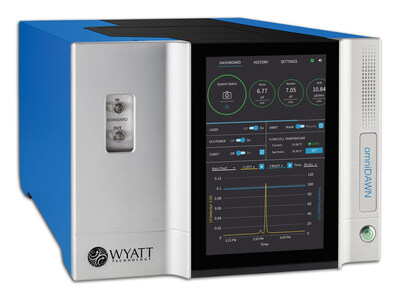
The omniDAWN MALS Photometer extends UPLC-compatible sizing ten-fold, from approximately 50 to 500 nm in radius, enabling reliable characterization of larger, more complex analytes such as protein aggregates, viral vectors, lipid nanoparticles (LNPs), and advanced materials. Because it provides absolute molar mass and size, the omniDAWN Photometer reduces reliance on column calibration standards and supports faster results and more confident comparisons, streamlining work across biosimilarity studies, antibody-drug conjugate (ADC) characterization, and viral vector analytics. As these modalities and other advanced therapeutics move into late-stage development and quality control, laboratories increasingly rely on UHPLC and UPLC Systems to meet rising throughput and resolution requirements.
"Advances in UHPLC and UPLC separations for complex biologics and newer modalities have outpaced detector technology, until now," said Rob Carpio, Senior Vice President, Waters Analytical Sciences, Waters Corporation. "The omniDAWN MALS Photometer brings extended-range multi-angle light scattering to modern separations. This means our customers can move faster while maintaining the resolution, robustness, and depth of characterization needed to accelerate the discovery, development, and quality control of next-generation therapies."
Integrating seamlessly with Waters UPLC Systems and columns, the omniDAWN Photometer eliminates traditional trade-offs between dispersion, robustness, and analytical performance, delivering a complete solution for multi-attribute characterization with improved usability2 compared to micro‑volume MALS approaches. When paired with UHPLC or UPLC Systems, the omniDAWN Photometer supports run times up to four times faster than conventional HPLC workflows, while reducing sample consumption by 30–
"Extending the capabilities of multi-angle light scattering to UHPLC and UPLC analysis will enable absolute molar mass measurements, paired with faster and more flexible separations. This represents a critical leap forward in MALS-based analyses, empowering us to better understand the structure of complex materials across drug delivery and environmental nanotechnology applications, ultimately supporting improved health outcomes," said Stacey Louie, Associate Professor, Department of Civil and Environmental Engineering, University of
The omniDAWN Photometer is powered by ASTRA™ Software, built on more than 40 years of light scattering innovation. By integrating MALS with ultraviolet (UV) and refractive index (RI) detection, ASTRA Software enables comprehensive analysis of size, composition, and heterogeneity in a single run, with dedicated workflows for ADCs, LNPs, and viral vectors. The platform is 21 CFR Part 11 and EU Annex 11 compliant and will be compatible with Waters Empower™ Software later this year.
The Waters omniDAWN MALS Photometer will be available globally in summer 2026. To learn more or request a demo, visit www.wyatt.com/omniDAWN.
Additional Resources:
Waters, omniDAWN, UPLC, ASTRA, Empower, and Wyatt Technology are trademarks of Waters Corporation or its affiliates.
About Waters Corporation:
Waters Corporation (NYSE: WAT) is a global leader in life sciences and diagnostics, dedicated to accelerating the benefits of pioneering science through analytical technologies, informatics, and service. With a focus on regulated, high-volume testing environments, our innovative portfolio harnesses deep scientific expertise across chemistry, physics, and biology. We collaborate with customers around the world to advance the release of effective, high-quality medicines, ensure the safety of food and water, and drive better patient outcomes by detecting diseases earlier, managing routine infections, and combating antibiotic resistance. Through a shared culture of relentless innovation, our passionate team of ~16,000 colleagues turn scientific challenges into breakthroughs that improve lives worldwide. For more information, please visit www.waters.com/about.
References:
- Comparative column and peak width analysis using UHPLC/UPLC versus HPLC SEC formats; internal evaluation. Source: internal data.
- Performance and range of 3-angle MALS compared to 18-angle MALS detector across representative analytes. Source: internal data.
- Performance comparison to conventional HPLC.
Contact:
Molly Gluck
Head of External Communications
Waters Corporation
508.498.9732
molly_gluck@waters.com

 View original content to download multimedia:https://www.prnewswire.com/news-releases/waters-debuts-industry-first-extended-range-mals-detector-for-uhplcuplc-powering-rapid-characterization-of-large-molecules-302741119.html
SOURCE Waters Corporation
FAQ
AI-generated questions and answers. How Rhea-AI works. Not financial advice.