
Immatics Presents Clinical Activity of IMA203CD8 PRAME Cell Therapy in Hard-to-Treat Gynecologic Cancers at 2026 ASCO Annual Meeting
Immatics (NASDAQ:IMTX) reported updated Phase 1 data for its PRAME-targeting TCR T-cell therapy IMA203CD8 in gynecologic cancers and synovial sarcoma at ASCO 2026.
Rhea-AI Summary
Immatics (NASDAQ:IMTX) reported updated Phase 1 data for its PRAME-targeting TCR T-cell therapy IMA203CD8 in gynecologic cancers and synovial sarcoma at ASCO 2026.
In clinically relevant gynecologic cohorts, ORR was 63% with 50% confirmed, including four complete responses. In synovial sarcoma, ORR was 67%, confirmed ORR 64%, with durable responses up to ~3 years. IMA203CD8 showed a manageable safety profile without treatment-related Grade 5 events, and Immatics expects to define the recommended Phase 2 dose (RP2D) in 2026 and present further data in the second half of 2026.
Positive
- Gynecologic cancers ≥DL4: ORR 63% (12/19), confirmed ORR 50% (9/18)
- Four complete responses in gynecologic cancers, with longest ongoing response at 12 months
- Synovial sarcoma: ORR 67% (8/12), confirmed ORR 64% (7/11)
- Synovial sarcoma median duration of response 14.8 months at 31.0 months median follow-up
- Disease control rate at week 6: 68% in gynecologic cancers, 100% in synovial sarcoma
- No IMA203CD8-related Grade 5 adverse events across reported patient populations
Negative
- Grade 3 cytokine release syndrome reported in 7% of gynecologic cancer patients
- Immune effector cell-associated neurotoxicity and HLH each observed in 7% of gynecologic patients
- Recommended Phase 2 dose is not yet defined and is expected in 2026
Key Figures
- ORR gynecologic cancers
- 63%
- IMA203CD8 at clinically relevant doses (≥DL4c) in ovarian and uterine cancers
- Confirmed ORR gynecologic
- 50%
- IMA203CD8 cORR (9/18) with four complete responses
- Longest response gynecologic
- 12 months
- Ongoing metabolic complete response after one-time IMA203CD8 infusion
- ORR synovial sarcoma
- 67%
- Phase 1 IMA203CD8 in heavily pretreated synovial sarcoma
- Confirmed ORR synovial
- 64%
- IMA203CD8 cORR (7/11) in synovial sarcoma across all doses
- Longest response synovial
- ~3 years
- Ongoing response after one-time IMA203CD8 infusion in synovial sarcoma
- mDOR synovial sarcoma
- 14.8 months
- Median duration of response at median follow-up of 31.0 months
- DCR synovial sarcoma
- 100%
- Disease control rate at week 6 (12/12) in synovial sarcoma
Historical Context
-
Reported Q1 2026 results and reiterated strong cash and PRAME pipeline timelines.
-
Announced four upcoming ASCO 2026 oral presentations across cell therapy and bispecifics.
-
Reported deep, durable remission in pediatric PRAME-positive nephroblastoma at AACR 2026.
-
Full-year 2025 results with extended cash reach and detailed anzu-cel timelines.
-
ESMO-IO 2025 Phase 1a IMA203CD8 data showing promising responses and manageable safety.
24h Move is the share-price change in the day after each event; other market factors may also have contributed.
Key Terms
objective response rate medical
cytokine release syndrome medical
immune effector cell-associated neurotoxicity syndrome medical
hemophagocytic lymphohistiocytosis medical
disease control rate medical
median duration of response medical
progression free survival medical
RECIST medical
AI-generated analysis. How Rhea-AI works. Not financial advice.




- One-time infusion of IMA203CD8 PRAME cell therapy in the ongoing Phase 1 dose escalation/dose expansion trial achieved anti-tumor activity in platinum-resistant ovarian cancer and in uterine cancer with a
63% objective response rate (ORR),50% confirmed ORR (cORR), including four complete responses, and longest ongoing response at 12 months - Additional Phase 1 data for IMA203CD8 in heavily pretreated patients with synovial sarcoma showed deep and durable responses with a
67% ORR and64% cORR, including one complete response, and ongoing responses up to ~3 years - IMA203CD8 demonstrated a manageable and consistent tolerability profile across patient populations
- Clinical anti-tumor activity observed across tumor types (ovarian carcinoma, uterine cancer, melanoma, synovial sarcoma) with distinct biology and differing levels of PRAME expression, including lower PRAME levels in ovarian carcinoma
- Clinical profile of IMA203CD8 supports continued development in gynecologic cancers and expansion into other PRAME-positive solid tumors
- Determination of recommended phase 2 dose (RP2D) remains expected in 2026
Houston, Texas and Tuebingen, Germany, May 30, 2026 – Immatics N.V. (NASDAQ: IMTX, “Immatics” or the “Company”), the global leader in precision targeting of PRAME with multiple clinical-stage programs spanning cell therapies and bispecifics, today announced updated Phase 1 data for its IMA203CD8 PRAME TCR T-cell therapy in gynecologic cancers and synovial sarcoma at the Annual Meeting of the American Society for Clinical Oncology (ASCO) in Chicago, IL, USA. One-time infusion of IMA203CD8 demonstrated meaningful clinical activity across different tumor types as well as manageable tolerability. The broad expression of PRAME in more than 50 cancers further supports the continued development of IMA203CD8 in multiple PRAME-positive solid tumors.
The updated Phase 1 results in gynecologic cancers will be presented on May 30, 2026, during the Rapid Oral Abstract Session – Gynecologic Cancer from 8:00-9:30 am CDT by Antonia Busse, M.D., Charité Medical University Hospital, Berlin, Germany (Abstract ID 5509). Presentation slides are accessible in the ‘Events & Presentations’ section of the Investors & Media section of the Company’s website. Phase 1 data in synovial sarcoma will be presented on May 31, 2026, during the Rapid Oral Abstract Session – Sarcoma from 4:30-6:00 pm CDT by Dejka M. Araujo M.D., The University of Texas MD Anderson Cancer Center (Abstract ID 11516). Presentation slides will be accessible on May 31, 2026.
“These clinical data in ovarian cancer, uterine cancer and synovial sarcoma, along with previously released data in melanoma, further reinforce our aim to develop IMA203CD8 in PRAME-positive cancers beyond melanoma. PRAME is expressed in more than 50 cancers, and the compelling anti-tumor activity observed in these historically hard-to-treat indications supports its promise as a broadly applicable target,” said Cedrik Britten, M.D., Ph.D., Chief Medical Officer at Immatics. “We are encouraged by the consistency of response signals observed with IMA203CD8 and remain focused on advancing IMA203CD8 in gynecologic cancers with the potential to broaden development to other indications in a tumor-agnostic approach to deliver meaningful outcomes to patients.”
Next development steps:
The clinical activity observed in ovarian cancer, a tumor type generally associated with lower levels of PRAME expression, together with the observed activity across tumor types with different and distinct tumor microenvironments, supports the broad applicability of IMA203CD8 across solid tumors with differing levels of PRAME and tumor biology, starting with ovarian and uterine cancer. Updated data from the ongoing study, including durability follow-up at the RP2D, are planned for presentation in the second half of 2026. Immatics is expanding clinical evaluation of IMA203CD8 into additional PRAME-positive solid tumor indications to more fully assess its therapeutic potential.
Highlights of Immatics’ clinical data on IMA203CD8 presented at ASCO 2026
Gynecologic cancers:
Patient population: Heavily pretreated patient population with limited treatment options
- As of March 30, 2026, 27 heavily pretreated patients with gynecologic cancers received a one-time infusion of IMA203CD8 in the ongoing Phase 1 dose escalation/dose expansion trial (NCT03686124).
- The median total infused dose across seven escalating dose levels was 3.3x10⁹ TCR T cells (range 0.5x10⁹ - 12.5x10⁹ TCR T cells) for ovarian carcinoma and 3.2x10⁹ TCR T cells (range 1.3x10⁹ - 10.1x10⁹ TCR T cells) for uterine cancer.
- All patients were heavily pretreated, including at least one prior line of platinum-based regimen. Patients with ovarian carcinoma had a median of four lines of systemic treatment (range 1-7), patients with uterine cancer had a median of two lines (range 1-3).
- The efficacy-evaluable1 patient population included 26 patients, 19 of whom were treated at clinically relevant doses (≥DL4c, median 5.4 x10⁹ TCR T cells, range 1.4 – 12.5): 17 with ovarian carcinoma and two with uterine cancer
Safety: Treatment with IMA203CD8 showed predictable and manageable tolerability
- IMA203CD8 demonstrated manageable tolerability in the 27 enrolled patients.
- The most frequent treatment-emergent adverse events (TEAE) were anticipated cytopenias associated with lymphodepletion.
- Expected and manageable cytokine release syndrome (CRS) was mostly low-grade and was consistent with the mechanism of action (Grade 1:
44% , Grade 2:44% , Grade 3:7% ). - Immune effector cell-associated neurotoxicity syndrome (ICANS) and hemophagocytic lymphohistiocytosis (HLH) were infrequently observed (any Grade:
7% , each). - No IMA203CD8-related Grade 5 events occurred.
- Based on the manageable tolerability profile, the Company expects to determine the recommended Phase 2 dose (RP2D) in 2026.
Anti-tumor activity: A one-time infusion of IMA203CD8 PRAME cell therapy showed anti- tumor activity in gynecologic cancers at clinically relevant doses (≥DL4c)
- Objective response rate (ORR):
63% (12/19), confirmed ORR (cORR)2:50% (9/18)- Including two confirmed and two unconfirmed complete responses
89% (8/9) of confirmed responses were ongoing as of the data cutoff with longest ongoing response at 12 months post infusion (metabolic complete response)- Responses were observed with and without low-dose IL-2
- Tumor reduction:
78% (14/18) - Disease Control Rate (DCR) at week 6:
68% (13/19) - Median duration of response (mDOR), median progression free survival (mPFS) and median overall survival (mOS) were not reached, with median follow-up times (mFU) of 3.9, 5.3 and 5.3 months, respectively
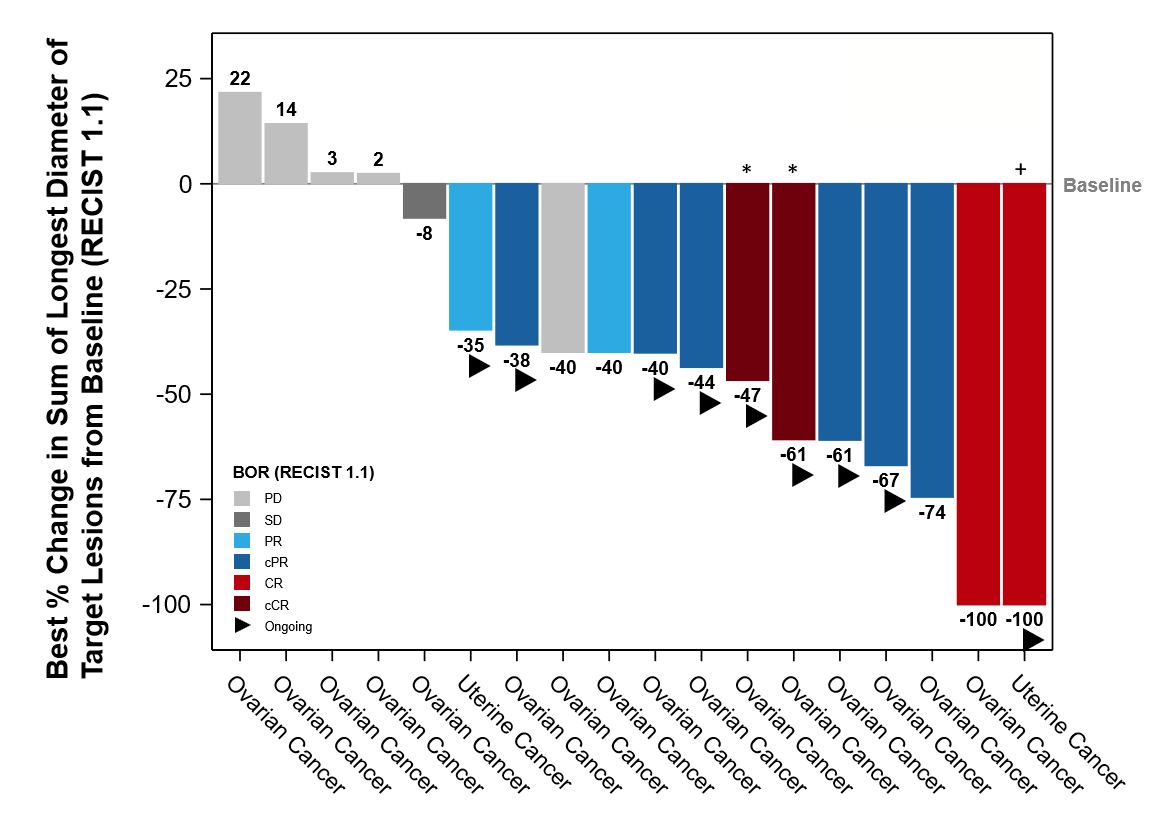
* For those patients who achieved a (c)CR with <
Synovial sarcoma:
- As of the March 30, 2026 data cutoff, 12 heavily pretreated patients with synovial sarcoma, who had received a median of two prior lines of systemic therapy (range, 1-5), were treated with a one-time infusion of IMA203CD8.
- The safety profile was manageable and consistent with the mechanism of action.
- The most frequent TEAEs were anticipated cytopenias associated with lymphodepletion. CRS events were expected, manageable and predominantly Grade 1/2.
- No IMA203CD8-related Grade 5 events were observed.
A one-time infusion of IMA203CD8 showed promising anti-tumor activity with deep and durable response in synovial sarcoma across all doses (median 1.59 × 10⁹ TCR T cells; range: 0.89–10.00 × 10⁹):
- ORR:
67% (8/12), cORR:64% (7/11)- 4 ongoing responses, including 1 confirmed complete response, with longest response ongoing at ~ 3 years
- Tumor reduction:
92% (11/12) - DCR at week 6:
100% (12/12) - mDOR: 14.8 months (3.7, 31.8+) at mFU of 31.0 months
About IMA203CD8 PRAME Cell Therapy
IMA203CD8 is Immatics’ PRAME-directed TCR T-cell therapy engineered to recognize an intracellular PRAME-derived peptide presented by HLA-A*02:01 on the cell surface and initiate a potent and specific anti-tumor response. The co-transduction of CD8αβ alongside the PRAME TCR adds functional CD4+ T cells designed to boost anti-tumor activity. IMA203CD8 is currently being evaluated in a Phase 1 clinical trial in solid tumors expressing PRAME.
About PRAME
PRAME is a target expressed in more than 50 cancers. Immatics is the global leader in precision targeting of PRAME and has the broadest PRAME franchise with the most PRAME indications and modalities. The Immatics PRAME franchise currently includes three product candidates, two therapeutic modalities and three combination therapies that target PRAME: anzu-cel (anzutresgene autoleucel, IMA203) PRAME cell therapy, IMA203CD8 PRAME cell therapy, IMA402 PRAME bispecific as monotherapy, in combination with immune checkpoint inhibitors, in combination with IMA401 MAGEA4/8 bispecific as well as anzu-cel in combination with Moderna’s PRAME mRNA designed to enhance cell therapy.
About Immatics
Immatics is committed to making a meaningful impact on the lives of patients with cancer. We are the global leader in precision targeting of PRAME, a target expressed in more than 50 cancers. Our cutting-edge science and robust clinical pipeline form the broadest PRAME franchise with the most PRAME indications and modalities, spanning TCR T-cell therapies and TCR bispecifics.
Immatics intends to use its website www.immatics.com as a means of disclosing material non-public information. For regular updates, you can also follow us on LinkedIn and Instagram.
Forward-Looking Statements
Certain statements in this press release may be considered forward-looking statements. Forward-looking statements generally relate to future events or the Company’s future financial or operating performance. For example, statements concerning timing of data read-outs for product candidates, observations from the Company’s clinical trials, the timing, outcome and design of clinical trials, the nature of clinical trials (including whether such clinical trials will be registration-enabling), the timing of IND, CTA or BLA filings, estimated market opportunities of product candidates, the Company’s focus on partnerships to advance its strategy, and other metrics are forward-looking statements. In some cases, you can identify forward-looking statements by terminology such as “may”, “should”, “expect”, “plan”, “target”, “intend”, “will”, “estimate”, “anticipate”, “believe”, “predict”, “potential” or “continue”, or the negatives of these terms or variations of them or similar terminology. Such forward-looking statements are subject to risks, uncertainties, and other factors which could cause actual results to differ materially from those expressed or implied by such forward-looking statements. These forward-looking statements are based upon estimates and assumptions that, while considered reasonable by Immatics and its management, are inherently uncertain. New risks and uncertainties may emerge from time to time, and it is not possible to predict all risks and uncertainties. Factors that may cause actual results to differ materially from current expectations include, but are not limited to, various factors beyond management's control including general economic conditions and other risks, uncertainties and factors set forth in the Company’s Annual Report on Form 20-F and other filings with the Securities and Exchange Commission (SEC). Nothing in this press release should be regarded as a representation by any person that the forward-looking statements set forth herein will be achieved or that any of the contemplated results of such forward-looking statements will be achieved. You should not place undue reliance on forward-looking statements, which speak only as of the date they are made. The Company undertakes no duty to update these forward-looking statements. All the scientific and clinical data presented within this press release are – by definition prior to completion of the clinical trial and a clinical study report – preliminary in nature and subject to further quality checks including customary source data verification.
For more information, please contact:
Media
Trophic Communications
Phone: +49 151 74416179
immatics@trophic.eu
Immatics N.V.
Jordan Silverstein
Head of Strategy
Phone: +1 346 319-3325
InvestorRelations@immatics.com
1 All patients who received IMA203CD8 infusion and had at least one post-baseline scan, progressive disease or death.
2 cORR excludes one patient with ongoing unconfirmed response at data cutoff.
Attachment

FAQ
AI-generated questions and answers. How Rhea-AI works. Not financial advice.