
Immatics Presents Data on IMA401 MAGEA4/8 Bispecific at 2026 ASCO Annual Meeting with Simultaneous Publication in Nature Medicine Supporting Development of IMA401/IMA402 Combination in Lung Cancer
Immatics (NASDAQ:IMTX) reported Phase 1 data for IMA401, a MAGEA4/8 TCR bispecific, in heavily pretreated solid tumors.
Rhea-AI Summary
Immatics (NASDAQ:IMTX) reported Phase 1 data for IMA401, a MAGEA4/8 TCR bispecific, in heavily pretreated solid tumors. At the recommended Phase 2 dose, IMA401 with or without pembrolizumab showed a 29% confirmed ORR and 64% DCR in head and neck cancer, with 8.8-month mDOR.
Melanoma patients achieved 33% cORR and 67% DCR, with responses lasting over six months. Safety showed mostly low-grade CRS, lymphopenia and neutropenia, with no ICANS observed. These data support an ongoing Phase 1 IMA401/IMA402 combination cohort in sqNSCLC, with first data expected in 2027.
Positive
- Head and neck cancer cORR 29% (4/14) and DCR 64% at RP2D
- Head and neck cancer median duration of response 8.8 months; deep 60–100% tumor shrinkage
- Melanoma cORR 33% (2/6) and DCR 67%; one response ongoing >2.5 years
- Favorable tolerability at 1–2 mg RP2D with or without pembrolizumab; no ICANS
- Phase 1 IMA401/IMA402 sqNSCLC combination cohort enrolling, targeting ~40,000 annual US+EU5 patients
- >90% of sqNSCLC patients express PRAME and/or MAGEA4/8, supporting broad target coverage
Negative
- Data are from an early-stage Phase 1 trial in 61 heavily pretreated patients
- Clinically relevant treatment-related events include low-grade CRS (38%), lymphopenia (33%) and neutropenia (31%)
- First IMA401/IMA402 sqNSCLC combination data not expected until 2027, delaying clarity on efficacy
Key Figures
- Head & neck cORR
- 29% (4/14)
- IMA401 at RP2D with/without pembrolizumab in head and neck cancer
- Head & neck DCR
- 64% (9/14)
- IMA401 at RP2D in head and neck cancer
- mDOR head & neck
- 8.8 months
- Median duration of response for IMA401 in head and neck cancer
- IMA401 Phase 1 patients
- 61 patients
- Recurrent/refractory solid tumors treated as of March 2, 2026 cutoff
- Median prior treatments
- 3 prior lines (range 1–8)
- Heavily pretreated Phase 1 population
- Melanoma cORR
- 33% (2/6)
- IMA401 at RP2D in melanoma
- sqNSCLC target prevalence
- >90%
- sqNSCLC patients positive for PRAME and/or MAGEA4/8
- Metastatic sqNSCLC population
- 40,000 patients/year
- Estimated addressable sqNSCLC population in US and EU5
Historical Context
-
Reported Q1 2026 results with $521.5M cash and PRAME pipeline updates.
-
Announced four upcoming ASCO 2026 oral presentations across cell therapy and bispecifics.
-
Late‑breaking AACR poster on deep, durable remission in PRAME‑positive nephroblastoma.
-
Full‑year 2025 update with $551.4M cash and timelines toward potential 2027 launch.
-
ESMO‑IO 2025 data showing 36% cORR and 9.2‑month median response for IMA203CD8.
24h Move is the share-price change in the day after each event; other market factors may also have contributed.
Key Terms
tcr medical
bispecific medical
pembrolizumab medical
immune checkpoint inhibitor medical
cytokine release syndrome medical
neutropenia medical
progression-free survival medical
recist medical
AI-generated analysis. How Rhea-AI works. Not financial advice.




- IMA401 achieved deep and durable responses in various indications, including melanoma and head and neck cancer, with an initial promising clinical signal observed in lung cancer
- In head and neck cancer, IMA401 treatment at recommended Phase 2 dose (RP2D) with or without pembrolizumab resulted in a
29% confirmed ORR (4/14),64% DCR (9/14) and mDOR of 8.8 months; all responders achieved deep responses with 60-100% tumor reduction - IMA401 MAGEA4/8 TCR bispecific demonstrated favorable tolerability at RP2D with or without pembrolizumab, suggesting its potential for broad combinability
- IMA401 data will be presented in an oral presentation at the 2026 ASCO Annual Meeting and published simultaneously in Nature Medicine
- The data support Immatics’ strategy to combine IMA401 with IMA402 (PRAME bispecific) in lung cancer and potentially other indications, where the combined target prevalence supports broad patient coverage and potential synergistic activity; the IMA401/IMA402 combination cohort is now enrolling at multiple clinical trial sites, with first data expected in 2027
Houston, Texas and Tuebingen, Germany, May 31, 2026 – Immatics N.V. (NASDAQ: IMTX, “Immatics” or the “Company”), the global leader in precision targeting of PRAME with multiple clinical-stage programs spanning cell therapies and bispecifics, today announced the presentation of extended data from the ongoing Phase 1 clinical trial evaluating its TCR bispecific (TCER®) candidate IMA401 targeting MAGEA4/8 in heavily pretreated patients with solid tumors, including head and neck cancer and lung cancer, in an oral presentation at the Annual Meeting of the American Society for Clinical Oncology (ASCO) in Chicago, IL, USA. The data show a consistent and favorable tolerability profile across multiple tumor types and encouraging anti-tumor activity at the recommended Phase 2 dose (RP2D) with or without the immune checkpoint inhibitor (ICI) pembrolizumab. Results from the Phase 1 study are being published simultaneously in Nature Medicine.
Data from the ongoing Phase 1 study of IMA401 will be presented on May 31, 2026, during the Developmental Therapeutics Session – Immunotherapy from 8:00-11:00 am CDT by Martin Wermke, M.D., TU Dresden University of Technology, NCT/UCC Early Clinical Trial Unit, Dresden, Germany (Abstract ID: 2507). The slides are available in the ‘Events & Presentations’ section of the Investor & Media page on the Company’s website.
Carsten Reinhardt, M.D., Ph.D., Chief Development Officer at Immatics, said, “The IMA401 clinical data represent an important step forward for our next-generation, off-the-shelf TCER® platform and reinforce the potential of this modality to address both advanced and earlier-stage solid tumors. Building on the encouraging clinical activity and supportive preclinical findings, we believe IMA401 may have even greater potential in combination with IMA402, our PRAME-directed bispecific. The initiation of the IMA401/IMA402 combination cohort in squamous cell non-small cell lung cancer marks a milestone toward broadening patient reach and delivering meaningful clinical benefit for patients with significant unmet needs.”
Based on the clinical data for IMA401, including the initial clinical signal in squamous cell non-small cell lung cancer (sqNSCLC), as well as preclinical proof-of-concept data and clinical data for IMA402, Immatics has initiated enrollment in a Phase 1 cohort at multiple clinical trial sites evaluating IMA401 targeting MAGEA4/8 in combination with IMA402 targeting PRAME in sqNSCLC. The dual targeting approach is designed to broaden patient coverage and potentially enhance anti-tumor activity by addressing two highly prevalent cancer targets, with sqNSCLC as the first indication, and further development potential for many others. Based on combined target prevalence, more than
Highlights of Immatics’ clinical data on IMA401
Patient population: Heavily pretreated, highly heterogeneous patient population
- As of the data cutoff on March 2, 2026, 61 patients with recurrent and/or refractory solid tumors across >15 different tumor types were treated with IMA401 with or without an immune checkpoint inhibitor (ICI, pembrolizumab) in a Phase 1 dose-escalation basket trial (NCT05359445).
- Patients were heavily pretreated with a median of three prior lines of systemic treatment (range: 1-8).
- 44 patients were treated at RP2D (1-2 mg), with 32 receiving monotherapy and 12 receiving the combination of IMA401 and pembrolizumab. Among these patients, head and neck cancer represented the largest subgroup treated at RP2D (n=14).
Safety: Favorable tolerability at RP2D supporting broad combinability of IMA401
- The tolerability profile of IMA401 with or without pembrolizumab was consistent across patient populations.
- The most frequent clinically relevant treatment-related adverse events (TRAE) observed across dose levels were low-grade cytokine release syndrome (CRS) (
38% G1-2, no ≥ Grade 3), expected and transient lymphopenia (33% ), consistent with the mechanism of action, and neutropenia (31% ). Within the RP2D range of 1-2 mg, neutropenia was mostly transient and manageable. - Notably, no immune effector cell-associated neurotoxicity syndrome (ICANS) was observed.
- Tolerability of IMA401 at RP2D in combination with pembrolizumab was consistent with IMA401 as a monotherapy at RP2D, with no overlapping and/or additive toxicity observed.
- Tolerability profile of IMA401, both as a monotherapy and with pembrolizumab, supports broad combination potential of IMA401.
Anti-tumor activity and durability: Promising clinical activity with deep and durable responses
Patients treated with IMA401 at RP2D as a monotherapy or in combination with pembrolizumab demonstrated clinical activity across multiple solid tumor indications, including melanoma, sqNSCLC, head and neck cancer and others:
- Head and neck cancer (largest patient subgroup treated at RP2D): confirmed objective response rate (cORR) of
29% (4/14), disease control rate (DCR) of64% (9/14), median duration of response (mDOR) of 8.8 months. The 12-month overall survival (OS) rate was63% and the six-month progression-free survival (PFS) rate was43% . All responders achieved deep tumor reduction ranging from 60-100% and three of four responders were ongoing at data cutoff. - Melanoma: cORR of
33% (2/6), DCR of67% (4/6); both confirmed responses lasted beyond six months post treatment, with one ongoing for >2.5 years. - sqNSCLC: A presented patient case highlighted a patient with ICI-resistant sqNSCLC who received IMA401 plus pembrolizumab in fifth-line (prior best overall response: stable disease) and achieved a partial response with shrinkage of all target lesions.
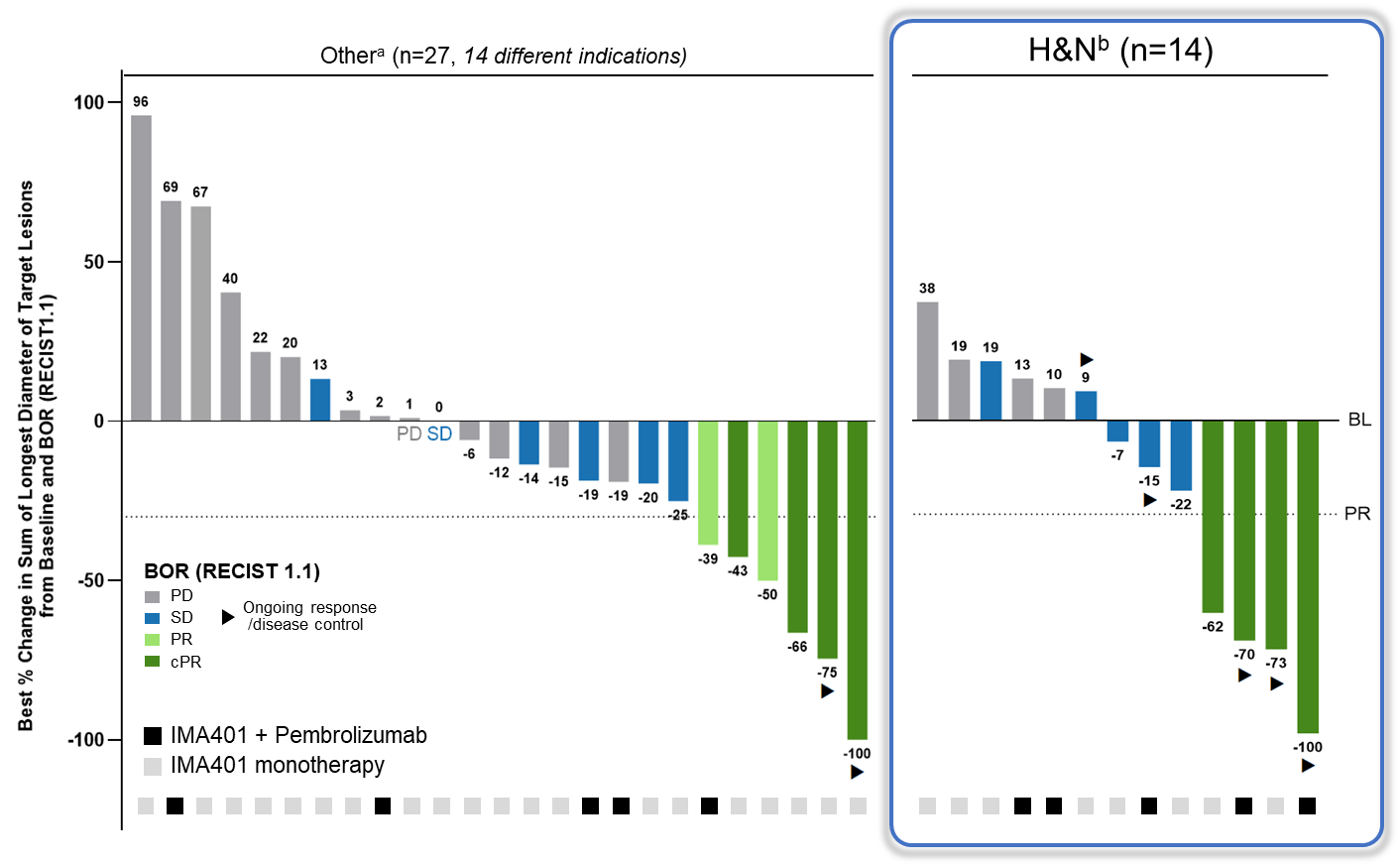
a Two patients not shown in plot due to clinical progression before post-infusion scan. b One patient not shown in plot due to clinical progression before post-infusion scan. BL: Baseline; BOR: Best overall response; (c)PR: (confirmed) partial response; H&N: head and neck cancer; PD: progressive disease; RECIST: response evaluation criteria in solid tumors; SD: stable disease.
Preclinical data: Supporting broad patient coverage and potential synergistic activity of IMA401/IMA402 combination
- Target expression data from analyzed tumor samples showed that >
90% of patients with sqNSCLC are positive for PRAME and/or MAGEA4/8, and ~60% of patients with sqNSCLC are positive for both targets, suggesting that a combination therapy against both targets could boost anti-tumor activity and counteract potential tumor escape mechanisms. - IMA401/IMA402 combination demonstrated synergistic anti-tumor activity in MAGEA4/8 and PRAME double-positive tumor cell lines.
Data on the IMA401 Phase 1 trial are published simultaneously in Nature Medicine.
About Immatics TCR Bispecifics (TCER®)
Immatics’ next-generation half-life extended TCER® molecules are antibody-like “off-the-shelf” biologics that leverage the body’s immune system by redirecting and activating T cells towards cancer cells expressing a specific tumor target. The design of the TCER® molecules enables the activation of any T cell in the body to attack the tumor, regardless of the T cells’ intrinsic specificity. Immatics’ proprietary biologics are engineered with two binding regions: a TCR domain and a T cell recruiter domain. The TCER® format is designed to maximize efficacy while minimizing toxicities in patients. It contains a high-affinity TCR domain that is designed to bind specifically to the cancer target peptide on the cell surface presented by an HLA molecule. The antibody-derived, low-affinity T cell recruiter domain is directed against the TCR/CD3 complex and recruits a patient’s T cells to the tumor to attack cancer cells. With a low-affinity recruiter aiming for optimized biodistribution and enrichment of the molecule at the tumor site instead of the periphery, TCER® are engineered to reduce the occurrence of immune-related adverse events, such as cytokine release syndrome. In addition, the TCER® format comprises an Fc part that confers half-life extension, stability, and manufacturability. TCER® molecules are “off-the-shelf” biologics and thus immediately available for patient treatment. They can be distributed through standard pharmaceutical supply chains and can reach a large patient population without the need for specialized medical centers.
About IMA401 MAGEA4/8 Bispecific
IMA401 is a molecule from Immatics’ TCR bispecifics pipeline that targets an HLA-A*02:01-presented peptide derived from two different cancer-associated proteins, melanoma-associated antigen 4 and/or 8 (“MAGEA4/8”). The MAGEA4/8 peptide has been identified and validated by Immatics’ proprietary mass spectrometry-based target discovery platform XPRESIDENT® and is presented at a 5-fold higher target density (copy number per tumor cell) than the MAGEA4 peptide targeted in other clinical trials. IMA401 is currently being evaluated in a Phase 1 basket trial in patients with MAGEA4/8-positive solid tumors. The MAGEA4/8 peptide has a high prevalence in several solid tumor indications such as head and neck squamous cell carcinoma (HNSCC), squamous cell non-small cell lung cancer (sqNSCLC), as well as melanoma and other solid cancer types.
About IMA402 PRAME Bispecific
IMA402 is a molecule from Immatics’ TCR bispecifics (TCER®) pipeline directed against an HLA-A*02:01-presented peptide derived from PRAME. IMA402 is currently being evaluated in a Phase 1 trial in patients with solid tumors expressing PRAME. IMA402 is part of Immatics’ strategy to leverage the full clinical potential of targeting PRAME, one of the most promising targets for TCR-based therapies.
About Immatics
Immatics is committed to making a meaningful impact on the lives of patients with cancer. We are the global leader in precision targeting of PRAME, a target expressed in more than 50 cancers. Our cutting-edge science and robust clinical pipeline form the broadest PRAME franchise with the most PRAME indications and modalities, spanning TCR T-cell therapies and TCR bispecifics.
Immatics intends to use its website www.immatics.com as a means of disclosing material non-public information. For regular updates, you can also follow us on LinkedIn and Instagram.
Forward-Looking Statements
Certain statements in this press release may be considered forward-looking statements. Forward-looking statements generally relate to future events or the Company’s future financial or operating performance. For example, statements concerning timing of data read-outs for product candidates, observations from the Company’s clinical trials, the timing, outcome and design of clinical trials, the nature of clinical trials (including whether such clinical trials will be registration-enabling), the timing of IND, CTA or BLA filings, estimated market opportunities of product candidates, the Company’s focus on partnerships to advance its strategy, and other metrics are forward-looking statements. In some cases, you can identify forward-looking statements by terminology such as “may”, “should”, “expect”, “plan”, “target”, “intend”, “will”, “estimate”, “anticipate”, “believe”, “predict”, “potential” or “continue”, or the negatives of these terms or variations of them or similar terminology. Such forward-looking statements are subject to risks, uncertainties, and other factors which could cause actual results to differ materially from those expressed or implied by such forward-looking statements. These forward-looking statements are based upon estimates and assumptions that, while considered reasonable by Immatics and its management, are inherently uncertain. New risks and uncertainties may emerge from time to time, and it is not possible to predict all risks and uncertainties. Factors that may cause actual results to differ materially from current expectations include, but are not limited to, various factors beyond management's control including general economic conditions and other risks, uncertainties and factors set forth in the Company’s Annual Report on Form 20-F and other filings with the Securities and Exchange Commission (SEC). Nothing in this press release should be regarded as a representation by any person that the forward-looking statements set forth herein will be achieved or that any of the contemplated results of such forward-looking statements will be achieved. You should not place undue reliance on forward-looking statements, which speak only as of the date they are made. The Company undertakes no duty to update these forward-looking statements. All the scientific and clinical data presented within this press release are – by definition prior to completion of the clinical trial and a clinical study report – preliminary in nature and subject to further quality checks including customary source data verification.
For more information, please contact:
Media
Trophic Communications
Phone: +49 151 74416179
immatics@trophic.eu
Immatics N.V.
Jordan Silverstein
Head of Strategy
Phone: +1 346 319-3325
InvestorRelations@immatics.com
Attachment

FAQ
AI-generated questions and answers. How Rhea-AI works. Not financial advice.