
Eco Wave Power Completes First Phase of AI-Powered Digital Twin, Advancing Intelligent Wave Energy and Future AI Data Center Applications
Potential later phases would connect the virtual model to energy-conversion equipment, operational data and broader machine-learning capabilities.
Sentiment and the balance of points
Rhea-AI Sentiment reads the wording of the document, how positive or negative its language is on a 1 to 5 scale. The balance of points shown with the takes weighs what the document actually discloses, so the two can disagree, for example when a trial that missed its main goal is described in upbeat language.
Rhea-AI Summary
Eco Wave Power (NASDAQ: WAVE) completed the first phase of its AI-powered digital twin program with Germany-based AI engineering. The phase created a physics-based virtual model of wave interactions with its floaters, including initial machine-learning capabilities for energy and load forecasting.
The company expects Phase 2 to cover hydraulic and mechanical energy conversion. Potential Phases 3 and 4 would add operational data and broader machine-learning capabilities. Eco Wave Power is discussing potential electricity supply with coastal data-center developers and infrastructure partners, while developing secure connection and electricity-settlement technology.
NVIDIA Networking provided a support letter for a proposed research project submitted to the Israel Innovation Authority. Its intended assistance depends on project funding and a mutual written agreement.
Positive
- Minor pointPhase 1 completed with AI engineering, establishing a physics-based digital model with initial forecasting capabilities.
- Minor point. Forward-looking: it has not happened yet and may not happen.Phase 2 is expected to expand the model to hydraulic and mechanical energy conversion.
- Minor point. Forward-looking: it has not happened yet and may not happen.Potential Phase 3 would connect the model to operational sensors, environmental conditions and electricity-generation data.
- Minor point. Forward-looking: it has not happened yet and may not happen.Potential Phase 4 would add broader machine learning for forecasting, system-behavior prediction and optimization.
- Minor pointData-center discussions cover potential wave-generated electricity supply to coastal and nearshore facilities.
2 minor points
- Minor pointSecure connection and settlement technology is under development for linking wave generation with data-center infrastructure.
- Minor pointNVIDIA Networking support letter backs the proposed Digital Twin & Energy-Aware Computing research project.
Negative
- Minor point. Forward-looking: it has not happened yet and may not happen.NVIDIA Networking's intended assistance requires project funding and a mutual written agreement.
Details
Market move: WAVE -5.47% vs previous close. Phase 1 digital twin milestone
On Nov 2, the day this news came out, the latest delayed price for WAVE is 5.47% below the previous close. The latest delayed price is $4.49.
Data tracked by StockTitan Argus (15 min delayed). Upgrade to Gold for real-time data.
Key Figures
- Digital Twin development phase
- Phase 1 completed
- AI-powered wave energy program
Previous AI Reports
-
Agreement launched the same physics-based platform; Phase 1 scope included wave-floater modeling and forecasting.
24h Move is the share-price change in the day after each event; other market factors may also have contributed.
Key Terms
digital twin technical
machine-learning technical
computational-fluid-dynamics technical
fluid-structure interaction technical
AI-generated analysis. How Rhea-AI works. Not financial advice.


Milestone establishes digital foundation for predictive wave energy systems; both Eco Wave Power
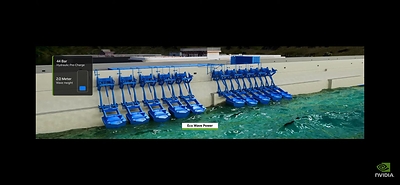
The milestone represents an important step in Eco Wave Power's strategy to make wave energy increasingly intelligent, predictive and scalable.
Phase 1 created a physics-based digital model of how ocean waves interact with Eco Wave Power's proprietary floaters. The work included simulations of wave loading, floater movement, structural forces and potential energy generation under varying sea conditions, together with initial machine-learning capabilities for energy and load forecasting.
Importantly, the project also evaluated how the model can be adapted to future sites with different wave conditions — potentially enabling Eco Wave Power to transfer knowledge and engineering insights from one project to the next as it expands globally.
"We are building the digital intelligence around our physical technology," said Inna Braverman, Founder and CEO of Eco Wave Power.
"Our technology already converts ocean waves into clean electricity. By combining it with Digital Twins and AI, our goal is to increasingly predict system performance, optimize our technology before deployment and learn faster from every project we build."
"We believe this can help us improve engineering decisions, accelerate deployment and ultimately create increasingly intelligent wave energy systems as we move toward larger commercial installations."
NVIDIA: Connecting AI, Energy and Digital Twins
Both Eco Wave Power
As part of the Digital Twin initiative, the companies are utilizing and evaluating NVIDIA Omniverse for Digital Twin visualization and simulation workflows, NVIDIA Warp within the simulation and modeling toolchain, and NVIDIA-accelerated computing infrastructure to support high-fidelity simulation and machine-learning development.
Eco Wave Power's technology was also featured twice during 2026 in keynote presentations by NVIDIA Founder and CEO Jensen Huang.
In June 2026, NVIDIA further highlighted Eco Wave Power in a dedicated corporate blog titled 'Eco Wave Power Turns Waves Into Watts With NVIDIA AI Infrastructure and Digital Twins.'
NVIDIA corporate blog:
https://blogs.nvidia.com/blog/eco-wave-power-ai-digital-twins/
The NVIDIA feature explored how NVIDIA AI infrastructure, accelerated computing and NVIDIA Omniverse libraries can support Digital Twins of wave energy systems, predictive optimization and, longer term, energy-aware computing and ocean-powered data centers.
In September 2026, Eco Wave Power received an additional show of support when NVIDIA Networking (Mellanox Technologies Ltd., a subsidiary of NVIDIA Corporation) provided a formal letter supporting Eco Wave Power's proposed 'Digital Twin & Energy-Aware Computing' research project submitted to the Israel Innovation Authority.
In the letter, NVIDIA Networking described Eco Wave Power's initiative as "a key opportunity to demonstrate the application of AI, accelerated computing and Digital Twin technologies to next-generation renewable energy infrastructure" and expressed strong interest in the technology and its development.
NVIDIA Networking further stated that, if the project receives funding, it intends to assist Eco Wave Power in achieving the project's mission, subject to a mutual written agreement between the companies.
AI Engineering: Building the Physics Behind the Digital Twin
"Wave energy is a particularly challenging engineering problem because it combines complex free-surface fluid dynamics, structural motion, and highly variable environmental conditions. Our goal is to create a physics-based digital representation of Eco Wave Power's system that links high-fidelity simulation with operational data. This approach allows us to better understand energy capture, structural loading, and system behavior across a wide range of sea states. Over time, combining these physics models with machine learning can support more accurate forecasting, design optimization, and scalable deployment of wave energy technology," said PD Dr.-Ing. habil. Stefan Adami, Co-Founder and General Manager of AI engineering GmbH.
From Smarter Wave Energy to AI Data Centers
Eco Wave Power believes the Digital Twin can have applications beyond optimizing wave energy generation.
As AI data centers require increasing amounts of electricity, Eco Wave Power sees a significant opportunity to supply wave-generated renewable electricity directly to data centers located in proximity to coastlines.
The Company is currently in discussions with a number of data-center developers and infrastructure partners regarding the potential supply of wave-generated electricity to coastal and nearshore data-center facilities.
In parallel, Eco Wave Power is working to develop technology designed to enable a secure connection between wave-energy generation systems and data-center infrastructure, together with a secure settlement mechanism intended to support trusted measurement, verification and settlement of the electricity supplied.
The Digital Twin could add another important layer to this infrastructure by forecasting when wave-energy production is expected to increase or decrease. This information could ultimately be combined with data-center electricity demand, energy storage and grid availability, enabling computing infrastructure to better coordinate its energy consumption with renewable-energy availability.
This vision was also highlighted by NVIDIA in its corporate blog on Eco Wave Power, which discussed using AI to align energy-intensive computing workloads with renewable-energy generation.
"AI can help make wave energy smarter — and wave energy can help provide the electricity that AI increasingly needs," Braverman said.
"We believe this is where the opportunity becomes particularly exciting. We are not only developing the intelligence to predict and optimize wave-energy production; we are also working on the secure infrastructure needed to connect that electricity directly with the data centers that need it."
"Our discussions with data-center developers are an important part of understanding how wave energy can become a practical part of the future energy mix for AI infrastructure, particularly in coastal locations."
Next Steps: Toward an Intelligent Wave Energy System
With Phase 1 completed, Eco Wave Power and AI engineering have established a roadmap for potential subsequent stages of the Digital Twin.
Phase 2 is expected to expand the model to Eco Wave Power's hydraulic and mechanical energy-conversion system.
Phase 3 would connect the Digital Twin with real-world operational sensors, environmental conditions and actual electricity-generation data.
Phase 4 would introduce a broader machine-learning operational layer designed to support energy forecasting, system-behavior prediction and increasingly intelligent optimization.
"Phase 1 gave us the digital foundation. The next stages are about connecting that foundation to our full energy-conversion system, real-world data and ultimately AI-driven operation," Braverman concluded.
"Our goal is simple: to make wave energy smarter, easier to scale and increasingly capable of interacting intelligently and securely with the energy infrastructure of the future."
About AI engineering GmbH
AI engineering GmbH is a
The company develops PAMICS, a particle-based multiphysics simulation framework for complex fluid-flow applications and Digital Twin development. AI engineering is a member of the NVIDIA Inception program.
About Eco Wave Power Global AB (publ)
Eco Wave Power Global (NASDAQ: WAVE) is a leading onshore wave energy company that converts ocean and sea waves into clean, reliable and cost-efficient electricity using its patented technology. The Company installs its systems on existing coastal infrastructure, including breakwaters, jetties and piers, enabling renewable electricity generation close to coastal cities, ports and energy-intensive infrastructure.
Eco Wave Power developed and operates Israel's first grid-connected wave energy power station and launched the first onshore wave energy pilot project in the United States at the Port of Los Angeles. The Company is also advancing projects in Portugal, Taiwan, India and other markets, with a global project pipeline of 404.7 MW.
Eco Wave Power has received support and recognition from organizations including the European Union, Innovate UK and the United Nations and is publicly traded on the Nasdaq Capital Market under the symbol WAVE.
For more information, please visit Eco Wave Power's website: www.ecowavepower.com
Press inquiries:
info@ecowavepower.com
Forward-Looking Statements
This press release contains forward-looking statements within the meaning of the "safe harbor" provisions of the U.S. Private Securities Litigation Reform Act of 1995 and other Federal securities laws. For example, the Company (NASDAQ: WAVE) is using forward-looking statements in this press release when it discusses the potential future development and benefits of its Digital Twin platform, including potential subsequent phases of the Digital Twin program with AI engineering GmbH and the future integration of hydraulic and mechanical energy-conversion modeling, real-world operational data, machine learning and energy forecasting; the potential for the Digital Twin to improve engineering decisions, accelerate deployment and enhance the scalability and optimization of its technology; the development of technology for secure connection and settlement between wave-energy generation systems and data-center infrastructure; its discussions with data-center developers and infrastructure partners and the potential supply of wave-generated electricity to coastal and nearshore data-center facilities; potential applications of wave energy and the Digital Twin for data centers and AI infrastructure; potential funding for the Digital Twin & Energy-Aware Computing research project and any assistance NVIDIA Networking may provide in connection with that project, which remains subject to a mutual written agreement and to change; and the Company's continued use and evaluation of NVIDIA technologies. Forward-looking statements can be identified by words such as: "anticipate," "intend," "plan," "goal," "seek," "believe," "project," "estimate," "expect," "strategy," "future," "likely," "may," "should," "will", or variations of such words, and similar references to future periods. These forward-looking statements and their implications are neither historical facts nor assurances of future performance and are based on the current expectations of the management of Eco Wave Power and are subject to a number of factors, uncertainties and changes in circumstances that are difficult to predict and may be outside of Eco Wave Power's control that could cause actual results to differ materially from those described in the forward-looking statements. Therefore, you should not rely on any of these forward-looking statements. Except as otherwise required by law, Eco Wave Power undertakes no obligation to publicly release any revisions to these forward-looking statements to reflect events or circumstances after the date hereof or to reflect the occurrence of unanticipated events. More detailed information about the risks and uncertainties affecting Eco Wave Power is contained under the heading "Risk Factors" in Eco Wave Power's Annual Report on Form 20-F for the fiscal year ended December 31, 2025 filed with the SEC on March 12, 2026, which is available on the SEC's website, www.sec.gov, and other documents filed or furnished to the SEC. Any forward-looking statement made in this press release speaks only as of the date hereof. References and links to websites have been provided as a convenience and the information contained on such websites is not incorporated by reference into this press release.
 View original content to download multimedia:https://www.prnewswire.com/news-releases/eco-wave-power-completes-first-phase-of-ai-powered-digital-twin-advancing-intelligent-wave-energy-and-future-ai-data-center-applications-302926362.html
SOURCE Eco Wave Power Global AB (publ)
FAQ
AI-generated questions and answers. How Rhea-AI works. Not financial advice.
What did Eco Wave Power complete in Phase 1 of its digital twin program?
Eco Wave Power completed a physics-based virtual model of how ocean waves interact with its floaters. The work simulated wave loading, floater movement, structural forces and potential energy generation under varying sea conditions, and included initial machine-learning capabilities for energy and load forecasting.
Does Eco Wave Power have an agreement for NVIDIA Networking to assist its research project?
NVIDIA Networking's intended assistance is conditional on project funding and a mutual written agreement. Its September 2026 support letter concerned Eco Wave Power's proposed Digital Twin & Energy-Aware Computing research project submitted to the Israel Innovation Authority.
How is Eco Wave Power using NVIDIA technology in its digital twin development?
Eco Wave Power and AI engineering are utilizing and evaluating NVIDIA Omniverse for visualization and simulation workflows, NVIDIA Warp within the simulation and modeling toolchain, and NVIDIA-accelerated computing infrastructure for simulation and machine-learning development. Both Eco Wave Power U.S. and AI engineering are NVIDIA Inception members.
Did Eco Wave Power test whether its digital model could be adapted to other sites?
Phase 1 evaluated how the model could be adapted to future sites with different wave conditions. The company sees potential to transfer knowledge and engineering insights between projects as it expands; this remains a potential application rather than a reported deployment at those future sites.