
New Research on Frontline Workers Finds Widening Expectation Gap in Schedule Flexibility, Pay Clarity and Digital Tools
A new survey from DailyPay and Workday shows sizable gaps between frontline workers’ expectations and employers’ offerings on schedules, pay clarity and digital tools.
Rhea-AI Summary
Workday (WDAY) and DailyPay released a Harris Poll study, “The Frontline Worker Expectation Gap,” highlighting large gaps between frontline workers’ priorities and what employers provide.
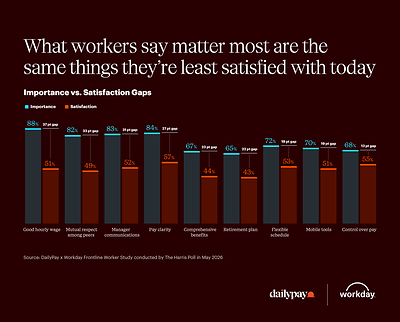
The survey of 2,208 U.S. hourly workers aged 18–45 finds 78% calculate expenses such as gas, commuting and childcare before accepting shifts, 46% borrow between pay periods, and 69% check pay after each shift. Control over schedules is important to 72% but only 51% are satisfied. Pay clarity and high wages matter to 84% and 88%, yet only 57% are very satisfied with pay clarity. Mobile tools are important to 70%, while 53% are satisfied with their access.
Recruiting and retention are affected: 45% rank schedule among the top three reasons for taking their job, 77% say on-demand pay influences choice between offers, and 23% say the right digital tools increase loyalty. On technology, 36% say digital tools and 34% say AI boost productivity, but 50% worry AI will replace jobs, even though 64% of workers whose employers already use AI report a positive impact. More than half (52%) do not expect employers to close these gaps.
Positive
- None.
Negative
- None.
Key Figures
- Survey sample
- 2,208 adults
- U.S. hourly employees ages 18-45
- Expense calculation
- 78%
- Frontline workers calculating costs before accepting a new shift
- Between-pay borrowing
- 46%
- Frontline workers borrowing money between pay periods
- Schedule control
- 72% important; 51% satisfied
- Frontline workers' schedule-control expectations and satisfaction
- Pay clarity
- 84% priority; 57% very satisfied
- Frontline workers' pay-clarity priorities and satisfaction
- Mobile tools
- 70% important; 53% satisfied
- Frontline workers' mobile-tool expectations and satisfaction
- On-demand pay impact
- 77%
- Frontline workers saying access sways choices between competitive job offers
- Positive AI impact
- 64%
- Workers whose employers already use AI reporting a positive impact
Key Terms
on-demand pay financial
bayesian credible interval technical
AI-generated analysis. How Rhea-AI works. Not financial advice.




Frontline Worker Research from DailyPay and Workday Reveals Closing This Gap Unlocks Key Advantages in Recruiting, Retention and Productivity
Frontline Workers Are Making Calculated Decisions About Work
Frontline workers are calculating the cost of essential expenses that can be largely invisible to employers: According to the report,
These decisions come amidst broader financial pressures. Nearly half (
Against that backdrop, the research identifies three areas where frontline workers want more from their workplace experience: autonomy over their time and money, transparency around pay and communication and access to digital tools.
The Expectation Gap
Employees' top priorities are their biggest pain points. The research revealed, every aspect of work measured has a double-digit gap between how important it is to frontline workers and how satisfied they are with their employer's offerings.
Control over work schedule is important to
"Employee expectations regarding their time, money and jobs have evolved. Yet, the systems supporting them haven't kept pace," said Andrew Brandman, chief operating officer, DailyPay. "As employers look to close the gap, they're also positioning themselves to have a competitive advantage in hiring and retention."
Employer Opportunity
The findings point to implications across recruiting, retention and the employee experience.
- Recruiting:
45% of frontline workers rank their schedule among the top three factors in accepting their current job, second only to pay. - Retention: More than three-quarters (
77% ) of frontline workers say access to on-demand pay sways their decision between two competitive job offers.23% say the right digital tools make them more likely to stay with their current employer. - Productivity: More than a third of frontline workers say digital tools (
36% ) and AI (34% ) boost productivity, while34% say digital tools improve manager communication. In fact, frontline workers are open to AI when it makes their jobs easier. Half (50% ) still worry AI will replace their jobs, but among those whose employers already use AI,64% report a positive impact.
"Frontline workers want tools that make their daily lives easier, not more complex," said Josh Secrest, vice president of Paradox, Workday. "Employers won't solve retention issues with piecemeal technology. When you bring scheduling, pay clarity, and frontline support together on one intuitive platform, you are able to build trust with your teams while helping your business thrive."
Many frontline workers don't expect these gaps to close. More than half (
The report includes detailed findings and recommendations for how employers can address the gap. Download the research report at www.dailypay.com/resource-center/frontline-worker-study.
Research methodology
The research was conducted online in
Data is weighted where necessary by age, gender, race/ethnicity, region, education, marital status, household size, household income, industry, and smoking status to bring them in line with their actual proportions in the population.
Respondents for this survey were selected from among those who have agreed to participate in our surveys. The sampling precision of
All sample surveys and polls, whether or not they use probability sampling, are subject to other multiple sources of error which are most often not possible to quantify or estimate, including, but not limited to coverage error, error associated with nonresponse, error associated with question wording and response options, and post-survey weighting and adjustments.
About DailyPay
DailyPay is the leader in On-Demand Pay, helping employers modernize how people get their pay. DailyPay serves more than 2,000 employers and over 6 million employees, including many of the world's most recognized brands. Through access to earned wages and financial wellness tools, DailyPay empowers workers to manage their finances and helps employers attract and retain talent. DailyPay is helping define the future of pay, where money moves at the speed of work. Learn more at www.dailypay.com/press.
About Workday
Workday operates at the heart of the enterprise – HR, finance, and IT – where the margin for error is effectively zero. By tightly coupling AI with the context, guardrails, and trusted processes that run the business, Workday goes beyond AI that assists with work to agents that are capable of driving measurable outcomes. More than 11,500 organizations worldwide, including more than
© 2026 Workday, Inc. All rights reserved. Workday and the Workday logo are trademarks of Workday, Inc. All other brand and product names are trademarks or registered trademarks of their respective holders.
Media Contacts:
Douglas Myers
douglas.myers@dailypay.com
Workday Media Inquiries
media@workday.com

 View original content to download multimedia:https://www.prnewswire.com/news-releases/new-research-on-frontline-workers-finds-widening-expectation-gap-in-schedule-flexibility-pay-clarity-and-digital-tools-302881508.html
SOURCE DailyPay; Workday
FAQ
AI-generated questions and answers. How Rhea-AI works. Not financial advice.
What are the main areas of the frontline worker expectation gap identified in the research?
The report highlights three key areas where frontline workers want more from employers: greater autonomy over their time and money, more transparency around pay and communication, and better access to digital tools that support their daily work.
How was the DailyPay and Workday frontline worker study conducted?
The research was conducted online in the United States by The Harris Poll on behalf of DailyPay among 2,208 adults aged 18–45 who are employed and paid hourly. The survey ran from April 23 to May 2, 2026. Data were weighted by demographics and other factors, and the results have a Bayesian credible interval of ±3.1 percentage points at a 95% confidence level.
Where can employers and investors access the full “Frontline Worker Expectation Gap” report?
The full research report, including detailed findings and recommendations, can be downloaded at www.dailypay.com/resource-center/frontline-worker-study.