
Wolfspeed Unveils the Industry’s Lowest RDS(ON) Silicon Carbide (SiC) MOSFETs in New Technology Generation
Wolfspeed (WOLF) introduced its fifth-generation silicon carbide (SiC) MOSFETs, claiming the industry’s lowest RDS(ON) in 1200 V and 750 V classes.




-
Wolfspeed's Gen 5 SiC MOSFET technology delivers a breakthrough in specific on-resistance, achieving up to
27% efficiency improvement over currently available competitive 1200 V solutions - Technology extends Wolfspeed’s commitment to developing SiC power devices that enable truly durable systems
- Built on Wolfspeed’s qualified, ramp-ready and highly automated 200 mm manufacturing platform, providing automotive and industrial customers with a rapid, low-risk path to market
“With Gen 4, Wolfspeed delivered the switching breakthrough our customers needed, and less than two years later we’re introducing Gen 5 that gives engineers the most current possible with a 5x5 mm silicon carbide footprint,” said Dr. Cengiz Balkas, Wolfspeed Chief Business Officer. “What excites me most isn't just the pace of our innovation; it's what this technology unlocks for our customers: an accelerated path to smarter, more efficient, compact systems made for real-world conditions.”
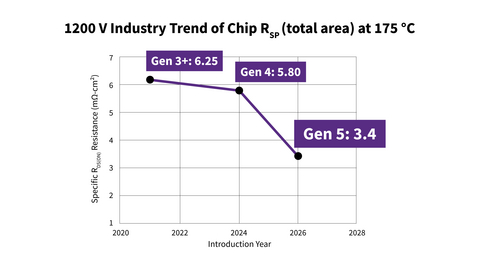
Automotive OEMs continue to face pressure to meet electrification targets, while vehicle cost, safety, mileage range, and charging infrastructure availability remain barriers to broader consumer adoption of EVs. Wolfspeed’s Gen 5 technology was designed to holistically address those barriers and sets a new benchmark for specific on-resistance (RSP) — a core figure of merit for efficiency relative to the MOSFET's active die area. Gen 5 products enable system architects to design more compact traction inverters and improve mileage per charge and right-size costly EV batteries. They also unlock new SiC opportunities by replacing mechanical relays with solid-state circuit breakers and set new efficiency standards for EV charging infrastructure. The benefits extend well beyond automotive, with applications like industrial power supplies equally positioned to take advantage of the Gen 5’s uncompromised switching performance.
Enabling unrivaled amperage per SiC area
Gen 5-based systems can achieve the highest current possible at high temperatures when compared to competitive 5 x 5 mm footprint silicon carbide MOSFETs. Wolfspeed’s continued optimization of RDS(ON) resolves two compelling design challenges:
-
It significantly improves system-level conduction losses via an up to
27% reduction in RSP over today’s commercially available competitive 1200-V solutions. The 1200 V QEM50120-25D10 achieves a 175℃ chip-level RSP of 3.4 mΩ-cm2, and the 750 V QEM50075-025D10 achieves a 175℃ chip-level RSP of 2.0 mΩ-cm2. -
It reduces the need for system-level design margin with ultra-low +/-
18% RDS(ON) distribution for both voltage nodes.
Powering designs that will endure
Wolfspeed Gen 5 includes the same body diode introduced with the Gen 4 technology platform but has an improved junction temperature of 200℃ continuous (215℃ limited life) – further demonstrating Wolfspeed’s commitment to helping customers build truly durable systems. The MOSFETs achieve benchmark RDS(ON) while maintaining excellent switching energy with the soft body diode; overall switching losses are also reduced with further improvement in reverse recovery charge.
Designed on a commercially mature platform
Gen 5 gives customers a direct, low-risk path from design-in to volume production with no impact to automotive ramp readiness, even with surging AI demand. This is the second Wolfspeed MOSFET technology generation to be designed, manufactured, and qualified within Wolfspeed’s ramp-ready 200 mm device fabrication facility in Mohawk Valley, N.Y. New product introductions (NPI), sampling, and customer validation will be completed using 200 mm production material. Furthermore, no new manufacturing toolsets are required for volume production.
“Our planar MOSFET technology still has innovation runway. We established Gen 5 on tools and processes our customers are familiar with to create a low-risk upgrade path for next-generation programs,” said Dr. Adam Barkley, Vice President of Power Device and Package Development. “For customers facing compressed development timelines, that means faster validation, faster qualification, and faster time to market — without sacrificing the performance they know and trust.”
To gain insights into how Wolfspeed achieved the above performance, read Dr. Barkley’s article Engineering for Outcomes: Three Ways Gen 5 Achieves Real-World Performance.
Availability & Resources
Samples for QEM50120-025D10 and QEM50075-025D10 are available for select customers through Wolfspeed’s direct sales representatives. New 750 V to 1200 V products are expected to continue launching throughout 2026 and into early 2027 as market demand and customer requirements become finalized.
Wolfspeed is proud to be demonstrating Gen 5 this week at PCIM Booth 7-435.
About Wolfspeed Inc.
Wolfspeed (NYSE: WOLF) leads the market in the worldwide adoption of silicon carbide technologies that power the world’s most disruptive innovations. As the pioneers of silicon carbide, and creators of the most advanced semiconductor technology on earth, we are committed to powering a better world for everyone. Through silicon carbide material, Power Modules, Discrete Power Devices and Power Die Products targeted for various applications, we will bring you The Power to Make It Real™. Learn more at wolfspeed.com.
Wolfspeed® is a registered trademark and The Power to Make It Real™ is a trademark of Wolfspeed, Inc.
Forward-Looking Statements
This press release contains forward-looking statements involving risks and uncertainties, both known and unknown, that may cause Wolfspeed’s actual results to differ materially from those indicated in the forward-looking statements. Forward-looking statements by their nature address matters that are, to different degrees, uncertain, such as statements about Wolfspeed’s strategic plans, priorities, growth opportunities, and ability to achieve profitability. Actual results could differ materially due to factors detailed in Wolfspeed’s filings with the U.S. Securities and Exchange Commission (“SEC”), including its most recent Annual Report on Form 10-K and subsequent SEC filings. These forward-looking statements represent Wolfspeed’s judgment as of the date of this release. Except as required under U.S. federal securities laws, Wolfspeed disclaims any intent or obligation to update any forward-looking statements after the date of this release.
View source version on businesswire.com: https://www.businesswire.com/news/home/20260609876239/en/
Media Relations:
media@wolfspeed.com
Investor Relations:
investorrelations@wolfspeed.com
Source: Wolfspeed