
A record 242 US cities now have starter homes that cost $1M
Zillow (NASDAQ:Z) reports that a record 242 US cities now have typical starter homes valued at $1 million or more, up from 80 in February 2020 and 226 in April 2025.
Sentiment and the balance of points
Rhea-AI Sentiment reads the wording of the document, how positive or negative its language is on a 1 to 5 scale. The balance of points shown with the takes weighs what the document actually discloses, so the two can disagree, for example when a trial that missed its main goal is described in upbeat language.
Rhea-AI Summary
Zillow (NASDAQ:Z) reports that a record 242 US cities now have typical starter homes valued at $1 million or more, up from 80 in February 2020 and 226 in April 2025. A starter home is defined as a home in the lowest third of values locally.
According to Zillow, the typical US starter home is worth $198,649, up 1.7% year over year. California leads with 105 such cities, while New York and New Jersey show the fastest growth, reaching 41 and 26 cities respectively.
Details
News Market Reaction – Z
On Jun 15, the day this news came out, Z closed 1.03% above the previous close.
Data tracked by StockTitan Argus for the Jun 15 session.
Key Figures
- US cities with $1M+ starters
- 242 cities
- April 2026; cities where a typical starter home costs $1M+
- US cities with $1M+ starters
- 80 cities
- February 2020 baseline for $1M+ starter homes
- Typical US starter home value
- $198,649
- Nationwide typical starter home value, up 1.7% year over year
- US cities with $1M+ starters
- 226 cities
- April 2025; prior year count of $1M+ starter home cities
- Homeownership breakeven time
- six years
- Typical time for buyers to break even versus renting, down from 8+ years
- California $1M+ starter cities
- 105 cities
- April 2026; state with the most $1M+ starter markets
- New York $1M+ starter cities
- 41 cities
- April 2026; up from 12 before the pandemic
- New Jersey $1M+ starter cities
- 26 cities
- April 2026; up from 1 before the pandemic
Historical Context
-
AI Assist usage boosting renter applications, tours, and lease signings.
-
Update on mortgage rates, listings, prices, payments and inventory trends.
-
Analysis of years to break even buying versus renting across metros.
-
Data on rising rental concessions and vacancy, with typical rent figures.
-
Report on sales rebounding where inventory has recovered versus pre-pandemic.
24h Move is the share-price change in the day after each event; other market factors may also have contributed.
AI-generated analysis. How Rhea-AI works. Not financial advice.




The count of cities with
- The number of cities where a typical starter home is worth
$1 million California still has the most cities with million-dollar starter homes, butNew York andNew Jersey are seeing the fastest growth.- Nationwide, the typical starter home is worth
$198,649 1.7% from a year ago.
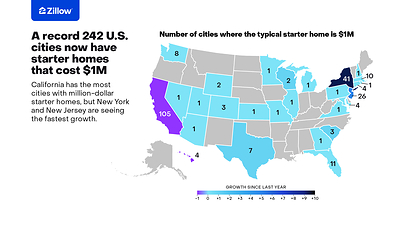
A typical "starter home" is defined for this analysis as a home in the lowest third of home values in a given region. The count of cities with million-dollar starter homes has grown from 226 cities a year ago, even as affordability pressures have begun to ease in parts of the country.
The effects of the pandemic housing boom have proven durable. A housing shortage, a decade in the making, ran headlong into intense demand amid historic lows in mortgage rates, driving up home values at a record pace. While plenty of markets are still feeling the pinch of this price reset, conditions are slowly becoming friendlier for buyers: The typical home buyer now breaks even relative to renting after roughly six years, down from more than eight years in late 2023.
"The pandemic reset the cost of buying a home, spreading million-dollar starter homes from a handful of coastal states to more than two dozen states across the country," said Kara Ng, senior economist at Zillow. "But while it may feel like a market of beer tastes at champagne budgets, those million-dollar starter homes are still the exception. More inventory, slower price growth and a narrowing rent-versus-buy gap mean buyers who are financially prepared are generally in better shape than in recent years."
"Million-dollar starter homes are popping up in more Northeast cities because the housing shortage there hasn't been solved," said Ng. "Sun Belt markets have responded with new supply and seen price growth moderate as a result. The Northeast hasn't had that relief. Eliminating barriers to building like restrictive zoning is the most direct path to improvement, which is something Zillow is actively advocating for across the country."
The
For buyers navigating today's market, Zillow Home Loans' BuyAbility℠ tool provides a personalized, real-time estimate of the home price and monthly payment that fit within their budget. Home listings on Zillow also include a down payment assistance module to help shoppers identify local programs that may be available to them.
For those who decide renting is the right call, Zillow Rentals® lists options across every price point and property type — including single-family homes, apartments and individual room listings. Renters can also use CreditClimb to report on-time rent payments to the major credit bureaus, building the credit history that will put them in a stronger position when they're ready to buy.
State | Cities with | Cities with | Cities with |
242 | 226 | 80 | |
105 | 106 | 52 | |
41 | 31 | 12 | |
26 | 21 | 1 | |
11 | 11 | 4 | |
10 | 10 | 1 | |
8 | 8 | 7 | |
7 | 6 | 0 | |
4 | 4 | 0 | |
4 | 5 | 1 | |
4 | 4 | 1 | |
3 | 3 | 1 | |
3 | 2 | 0 | |
2 | 2 | 0 | |
2 | 1 | 0 | |
1 | 1 | 0 | |
1 | 1 | 0 | |
1 | 1 | 0 | |
1 | 1 | 0 | |
1 | 1 | 0 | |
1 | 1 | 0 | |
1 | 1 | 0 | |
1 | 1 | 0 | |
1 | 1 | 0 | |
1 | 1 | 0 | |
1 | 1 | 0 | |
1 | 1 | 0 |
About Zillow Group
Zillow Group, Inc. (Nasdaq: Z and ZG) is reimagining real estate to make home a reality for more and more people.
As the most visited real estate app and website in the United States, Zillow connects hundreds of millions of consumers with innovative technology, trusted agents and loan officers, and seamless digital solutions. With industry-leading tools and resources, Zillow supercharges real estate professionals so they can grow their businesses and deliver exceptional client experiences. For renters and housing providers, Zillow offers not only a robust marketplace but a set of end-to-end products and services to streamline applications, leases, payments and more.
Zillow's ecosystem spans the entire home journey — from dreaming and shopping to renting, buying, selling and financing.
Zillow Group's affiliates, subsidiaries and brands include Zillow®, Zillow Premier Agent®, Zillow Home Loans®, Zillow Rentals®, Zillow® New Construction, Trulia®, StreetEasy®, Out East®, HotPads®, Follow Up Boss®, ShowingTime®, dotloop® and Zillow® Closing.
All marks herein are owned by MFTB Holdco, Inc., a Zillow affiliate. Zillow Home Loans, LLC is an Equal Housing Lender, NMLS #10287 (www.nmlsconsumeraccess.org). © 2026 MFTB Holdco, Inc., a Zillow affiliate.
(ZFIN)
 View original content to download multimedia:https://www.prnewswire.com/news-releases/a-record-242-us-cities-now-have-starter-homes-that-cost-1m-302799560.html
SOURCE Zillow
FAQ
AI-generated questions and answers. How Rhea-AI works. Not financial advice.