
Black homeownership rate rises, but hasn't returned to 2004 level
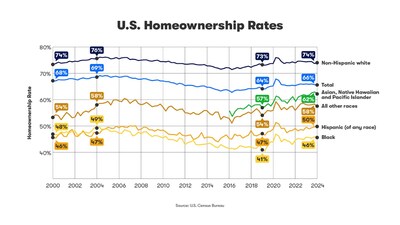
The homeownership rate for Black households has grown faster than average since 2019, but remains below the 2004 peak of 49.7%, currently at 46%.
Rhea-AI Summary
The homeownership rate for Black households has grown faster than average since 2019, but remains below the 2004 peak of 49.7%, currently at 46%. Almost 1 in 4 Black mortgage applicants are denied, compared to 1 in 10 white applicants, primarily due to credit history issues. The value of Black-owned homes is significantly lower, contributing to a $3 trillion wealth gap between Black and white families. Zillow is leveraging technology to mitigate these disparities, advocating for changes to credit scoring to include rent payments and making down payment assistance easily accessible.
Despite improvements, the gap in homeownership rates and home values between Black and white households remains substantial, affecting wealth accumulation and financial stability.
Positive
- Black homeownership rate increased to 46% from 43% in 2019.
- Zillow is advocating for changes to credit scoring to include rent payments, potentially improving credit access for Black households.
- Home shoppers can now easily check down payment assistance eligibility on Zillow's platform.
- Zillow released the Fair Housing Classifier to address biases in real estate conversations using AI.
Negative
- Black homeownership rate remains below the 2004 peak of 49.7%.
- Nearly 24% of Black mortgage applicants are denied, compared to 12.6% of all applicants and 10% of white applicants.
- Credit history is a significant barrier, with 43% of Black applicants denied for this reason.
- Black-owned homes are valued significantly lower than white-owned homes, contributing to a $3 trillion wealth gap.
Details
News Market Reaction – ZG
In the trading session that priced this news, ZG declined 1.10%, reflecting a mild negative market reaction.
Data tracked by StockTitan Argus on the day of publication.
AI-generated analysis. How Rhea-AI works. Not financial advice.




The gap between Black and white homeownership rates closed over the pandemic, but disparities remain
- Nearly 1 in 4 Black mortgage applicants are denied, versus 1 in 10 white applicants.
- Credit history is the most common reason given for denying a Black applicant.
- If the typical home was worth
$1 85 cents and white-owned homes worth$1.03
Insufficient credit is holding many Black households back from homeownership. Nearly 1 in 4 mortgage applications from Black borrowers —
That's almost twice the rate of all applicants (
"While discriminatory policies like redlining have long been outlawed, the damage from these historic practices is still felt today. Many communities once barred from accessing credit are now finance deserts, with few traditional financial institutions, making it harder to build credit and buy a house," said Zillow senior economist Orphe Divounguy. "That's why it's so important to expand credit access. Allowing rent payments to count in credit scores is one example of how to move the industry forward."
Today, nearly
Although the gap between white homeownership rates and those of Black and Hispanic households has diminished since 2019, the deficit is still large and contributes to vast inequalities in wealth.
The single largest asset for most homeowners is their house, and it's a major means of building wealth and passing it on to the next generation. Zillow Research found a
Despite rising faster than average since 2019, Black-owned home values are still far lower than average. If the typical home was worth
How Zillow leverages technology to understand and address housing inequality and accessibility challenges.
- Rent payments made to landlords on the Zillow Rentals platform can now count toward a renter's credit score. Zillow is pushing for systemic, national changes on this front, advocating for bipartisan legislation that would encourage property owners and utility and telecom providers to report payment data to credit reporting agencies. This would give consumers who pay their bills on time the chance to build a positive credit history.
- Home shoppers can see what down payment assistance programs they could qualify for on every Zillow listing, saving shoppers the hassle of looking up their eligibility on various government websites.
- Continuing its investment in new technology to address biases and inequalities in housing, Zillow recently released the open-source Fair Housing Classifier. This free and easy-to-access new tool establishes guardrails to help prevent historic biases from resurfacing in real estate conversations powered by large language model (LLM) technology.
1 For conventional purchases of a primary residence.
About Zillow Group
Zillow Group, Inc. (Nasdaq: Z and ZG) is reimagining real estate to make home a reality for more and more people. As the most visited real estate website in
Zillow Group's affiliates, subsidiaries and brands include Zillow®, Zillow Premier Agent®, Zillow Home Loans℠, Trulia®, Out East®, StreetEasy®, HotPads®, ShowingTime+℠, Spruce® and Follow Up Boss®.
All marks herein are owned by MFTB Holdco, Inc., a Zillow affiliate. Zillow Home Loans, LLC is an Equal Housing Lender, NMLS #10287 (www.nmlsconsumeraccess.org). © 2023 MFTB Holdco, Inc., a Zillow affiliate.

 View original content to download multimedia:https://www.prnewswire.com/news-releases/black-homeownership-rate-rises-but-hasnt-returned-to-2004-level-302157526.html
SOURCE Zillow
FAQ
AI-generated questions and answers. How Rhea-AI works. Not financial advice.