


On this page
The short answer. Alibaba wants T-Head, the designer of the Zhenwu AI chips in its cloud, to trade on its own in Hong Kong. T-Head is expected to remain an Alibaba subsidiary, a company inside Alibaba's group. It matters beyond Alibaba because of US limits on advanced chip sales to China, Nvidia's included. Alibaba says restrictions and sanctions, these chip limits among them, have forced it to develop its own technology or find suppliers outside the US. This guide explains what T-Head makes, why Alibaba is doing this, and why Hong Kong let Alibaba skip the rule that would guarantee its shareholders T-Head shares.
Alibaba's T-Head plan in three numbers
Outside customers using T-Head's Zhenwu AI chips
>650
Through Alibaba Cloud, per Alibaba's June 2026 quarter results of Aug 20, 2026
Spin-off size on Hong Kong's listing-rule size tests
<5%
Alibaba expects the highest of the Listing Rules' size ratios to be under 5% (6-K, Nov 10, 2026)
June 2026 quarter capital spending as a share of fiscal 2026
~54%
Spending on buildings and equipment: RMB67.7B in one quarter vs RMB126.1B in the year to March 2026

Show the data
- Alibaba shareholders on the NYSE to Alibaba: Own Alibaba through depositary shares.
- Alibaba shareholders in Hong Kong to Alibaba: Own Alibaba shares.
- Alibaba to T-Head: Expected to stay parent; stake not set.
- New investors in the Hong Kong offering to T-Head: Would hold T-Head H shares.
Every company reporting the same week, with its date and time, is in StockTitan's Earnings Calendar for the Week of November 9, 2026.
What is the Alibaba T-Head spin-off?
T-Head plans to offer shares to new investors and list on the Hong Kong stock exchange, and it is expected to stay part of Alibaba's group. No ticker, share price, value or date is set, and T-Head's own sales and profit have not been published.
T-Head (Shanghai) Technology is wholly owned by Alibaba today. Alibaba's announcement, filed with the SEC at 08:58 ET, calls it "a leading provider of full-stack data center chips which enable system-level compute solutions in China." In plain terms, T-Head designs the chips that run in data centers and the systems built around them.
T-Head applied to list on September 11, 2026. It filed its application form with the exchange on a confidential basis, so no prospectus is public yet. The exchange had first confirmed that Alibaba could go ahead.
The plan is a "Global Offering" of T-Head's H shares, the name for shares of a mainland Chinese company that trade in Hong Kong dollars in Hong Kong. Part would be sold to the public in Hong Kong. The rest would be placed with institutional and professional investors, such as fund managers.
After the sale, Alibaba says it expects T-Head "will remain as a subsidiary." How much of T-Head Alibaba gives up, and how big the offering is, "have not yet been finalized." Alibaba also says there is no assurance the listing happens, or when.
What chips does T-Head make?
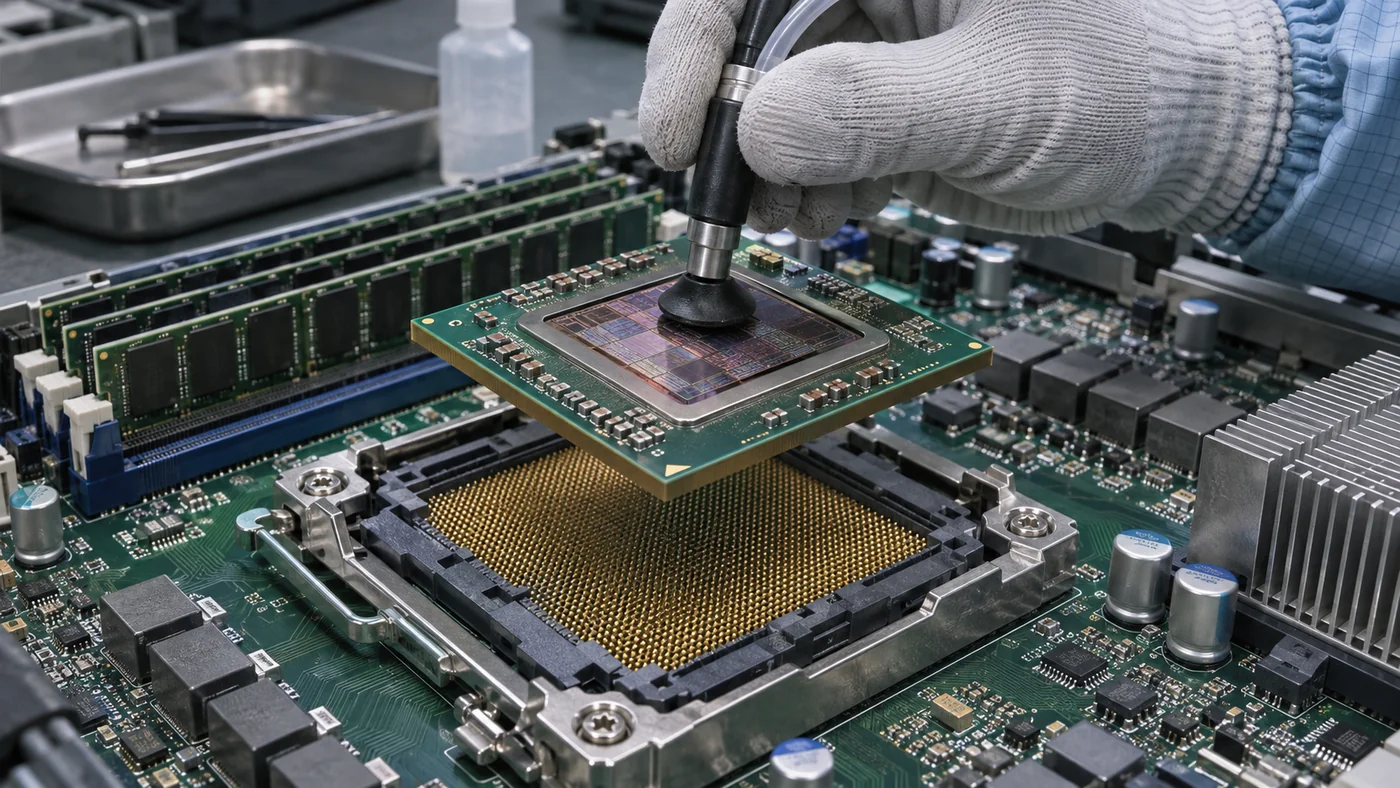
T-Head designs AI chips, server processors and chips for storage and networking. Its Zhenwu AI chips are used through Alibaba's cloud by more than 650 outside customers, from self-driving firms to financial companies.
- Zhenwu PPUs >100K AI chips running on Alibaba's public cloud, used by more than 30 carmakers and self-driving companies, per May 2026 results.
- Zhenwu M890 The newest Zhenwu AI chip; Zhenwu chips had more than 650 outside customers through Alibaba Cloud, per August 2026 results.
- Yitian 710 A server processor with 128 cores, custom built by T-Head and shown in October 2021.
- Storage and networking chips Part of the range Alibaba listed in its June 2026 quarter results, beside T-Head's GPU and CPU chips.
In its results for the June 2026 quarter, Alibaba said T-Head has built "proprietary silicon, spanning GPU, CPU, storage and networking chips." A GPU is the kind of chip that trains and runs AI models. A CPU is a computer's general-purpose processor.
The best known line is Zhenwu, which Alibaba calls a PPU, its name for its AI processor. The newest is the Zhenwu M890. Alibaba said in August that Zhenwu chips were used through Alibaba Cloud by "more than 650 external customers across over 20 industries, including autonomous driving, Internet, and financial services." So those customers use the chips' computing power inside Alibaba's cloud.
Alibaba has given two measures of that scale this year. In May, it said over 100,000 Zhenwu PPUs were running on its public cloud, with more than 30 carmakers and self-driving companies using them for research. Its annual report says the business "now contributes meaningfully to our cloud infrastructure supply."
Alibaba's chip work is older than the AI boom. Alibaba says it released its first AI inference chip, one that runs AI models after they are trained, the Hanguang 800, in 2019. In an October 2021 release it showed the Yitian 710, a server processor with 128 cores, or processing units, that T-Head custom built.
T-Head's own figures are folded into a bigger group. Since the June 2026 quarter, T-Head sits inside a reporting segment called AI Cloud and Compute Services, together with Alibaba Cloud. That segment brought in RMB48.4 billion ($7.1 billion) in the June 2026 quarter, about 18% of Alibaba's revenue, and it grew 45% from a year earlier.
Why does Alibaba need its own AI chips?
The US has restricted sales of advanced AI chips to China since 2022. Alibaba says that forces it to build its own technology or find it outside the US, and T-Head is where its own chips come from.
Alibaba lays out the pressure in the risk factors of its annual report. Since 2022, it says, the US government has restricted exports to China of advanced computing chips and chipmaking tools, including "export restrictions on advanced computing chips of Nvidia." The report says such restrictions and sanctions mean Alibaba and its technology partners "are forced to develop equivalent technologies or components, or obtain equivalent technologies or components from sources outside the United States."
China has set limits of its own. Alibaba's report says that in September 2025 China's internet regulator "requested Chinese technology companies to halt purchases of certain chips."
The annual report ties T-Head to that problem. It says T-Head "enhances our long-term computing supply capacity," and that Alibaba will "continue to expand T-Head's compute supply" and design T-Head's chips together with its cloud and its Qwen AI models to lower the cost of running AI.
The same report flags the risk to Alibaba itself. In February 2026 the US Department of Defense added Alibaba Group to its list of Chinese military companies, then withdrew the list. Alibaba warns that being added to the Commerce Department's Entity List, which limits what US suppliers can sell to a company, could cut it off from suppliers.
Why is Alibaba spinning off T-Head?
Alibaba says a separate listing lets investors put a value on T-Head by itself, and lets T-Head borrow and raise money on its own. That comes as Alibaba's capital spending jumped in its latest reported quarter.
The announcement gives four reasons. Investors could "better assess and value" the rest of Alibaba. T-Head's value could be judged "on its own merits." The listing could draw investors who want "dedicated exposure" to a chip business. And a public listing would raise T-Head's profile with customers and suppliers.
That last reason also covers money. A listing would let T-Head "directly and independently access both equity and debt capital markets," and get bank loans more easily, "which allows a more efficient deployment of Alibaba Group's financial resources."

Show the data
| Category | Value |
|---|---|
| Jun 2025 | 38.7B |
| Sep 2025 | 31.5B |
| Dec 2025 | 29.0B |
| Mar 2026 | 26.9B |
| Jun 2026 | 67.7B |
Those words come as Alibaba's capital spending jumped in its latest reported quarter. Capital spending is the money a company puts into buildings and equipment such as servers. Alibaba's was RMB67.7 billion (about $10 billion) in the June 2026 quarter, up 75% from a year earlier.
That one quarter came to about 54% of its capital spending in the whole 12 months to March 2026. Alibaba's results named "higher pricing of a broad range of chip components" among the reasons.
Alibaba's free cash flow, the cash left after that spending, was an outflow of RMB44.7 billion in the same quarter. In August it raised HK$80 billion by selling 710 million new shares to investors outside the United States. It said the money would go to computing power and AI data centers.
Do Alibaba shareholders get T-Head shares?
Under the plan as announced, no T-Head shares are set aside for them. Hong Kong's rule normally gives a parent's shareholders free shares or priority to apply for them, and the exchange waived it for Alibaba. Owners keep T-Head only through their Alibaba shares.
The rule is Practice Note 15 of the Hong Kong listing rules. Its paragraph 3(f) expects a parent to give its shareholders an "assured entitlement" to the new company's shares. That means either handing out shares for free, called a distribution in specie, or letting holders apply for new shares ahead of the public.
| Usual rule (Practice Note 15) | Alibaba's T-Head plan | |
|---|---|---|
| Guaranteed shares | Assured entitlement to new shares | Waived at Alibaba's request |
| How holders get them | Free shares, or priority to apply | Neither is set aside |
| Who is covered | All holders, treated equally | No NYSE or Hong Kong holder |
| Link to the new company | Direct, through shares received or taken up | Only through Alibaba |
Alibaba asked for a waiver and got it. Its grounds, in the announcement's words, include that providing the entitlement would be "disproportionate or excessive to the benefits," because "U.S. securities laws would require T-Head to conduct a public offering in the United States" and file a registration statement with the SEC. It adds that handing out shares "would be unduly burdensome and impracticable due to the PRC legal and operational restrictions," including a Chinese legal lock-up, a period in which T-Head's existing shares cannot be sold. It also calls it "unduly burdensome and not practically necessary" to ask shareholders to vote on the waiver.
The fourth ground is about size. Alibaba told the exchange that the spin-off "is insignificant to the Company and its Shareholders," measured against Alibaba's total assets, revenue and net income. Separately, it expects the deal to come in under 5% on every size test in the listing rules, so it would not count as a "discloseable transaction."
For an American holder, the plan sets aside no T-Head shares by right. Each Alibaba American depositary share, the form that trades on the NYSE as BABA, represents eight ordinary shares, according to Alibaba's annual report.
Someone with 100 BABA depositary shares in a US account owns 800 Alibaba ordinary shares. Under the plan as announced, those 800 shares come with no T-Head shares and no priority to apply for them. Their link to T-Head is the part of T-Head that Alibaba keeps, and the offering's details are not final.
For a holder, the open details decide what the plan changes. They are how many T-Head shares are offered, how much of T-Head Alibaba keeps, and T-Head's own results once its prospectus is out.
The rule itself is under review. In a consultation paper titled "Listing Framework Competitiveness Review (Phase 2)," published in September 2026, the Hong Kong exchange proposed to remove the assured entitlement requirement for all spin-offs. It is a proposal open for comment until November 30, 2026, and the current rule still applies. It said these entitlements "were generally small" and that priority offerings of spin-off shares "were very often undersubscribed." It also noted that when the new company stays a subsidiary, shareholders keep "an indirect interest through the listed issuer." That is the position Alibaba's holders would be in.
When will T-Head list in Hong Kong?
No date is set. Alibaba names three conditions, among other things: Hong Kong's approval, a filing with China's securities regulator, and final decisions by both companies.
- Hong Kong exchange approval The Hong Kong exchange's Listing Committee must approve the listing.
- China regulator filing The filing with the China Securities Regulatory Commission must be completed.
- Final company decisions Alibaba and T-Head must make their final decisions on proceeding.
The listing needs approval from the exchange's Listing Committee. T-Head must also complete its filing with the China Securities Regulatory Commission, China's securities regulator. Then Alibaba and T-Head must make their final decisions.
Alibaba says it will make more announcements "as and when appropriate." It also expects its own listings in Hong Kong and on the NYSE to stay as they are.
What to watch
- Whether Alibaba says more about T-Head: its results for the September 2026 quarter, due November 19, 2026.
- The Hong Kong exchange's Listing Committee: its decision on T-Head's listing, in a further Alibaba announcement.
- The filing with the China Securities Regulatory Commission: its completion, in a further Alibaba announcement.
- T-Head's own financial figures: its prospectus for the Hong Kong exchange listing, once published.
- The future of the assured entitlement rule: the Hong Kong exchange's conclusions on its consultation, after responses close November 30, 2026.
Our numbers
These figures are our calculations from the sources linked in this article. The capital spending figures cover Alibaba as a whole, and the 18% is the share of the whole segment that holds T-Head and Alibaba Cloud.
- About 54%: Alibaba's capital spending of RMB67.7 billion in the June 2026 quarter divided by its RMB126.1 billion for the fiscal year that ended March 31, 2026.
- About 18%: AI Cloud and Compute Services revenue of RMB48.4 billion divided by Alibaba's total revenue of RMB269.0 billion, both for the June 2026 quarter.
- RMB31.5 billion in the September 2025 quarter: Alibaba's fiscal 2026 capital spending minus the three other quarters it reported.
Frequently asked questions
T-Head (Shanghai) Technology is Alibaba's chip design unit. It designs AI chips, server processors and storage and networking chips for data centers, and Alibaba describes it as a leading provider of full-stack data center chips in China. Its Zhenwu AI chips are used through Alibaba Cloud by more than 650 outside customers.
Not by right. The Hong Kong exchange granted Alibaba a waiver from the rule that would give its shareholders an assured entitlement to T-Head shares. Alibaba expects to keep T-Head as a subsidiary, so its shareholders keep an indirect stake through Alibaba.
Not yet. T-Head filed a confidential application to list its H shares on the Hong Kong exchange's Main Board on September 11, 2026. It still needs the Listing Committee's approval and a completed filing with the China Securities Regulatory Commission.
Alibaba has not announced one. The size and structure of the offering are not finalized, and Alibaba says there is no assurance the listing will take place or as to when.
Alibaba says it expects T-Head to remain a subsidiary after the offering. How much of T-Head it gives up has not been finalized.
Sources
- Alibaba Form 6-K on the T-Head spin-off, November 10, 2026 (StockTitan)
- Alibaba June quarter 2026 results, August 20, 2026 (StockTitan)
- Alibaba March quarter and fiscal 2026 results, May 13, 2026 (StockTitan)
- Alibaba December quarter 2025 results, March 19, 2026 (StockTitan)
- Alibaba June quarter 2025 results, August 29, 2025 (StockTitan)
- Alibaba completes HK$80 billion share placing, August 26, 2026 (StockTitan)
- Alibaba September quarter 2026 results date (StockTitan)
- Alibaba annual report on Form 20-F, fiscal 2026 (StockTitan)
- Alibaba Cloud unveils Yitian 710 server chips, October 19, 2021
- HKEX consultation paper, Listing Framework Competitiveness Review (Phase 2), September 2026