
GE Vernova Trench Acquisition: Buying a Supplier as Grid Orders Pile Up


GE Vernova announced on October 28, 2026 that it will buy Trench Group, a maker of high-voltage grid parts that already supplies it, for $9.0 billion. Its grid business holds $42.2 billion of equipment orders still to deliver, about 2.8 to 2.9 years of this year's expected grid sales by our calculation.
The short answer. GE Vernova is paying $9.0 billion for Trench Group, a maker of grid parts it already buys from, and expects to pay half in cash and half with debt. It matters beyond its shareholders because Trench parts sit in most long-distance direct current power lines, and in GE Vernova's words grids face "surging demand from aging infrastructure, data centers, renewable energy, and industrial electrification." By our calculation its grid order backlog equals about 2.8 to 2.9 years of this year's grid sales. Trench is also forecast at a wider profit margin, profit as a share of sales, than GE Vernova's own grid unit.
The numbers behind GE Vernova buying Trench
On this page
Why is GE Vernova making the Trench acquisition
GE Vernova already buys parts from Trench, and it says owning the supplier adds factory room for grid equipment its customers want. The price is $9.0 billion, about 8 billion euros.
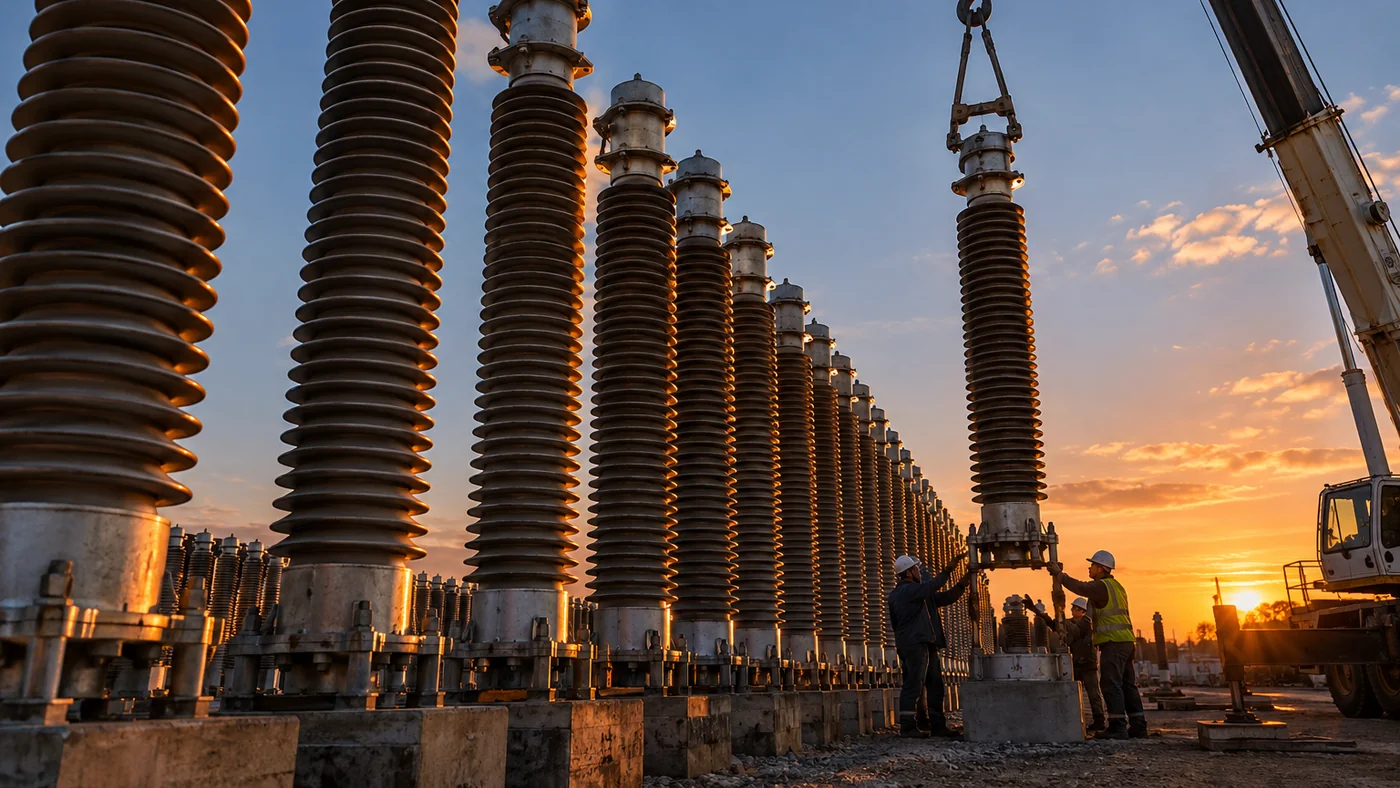
Trench, based in Berlin, makes high-voltage parts, chiefly bushings, instrument transformers and coils. A bushing is the insulated passage that lets a power line enter a transformer's metal tank without touching it. Instrument transformers measure the current and voltage on a line, and coils help control the flow of power.
These are small pieces of much bigger systems. GE Vernova's announcement says Trench parts are in the majority of high-voltage direct current lines built worldwide, the long lines that carry power over great distances. Trench also has a newly opened plant in Charlotte, North Carolina, where GE Vernova expects manufacturing of 765 kilovolt (765,000 volt) equipment to begin in late 2027.
That plant matters for the bigger story. GE Vernova says higher voltage lines can carry "up to six times more power per corridor than conventional lines," and that they are becoming the backbone of grids facing demand from data centers and electrification.
The company's own reason for the deal is in its first lines. It "vertically integrates an existing supplier and increases capacity for key grid equipment," which in everyday words means GE Vernova will own a factory network it now buys from. Trench sells to more than 800 utilities and hyperscalers, the companies that run the largest cloud and AI data centers.
Chief executive Scott Strazik pointed to Trench's order book: "With a margin-accretive financial profile and approximately $5 billion in backlog and framework agreements, some of which reach into the next decade, this acquisition will deliver both immediate earnings visibility and long-term strategic value." We read margin-accretive as Trench earning a higher profit margin than GE Vernova does today. Framework agreements are long-term supply agreements, and the release does not say how much of that total is firm orders.
| Deal term | As the companies state it |
|---|---|
| Price at closing | $9.0 billion US dollar equivalent, about €8.0 billion, at EUR/USD 1.12 |
| Funding | Currently expected equally from cash and debt |
| Price against EBITDA | 13 times Trench's 2028 adjusted EBITDA forecast (earnings before interest, taxes, depreciation and amortization, a profit measure that leaves out those costs), before synergies (savings from combining the two) |
| Agreement signed | October 25, 2026, announced October 28, 2026 |
| Seller | Triton Partners, an investment firm |
| Trench size | More than 3,000 employees, 11 factories in 8 countries |
| Expected closing | Late 2027 |
Source: GE Vernova release, October 28, 2026; GE Vernova 10-Q for the quarter ended September 30, 2026, Part II, Item 5.
How big is GE Vernova's grid equipment backlog
Big, and growing. The grid equipment orders GE Vernova still has to deliver reached $42.2 billion in September 2026. That is more than double the end of 2024, partly through orders acquired with Prolec GE.
GE Vernova calls its grid unit Electrification, and its equipment backlog is the value of signed equipment orders not yet delivered. It stood at $42.2 billion on September 30, 2026, according to the company's third quarter results, up 60% in a year.
Part of that came by purchase. When GE Vernova finished buying Prolec GE, a transformer maker, in February, $5 billion of orders came with it. Leaving those out, the backlog still grew 86% from the end of 2024, by our calculation.
The same release guides 2026 Electrification revenue to $14.5 billion to $15.0 billion, the sales the company expects for the year. Set side by side, the waiting orders equal about 2.8 to 2.9 years of this year's expected grid sales, by our calculation. Backlog is delivered over several years, project by project, so this is a size comparison, never a delivery date.

Show the data
| Category | Value |
|---|---|
| Q4 2024 | $20.0B |
| Q1 2025 | $22.0B |
| Q2 2025 | $24.0B |
| Q3 2025 | $26.5B |
| Q4 2025 | $30.5B |
| Q1 2026 | $38.6B |
| Q2 2026 | $40.6B |
| Q3 2026 | $42.2B |
Orders kept coming in faster than the unit turned them into revenue. GE Vernova reports a book-to-bill ratio of about 1.4 for the third quarter, meaning new orders were about 1.4 times the quarter's revenue, so the backlog grew again. That shows demand, and the company does not say how much of the gap is a factory limit and how much is projects scheduled years ahead.
Trench is the second large grid purchase GE Vernova has agreed to since October 2025. In October 2025 GE Vernova agreed to pay $5.275 billion for the half of Prolec GE it did not own, also half cash and half debt. Strazik said then that it strengthened GE Vernova's presence "in North America where demand for grid equipment is growing rapidly."
How does Trench's profit margin compare with GE Vernova's
Trench is forecast to earn a wider margin. GE Vernova expects Trench's adjusted EBITDA margin to be about 33% in 2026, profit as a share of sales, well above what it guides for its own grid unit this year. EBITDA is a profit measure that leaves out interest, taxes, depreciation and amortization.
EBITDA means earnings before interest, taxes, depreciation and amortization, a rough gauge of what a business makes from operations. GE Vernova prepared Trench's figures from Trench's own data, on Trench's accounting policies. It expects an adjusted EBITDA margin of about 33% in 2026 and about 36% in 2028, adjusted meaning one-time and noncash items are left out.
GE Vernova's own Electrification segment EBITDA margin was 19.1% in the third quarter of 2026. For the full year the company guides 18% to 20%, now "trending toward the higher end." The measures are not identical, since one is a forecast for a company GE Vernova does not own yet and the other follows GE Vernova's segment rules.

Show the data
| Category | Value |
|---|---|
| Trench, 2026 forecast | 33% |
| Prolec GE, 2025 forecast | 25% |
| GE Vernova grid, 2026 guidance | 19% |
Prolec GE, the transformer maker GE Vernova bought earlier, was forecast at about 25% for 2025 when that deal was announced. It has been part of the grid unit since February 2026, so the unit's 19.1% in the third quarter already includes it. Trench is forecast higher still.
Trench is small next to the grid unit in sales, at about a tenth of its expected 2026 revenue, by our calculation. By EBITDA it is bigger, about a sixth to a fifth of the unit's expected total on the rounded figures, by our calculation. Because GE Vernova already buys from Trench, these are size comparisons, never a combined forecast.
| Business and period | Revenue | EBITDA margin | Basis |
|---|---|---|---|
| Trench, 2026 forecast | $1.4 billion | about 33% | Adjusted EBITDA, Trench accounting policies, forecast by GE Vernova |
| Trench, 2028 forecast | $1.9 billion | about 36% | Same |
| Prolec GE, 2025 forecast | $3 billion | about 25% | Adjusted EBITDA, at the October 2025 announcement |
| GE Vernova Electrification, Q3 2026 | $3.86 billion | 19.1% | Segment EBITDA, reported |
| GE Vernova Electrification, 2026 guidance | $14.5 to $15.0 billion | 18% to 20% | Segment EBITDA, company guidance |
Source: Trench release, October 28, 2026; GE Vernova Q3 2026 results; Prolec GE release, October 21, 2025. Adjusted EBITDA is a measure outside standard accounting rules, and segment EBITDA is GE Vernova's own segment measure.
How will GE Vernova pay for Trench Group
Half in cash and half with debt, as now planned. The cash half, about $4.5 billion, is about 27% of the cash GE Vernova held at the end of September, by our calculation.
GE Vernova reported a cash balance of $16.8 billion on September 30, 2026, according to its 10-Q. Its borrowings were $2.8 billion that day, and the other $4.5 billion of the price is planned as new debt.
Free cash flow was $5.4 billion in the third quarter, using GE Vernova's measure of cash from operations after spending on plants and equipment. That is up from $0.7 billion a year earlier, and more than the cash half of the price. The company says that jump came mainly from working capital, the cash tied up in or freed by day-to-day operations, and from stronger adjusted EBITDA. Its 10-Q adds that operating cash over the first nine months rose mostly on customer down payments, cash received before the equipment ships.

Show the data
| Category | Value |
|---|---|
| Trench price | $9.0B |
| Cash half of price | $4.5B |
| Cash on hand, Sept 30, 2026 | $16.8B |
| Free cash flow, Q3 2026 | $5.4B |
Next to the whole company, the price is small. It is about 3.8% of GE Vernova's market value on the announcement morning, by our calculation from StockTitan data. It is also about 1.7 times what GE Vernova paid for the rest of Prolec GE.
Set against Trench's profit, the price depends on which year is used. GE Vernova quotes 13 times Trench's 2028 adjusted EBITDA forecast. On the 2026 forecast it is about 18 to 19.5 times, by our calculation, because Trench's forecast profit grows by 2028. The range comes from the release's own rounding.
Show the data
| Measure | Value | Period |
|---|---|---|
| Cash, cash equivalents and restricted cash ($0.4 billion restricted to set uses) | $16.8 billion | September 30, 2026 |
| Total borrowings | $2.8 billion | September 30, 2026 |
| Market value, StockTitan data | About $238 billion | Morning of October 28, 2026 |
| Trench adjusted EBITDA forecast | $0.5 billion (2026), $0.7 billion (2028) | GE Vernova's forecast, rounded |
| Prolec GE purchase price, remaining half | $5.275 billion | Agreed October 2025 |
| Free cash flow | $5.4 billion | Q3 2026 |
| Free cash flow guidance | $16 billion to $17 billion | Full year 2026 |
| Capital returned to shareholders | $5.7 billion | First nine months of 2026 |
| Share buyback authorization | $20 billion, $10.1 billion remaining | October 2026 |
Source: GE Vernova Q3 2026 results; GE Vernova 10-Q, Note 14 and Liquidity; Trench release, October 28, 2026; Prolec GE release, October 21, 2025; StockTitan data.
Who owns Trench Group
Triton Partners, an investment firm, which bought it from Siemens Energy. Siemens Energy agreed to sell Trench in October 2023 to focus on its core business.
When Siemens Energy announced the sale on October 12, 2023, it described Trench as a small to medium business "with ambitious growth plans." Neither side disclosed the price, and the Trench release dates its independence to April 2024.
On its own, Trench grew quickly. It says its yearly revenue has doubled since April 2024, to more than €1 billion. It also has more workers and more factories than when Siemens Energy agreed to sell it.
| Sale announced, October 2023 | Today, October 28 2026 | |
|---|---|---|
| Employees | 2,400 | More than 3,000 |
| Factories | 9 | 11 in 8 countries |
| Owner | Siemens Energy, selling to Triton | Triton, independent since April 2024; GE Vernova after closing |
| Yearly revenue | Not given in the sale release | More than EUR 1 billion; doubled since April 2024 |
When will GE Vernova's Trench acquisition close
GE Vernova expects to close in late 2027, after regulators approve and after it consults employee representatives where the law requires it.
The price is payable at closing. It is set in euros, about €8.0 billion, so the $9.0 billion dollar figure can move with the exchange rate, as the release says. The quarterly filing adds a separate termination fee GE Vernova would pay if regulatory approvals are not obtained within set timeframes. It would be paid no earlier than the second half of 2027, and the filing does not give the amount.
- Regulatory approvals Customary regulatory approvals must be completed.
- Employee consultation GE Vernova must consult employee representatives where the law requires it.
- Expected closing Late 2027, when the price is payable.
Until then GE Vernova does not own Trench, which stays one of its suppliers.
What to watch
- Approvals, the fee and the funding mix: GE Vernova's quarterly filings through 2027 are where updates on the approvals, any termination fee and the split of cash and debt would appear.
- Whether the grid backlog keeps growing: GE Vernova's fourth quarter 2026 results, in early 2027, report the next Electrification backlog.
Our numbers
- About 2.8 to 2.9 years of grid sales waiting: $42.2 billion of grid equipment backlog over 2026 grid revenue guidance of $14.5 billion to $15.0 billion.
- Backlog up 111% since the end of 2024, 86% without Prolec GE's acquired $5 billion: against a December 2024 level we derived from the Q4 2025 release.
- A tenth of the sales, a sixth to a fifth of the EBITDA: Trench's 2026 forecasts set against the grid unit's 2026 guidance.
- Cash half about 27% of cash on hand: $4.5 billion over $16.8 billion at September 30, 2026.
- About 3.8% of market value: $9.0 billion over GE Vernova's value in StockTitan data on October 28, 2026.
- About 1.7 times the Prolec GE price: $9.0 billion over $5.275 billion.
- About 18 to 19.5 times 2026 EBITDA: $9.0 billion over Trench's 2026 forecast, given as $0.5 billion and as about 33% of $1.4 billion.
Frequently asked questions
What does GE Vernova do?
GE Vernova makes and services equipment that generates and moves electricity. It reports three segments, Power (gas turbines, nuclear and hydro), Electrification (grid equipment) and Wind, and has about 85,000 employees in about 100 countries.
How much is GE Vernova paying for Trench Group?
$9.0 billion in US dollar equivalent at closing, about €8.0 billion, which GE Vernova currently expects to fund half from cash and half from debt. The company says the price is 13 times Trench's 2028 adjusted EBITDA forecast, before any savings from combining the two.
Who is selling Trench Group to GE Vernova?
Triton Partners, an investment firm, which bought Trench from Siemens Energy in a sale announced in October 2023. GE Vernova becomes the owner if the deal closes, expected in late 2027.
Will buying Trench shorten grid equipment delivery times?
Neither company has said. GE Vernova says the deal "increases capacity for key grid equipment," but it has given no figure for extra output or shorter waits.
How did GE Vernova stock trade before the market opened on October 28, 2026?
In pre-market trading, GE Vernova last traded at $914.00 at 6:51 a.m. ET, according to StockTitan real-time Nasdaq data. That is about 2.1% above $895.08, its last regular-session price on October 27 in StockTitan daily prices. GE Vernova also released its third quarter results that morning, so the move cannot be put down to the deal.
What is a bushing in a power grid?
A bushing is an insulated sleeve that carries a high-voltage conductor through the grounded metal wall of a transformer or switch without letting the power jump to the metal. Trench lists bushings first among its products, alongside instrument transformers and coils.
Sources
- GE Vernova (GEV) on StockTitan
- GE Vernova to Acquire Trench Group, October 28, 2026
- GE Vernova to Fully Acquire Prolec GE Joint Venture, October 21, 2025
- GE Vernova Completes Prolec GE Acquisition, February 2, 2026
- GE Vernova third quarter 2026 results (Form 8-K, Exhibit 99)
- GE Vernova Form 10-Q, quarter ended September 30, 2026
- GE Vernova fourth quarter 2025 results
- Siemens Energy sells Trench to sharpen portfolio, October 12, 2023
The information provided in this article is for educational and informational purposes only. It does not constitute financial advice, investment recommendation, or an endorsement of any particular investment strategy. Past performance does not guarantee future results. Investors should conduct their own research and consult with a qualified financial advisor before making investment decisions.