
Seagate Earnings: Sales Up 17% on Barely More Storage Shipped


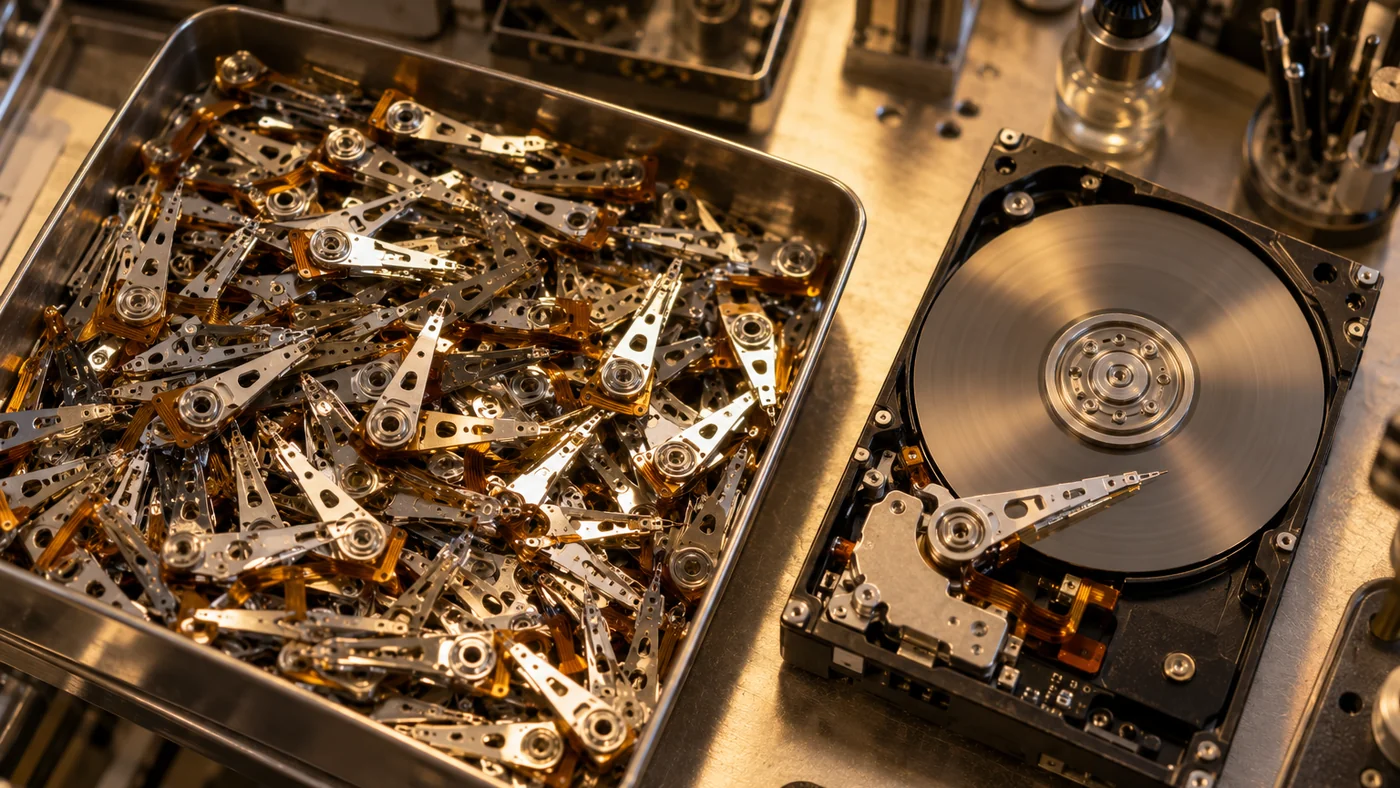
Seagate shipped just 1% more hard drive storage in its September quarter than in June, yet sales rose 17% to $4.23 billion. By our calculation, revenue per terabyte shipped, which reflects price and the mix of drives sold, jumped 16% in three months, the most in nine quarters.
The short answer. Seagate, a top maker of the hard drives inside cloud data centers, grew sales far faster than the storage it shipped and expects about $4.8 billion in the December quarter. It says most data center supply is allocated through 2028, which in our reading leaves cloud companies little unclaimed storage to buy. By our calculation, most of the past year's rise in gross profit (sales minus the cost of making the drives) came from higher profit per terabyte.
Seagate's September 2026 quarter in three numbers
On this page
- Seagate earnings beat its own forecast
- How much storage did Seagate ship?
- Why Seagate's gross margin hit 57%
- Seagate says most data center drive supply is allocated through 2028
- Seagate vs Western Digital
- Seagate guidance for the December quarter
- Seagate stock after earnings
- Seagate dividend, buybacks and debt
- Frequently asked questions
Seagate earnings beat its own forecast
Seagate beat the forecast it gave in July and the average analyst estimate. Sales of $4.23 billion landed above the $4.2 billion top of its own range.
In the quarter to October 2, 2026, the first of its 2027 fiscal year, Seagate's revenue was $4,233 million, according to its results release. In July it had forecast $4.1 billion, give or take $100 million.
From a year earlier, sales rose 61% on 21% more storage shipped, so the two comparisons tell different stories. Over twelve months, volume and revenue per terabyte both grew; over the last three, nearly all the growth came from revenue per terabyte.
Earnings per share on the company's adjusted basis, which leaves out stock pay and a few one-off items, came to $7.68. The July forecast was $7.30.
The consensus compiled by LSEG had expected $7.42 a share on $4.138 billion of revenue. The data panel below has the standard accounting figures.
This was the fourth quarter in a row in which revenue came in above the top of the range Seagate gave three months before. Its lead over the middle of that range was the smallest of the last five quarters, though, at about 3% by our calculation.

Show the data
| Item | Low | High | Value |
|---|---|---|---|
| Sep 2025 quarter | $2.35B | $2.65B | $2.63B |
| Dec 2025 quarter | $2.60B | $2.80B | $2.83B |
| Mar 2026 quarter | $2.80B | $3.00B | $3.11B |
| Jun 2026 quarter | $3.35B | $3.55B | $3.63B |
| Sep 2026 quarter | $4.00B | $4.20B | $4.23B |
Show the data
| Quarter to October 2, 2026 | Standard accounting (GAAP) | Adjusted (non-GAAP) | A year earlier, GAAP |
|---|---|---|---|
| Revenue | $4,233M | $4,233M | $2,629M |
| Gross margin | 57.3% | 57.8% | 39.4% |
| Operating margin | 48.8% | 50.7% | 26.4% |
| Net income | $1,761M | $1,781M | $549M |
| Diluted earnings per share | $7.59 | $7.68 | $2.43 |
| Free cash flow | $1,479M | $427M |
Source: Seagate fiscal Q1 2027 results release, October 27, 2026. Free cash flow is the company's own measure, operating cash flow minus equipment spending.
How much storage did Seagate ship?
Seagate shipped 220 exabytes of hard drive storage, each exabyte a million terabytes, barely more than in June. Nearly all of the quarter's extra sales came from higher revenue per terabyte.
The release itself gives no shipment figure. It sits in a supplemental slide deck Seagate posted on its investor site the same evening. Data center drives, which Seagate calls nearline, made up 198 exabytes, about 90% of the total.
Dividing revenue by storage shipped gives revenue per terabyte of $19.24, by our calculation, up from $16.65 in the June quarter. The figure mixes price with the shift to bigger drives, and revenue includes a small business outside hard drives.
The data center line alone tells the same story. By our calculation, data center revenue per terabyte of nearline storage rose to $17.42 from $15.04 in June.
The 16% step in three months is the largest in the nine quarters we measured, back to September 2024. No other quarter comes close. A year earlier the same measure stood at $14.45, and Seagate does not print a price per terabyte in its latest reports.

Show the data
| Category | Value |
|---|---|
| Sep 2024 | 138 |
| Dec 2024 | 151 |
| Mar 2025 | 144 |
| Jun 2025 | 162 |
| Sep 2025 | 182 |
| Dec 2025 | 190 |
| Mar 2026 | 199 |
| Jun 2026 | 218 |
| Sep 2026 | 220 |

Show the data
| Category | Value |
|---|---|
| Sep 2024 | $15.77 |
| Dec 2024 | $15.42 |
| Mar 2025 | $15.04 |
| Jun 2025 | $15.05 |
| Sep 2025 | $14.45 |
| Dec 2025 | $14.87 |
| Mar 2026 | $15.64 |
| Jun 2026 | $16.65 |
| Sep 2026 | $19.24 |
More storage per drive is how Seagate grows without building more drives. Its tool is HAMR, heat-assisted magnetic recording, which its annual report says raises how much data fits on a disk's surface. The slide deck says its Mozaic 4 HAMR drives are "ramping," meaning output is building up, with two leading cloud providers.
The same deck says more approvals by cloud and enterprise customers are "expected to complete in the coming months," and that test shipments of Mozaic 5 are on track for the end of 2027. Seagate also says it has shown 8 terabytes on a single disk in the lab.
Why Seagate's gross margin hit 57%
Seagate credits its pricing and supply discipline, and it keeps the number of drives it builds flat. By our calculation, its cost of making what it sold rose 13% from a year earlier while sales rose 61%.
Gross margin is the share of sales left after the cost of making the product. Seagate's reached 57.3% on standard accounting, up from 39.4% a year earlier, and the company calls its 57.8% adjusted figure a record.
The plan is deliberate. "Our strategy coming out of the last downcycle has been to keep the number of drives flat," chief executive Dave Mosley told analysts on the July 28 call. Chief financial officer Gianluca Romano said the disks and heads inside the drives "probably grew between 15% and 20%, and the units were absolutely flat."
Mosley's statement on Tuesday credits "supply discipline" and "our value-based pricing strategy." In July he described how extra output gets sold. "We have more exabytes to give, and we determine how hungry the market really is for those exabytes," he said. Customers usually pay more than the contract price for that extra storage, he added, which is why prices rise in what he called "step functions."

Show the data
| Step | Value |
|---|---|
| Sep 2025 qtr | $1,037M |
| More TB shipped | +$217M |
| Profit per TB up | +$1,173M |
| Sep 2026 qtr | $2,427M |
Gross profit more than doubled in a year, as the chart shows.
By our split, most of that gain came from higher gross profit per terabyte, between about 70% and 84% depending on how the overlap with extra volume is counted.
Gross profit per terabyte nearly doubled, to $11.03 from $5.70.
Lower costs did not drive the improvement from June. By our calculation, cost of revenue per terabyte rose about 3% from June, to $8.21, though it stayed below the level of a year earlier.
Before this quarter it was the other way round. From September 2024 to September 2025, revenue per terabyte drifted lower while cost of revenue per terabyte fell from $10.57 to $8.75, by our calculation. Gross margin still climbed.
Customer rebates had also been shrinking before this quarter. Sales incentives such as customer rebates fell to about 10% of gross revenue in the March 2026 quarter from 14% a year before, according to Seagate's quarterly report. The September figure will come with the next quarterly report.

Show the data
| Category | Value |
|---|---|
| Sep 2024 | 32.9% |
| Dec 2024 | 34.9% |
| Mar 2025 | 35.2% |
| Jun 2025 | 37.4% |
| Sep 2025 | 39.4% |
| Dec 2025 | 41.6% |
| Mar 2026 | 46.5% |
| Jun 2026 | 52.3% |
| Sep 2026 | 57.3% |
Seagate says most data center drive supply is allocated through 2028
Seagate says most of its data center drive supply is already allocated to customers through 2028, and some cloud contracts now run to 2030. Little storage is left unclaimed, which in our reading helps it hold prices up.
The slide deck says the "vast majority of Data Center nearline supply" is "allocated through CY28, with some cloud supply agreements extending through CY30." In July the company had said its nearline storage was allocated "into calendar 2028," with contracts that "define both product configuration and pricing terms" for all of 2027.
Allocated supply is not the same as guaranteed sales. The slide deck and the release do not say what prices apply after 2027.
The deck says Seagate's revenue from cloud customers grew for 12 quarters in a row, and revenue from enterprise and equipment makers for six. At the end of June, HAMR drives made up about 40% of the rate at which Seagate was shipping data center storage, it said on the July call.
Data center storage shipped grew 24% from a year earlier. That sits in the "mid-20% range" of yearly growth Seagate has targeted for the next few years, which in our reading leaves price as the faster lever.
Seagate vs Western Digital
Western Digital, Seagate's closest hard drive rival, reported the same quarter five days earlier. Its gross margin was 57.8%, half a point above Seagate's 57.3%.
A year earlier Western Digital's margin was 4.1 points higher, by our calculation from the two companies' releases. Seagate has closed almost all of that gap in four quarters, and after all operating costs it now keeps more of its sales than its rival does, 48.8% against 46.7%.
Western Digital split its own growth in its quarterly report. Its cloud revenue rose 54% on "a more than 20% increase in exabytes shipped along with an approximately 25% increase in average selling price per exabyte." That is a cloud price measure, while ours is an all-company ratio, so the two are close cousins and not the same number. Our analysis of Western Digital's quarter covers its side.
For the December quarter Western Digital forecast $5.1 billion of revenue, against Seagate's $4.8 billion. Western Digital puts its growth at 66% to 72% from a year earlier.
Seagate's midpoint works out to about 70% by our calculation. The two forecasts describe the same market.
| Seagate | Western Digital | |
|---|---|---|
| Revenue | $4.23 billion | $4.38 billion |
| Revenue growth from a year earlier | 61% | 55% |
| Gross margin (standard accounting) | 57.3% | 57.8% |
| Operating margin (standard accounting) | 48.8% | 46.7% |
| Next quarter revenue forecast, midpoint | $4.8 billion | $5.1 billion |
Seagate guidance for the December quarter
Seagate expects about $4.8 billion of sales in the December quarter. That would be about 70% more than a year earlier.
On its adjusted basis, Seagate forecast earnings of $9.20 a share, plus or minus 20 cents, against $3.11 in the same quarter a year earlier. The figure leaves out stock pay.
The slide deck adds that operating margin, the share of sales left after all running costs, would move "towards mid 50% range of revenue." On the same adjusted basis it was 50.7% in the September quarter.
The sales forecast runs from $4.7 billion to $4.9 billion, and its midpoint is 13% above the quarter just reported, by our calculation. Seagate gave no forecast for storage shipped or for gross margin.
Show the data
| December 2026 quarter forecast | Seagate's figure |
|---|---|
| Revenue | $4.8 billion, plus or minus $100 million |
| Adjusted diluted earnings per share | $9.20, plus or minus $0.20, excluding about $0.30 of stock pay |
| Adjusted operating margin | Towards mid 50% range of revenue |
| Adjusted operating expenses, at midpoint | About $300 million |
| Adjusted tax rate, at midpoint | About 16% |
| Diluted shares, at midpoint | About 233 million |
Source: Seagate fiscal Q1 2027 results release and supplemental financial information, October 27, 2026.
Seagate stock after earnings
Seagate shares fell in after-hours trading after the release, even though the quarter beat forecasts. The release gave no reason for the move.
STX closed Tuesday's regular session at $667.85, up 3.7% on the day, according to StockTitan's price data. The results came out at 4:05 p.m. ET.
Seagate shares traded at $637.10 at 5:44 p.m. ET, 4.6% below the $667.85 close, after falling as low as $609.00 early in after-hours trading (StockTitan real-time Nasdaq data).
The call came later. Seagate scheduled its conference call for 5 p.m. ET, and its transcript had not been published when this was written.
Seagate dividend, buybacks and debt
Seagate raised its quarterly dividend about 3% to 76 cents a share and kept paying down debt. It also stepped up share buybacks.
The dividend goes to shareholders on the company's books on December 23, 2026, and is paid on January 7, 2027, according to the release.
Free cash flow, the cash left after running the business and buying equipment, was $1.48 billion. It covered most of the $1.83 billion Seagate spent on buybacks, dividends and debt repayment in the quarter. Buybacks alone took $400 million.
Even so, 230 million shares were outstanding at quarter end, up from 214 million a year earlier. The release and the slide deck do not explain the rise.
The company retired about $1.2 billion of debt in the quarter, cutting gross debt, its total borrowing before cash, to $2.4 billion. It retired another $750 million after the quarter ended.
That leaves $1.6 billion of gross debt. Interest expense fell to $41 million from $80 million a year earlier.
Put side by side, the debt left is now close to what the business generated in free cash flow in a single quarter, by our calculation. The slide deck puts quarter-end gross debt 53% below a year earlier, when quarterly free cash flow was $427 million.
Show the data
| Quarter to October 2, 2026 | Amount | Comparison |
|---|---|---|
| Free cash flow | $1,479M | $427M a year earlier |
| Share buybacks | $400M | $29M a year earlier |
| Dividends paid | $168M | $153M a year earlier |
| Cash paid to redeem and repurchase debt | $1,262M | None a year earlier |
| Cash at quarter end | $1,258M | $1,704M at July 3, 2026 |
| Ordinary shares outstanding, quarter end | 230M | 214M a year earlier |
| Interest expense | $41M | $80M a year earlier |
Source: Seagate fiscal Q1 2027 results release (cash flow statement and balance sheet) and supplemental financial information, October 27, 2026.
What to watch
- What management said about pricing and supply on the October 27 call: the call transcript, which Seagate posts on its investor relations site.
- The share of sales paid out as rebates in the September quarter, and why the share count rose: Seagate's quarterly report on Form 10-Q, filing date not yet announced.
- Approvals of Mozaic 4 drives by more cloud and enterprise customers, which Seagate expects in the coming months: its December quarter results, date not yet announced.
Our numbers
- Revenue per terabyte shipped of $19.24, against $16.65 in June and $14.45 a year earlier: revenue divided by hard drive exabytes shipped.
- The largest quarterly rise in that measure in nine quarters: the same division for each quarter since September 2024.
- Data center revenue per nearline terabyte of $17.42, against $15.04 in June: data center revenue divided by nearline exabytes.
- Gross profit per terabyte of $11.03, against $5.70 a year earlier: gross profit divided by exabytes shipped.
- Cost of revenue per terabyte of $8.21, against $7.94 in June, $8.75 a year earlier and $10.57 two years earlier: cost of revenue divided by exabytes shipped.
- Revenue about 3% above the middle of Seagate's forecast range, the smallest such margin in five quarters: actual revenue against each forecast midpoint.
- About 70% to 84% of the $1.39 billion gross profit gain from higher gross profit per terabyte: the change split the two possible ways.
Frequently asked questions
When does Seagate report earnings?
Seagate reported its fiscal first quarter of 2027 on October 27, 2026, after the market close, and scheduled its call for 5 p.m. ET. It has not announced the date for its December quarter results.
Did Seagate beat earnings estimates?
Yes. Adjusted earnings of $7.68 a share topped the $7.42 consensus compiled by LSEG, and revenue of $4.23 billion topped the $4.138 billion estimate.
Is Seagate a US company?
Seagate Technology Holdings plc is incorporated in Ireland and lists its principal executive offices in Singapore, according to its quarterly report. Its shares trade on Nasdaq under the ticker STX.
What is HAMR in Seagate hard drives?
HAMR stands for heat-assisted magnetic recording. Seagate uses it in its Mozaic drives to store more data on each disk, so each drive holds more.
Does Seagate pay a dividend?
Yes. Seagate declared a quarterly dividend of 76 cents a share, up from 74 cents, payable on January 7, 2027 to shareholders on its books on December 23, 2026. StockTitan's dividend yield calculator turns a payout into a yield at any share price.
Where can I find Seagate's financials on StockTitan?
Seagate's quarterly revenue, margins and cash flow are on its StockTitan financials page, and its press releases and filings are on the STX overview page.
Sources
- StockTitan: Seagate (STX) overview and price data
- StockTitan: Seagate (STX) financials
- Seagate fiscal Q1 2027 results release, October 27, 2026
- Seagate fiscal Q4 2026 results release, July 28, 2026
- Western Digital fiscal Q1 2027 results release, October 22, 2026
- StockTitan: Western Digital earnings analysis
- StockTitan: Micron's record earnings and the memory cycle
- Seagate Supplemental Financial Information, fiscal Q1 2027
- Seagate Form 8-K, October 27, 2026
- Seagate fiscal Q4 2026 earnings call transcript, July 28, 2026
- Seagate Form 10-K, fiscal 2026
- Seagate Form 10-Q, quarter ended April 3, 2026
- Seagate Form 10-Q, quarter ended January 2, 2026
- Seagate Form 10-Q, quarter ended October 3, 2025
- Western Digital Form 10-Q, quarter ended October 2, 2026
The information provided in this article is for educational and informational purposes only. It does not constitute financial advice, investment recommendation, or an endorsement of any particular investment strategy. Past performance does not guarantee future results. Investors should conduct their own research and consult with a qualified financial advisor before making investment decisions.