
Why Nike Stock Fell After Earnings Despite a Profit Beat




Nike reported results for its fiscal first quarter, the three months to August 31, after the close on October 1, 2026, with earnings of $0.48 a share against the $0.43 analysts expected and revenue of $11.21 billion, down 4% and a little short of forecasts. For the full fiscal year Nike expects revenue to fall by a high-single-digit percentage and adjusted earnings of $1.15 to $1.35 a share, below the $1.61 consensus and every earnings estimate compiled by Nasdaq. The shares fell as much as 6.6% in extended trading and were down 3.6% just before the 5 p.m. ET earnings call.
That move came on top of a long slide. Nike closed at $35.10 before the release, about 80% below its record close of $177.51 in November 2021, so most of what follows is about what the new guidance says on the turnaround under chief executive Elliott Hill, and about a dividend that now costs more than the earnings Nike expects to make this year.
Key numbers at a glance
On this page
- Nike’s fiscal Q1 2027 results in numbers
- Why Nike stock fell after earnings
- The fiscal 2027 guidance and the rest of the year
- Greater China, Converse and the shrinking direct business
- North America wholesale and the sell-through question
- Gross margin, tariffs and the refund
- Pace and the $2.5 billion savings target
- Nike’s dividend against the new earnings guidance
- Nike’s P/E under different profit margins
- The 2017 to 2019 reset, for comparison
- Dates and signals to watch
- Frequently asked questions
Nike’s fiscal Q1 2027 results in numbers
Nike’s fiscal first quarter ended on August 31, 2026, and the results release filed with the SEC shows revenue of $11.21 billion against $11.72 billion a year earlier, down 4% as reported and 5% on a currency-neutral basis, which is the growth rate with exchange-rate moves stripped out. Net income was $712 million, or $0.48 a diluted share, against $727 million and $0.49 a year earlier. Analysts polled by LSEG had expected $0.43 a share on revenue of $11.32 billion, according to CNBC, so the quarter beat on earnings and fell about $107 million short on sales. The full release is also on Nike’s StockTitan news page.
| Measure | Fiscal Q1 2027 | Year earlier | Consensus |
|---|---|---|---|
| Revenue | $11.21 billion | $11.72 billion | $11.32 billion (LSEG) |
| Gross margin | 42.8% | 42.2% | 42.4% (StreetAccount) |
| Diluted earnings per share | $0.48 | $0.49 | $0.43 (LSEG) |
| Greater China revenue | $1.18 billion | $1.51 billion | not published |
| Fiscal 2027 revenue outlook | down high single digits | n/a | $45.31 billion, about -2% (LSEG, via CNBC’s preview) |
| Fiscal 2027 adjusted EPS outlook | $1.15 to $1.35 | n/a | $1.61 (Nasdaq) |
Gross margin, the share of revenue left after the cost of making and delivering the products, rose 0.6 of a percentage point (60 basis points) to 42.8%, above the 42.4% StreetAccount estimate cited by CNBC, and the release puts the gain down mainly to lower warehousing and logistics costs. Selling and administrative expense fell 3% to $3.91 billion. Inside that line, demand creation, Nike’s term for advertising and marketing, rose 5% to $1.25 billion on spending around major sports events, while operating overhead fell 6%, mostly on lower wage-related costs. Earnings before interest and taxes (EBIT) came to $907 million, almost exactly the $904 million of a year earlier, on 4% less revenue.
By product, Nike brand footwear fell 6% to $6.95 billion and apparel rose 2% to $3.38 billion. Hill’s summary in the release was that the Sport Offense, Nike’s name for the strategy built around performance sports such as running and football, "is driving measurable progress across our performance business," and that "we have more work to do in NIKE Sportswear, Jordan Brand and Greater China." Chief financial officer David Denton, who joined from Pfizer on August 17, said the quarter was "consistent with our expectations."
How profit held up while sales fell. Pre-tax income was $921 million, one million dollars less than a year earlier, even though gross profit fell by $145 million and marketing spending rose by $64 million. Operating overhead, down $170 million, covered most of that gap, and the rest came from below the operating line, where other income swung to a $19 million gain from a $23 million expense a year earlier, a $42 million difference worth roughly two cents a share after tax at the quarter’s 22.7% tax rate.
Why Nike stock fell after earnings
Nike shares closed at $35.10 on October 1, down 0.85% on the day and the lowest close since the November 2021 peak, before the release came out at 4:15 p.m. ET. Nasdaq’s after-hours quotes show the stock dropping to $32.78 at 4:20 p.m., 6.6% below the close, then recovering part of that to $33.85 at 4:57 p.m., 3.6% lower, just before the earnings call began. Nike’s results have moved the stock sharply before. The session after each of the last six reports brought moves between a 15.5% fall (April 2026) and a 15.2% gain (June 2025), based on Nasdaq’s closing prices.
The quarter itself was close to what Nike had told investors in June, when then chief financial officer Matt Friend said he expected first-quarter revenue to be "down low to mid-single digits" and gross margin to be "slightly positive," per Nike’s official transcript of that call.
The full-year outlook is where the gap opened. Before the report, LSEG figures cited in CNBC’s earnings preview put fiscal 2027 revenue at $45.31 billion, a decline of about 2%, and the consensus on Nasdaq’s earnings forecast page put earnings at $1.61 a share, with the 13 estimates ranging from $1.42 to $1.75 and seven downward revisions in the previous four weeks. A high-single-digit decline from fiscal 2026’s $46.4 billion works out to roughly $42.2 billion to $43.2 billion, and the $1.25 midpoint of the new earnings range sits 22% below $1.61. The top of the range, $1.35, is lower than the lowest of those 13 estimates, so the guidance sits below every forecast in that survey.
Nike’s new earnings range sits below every analyst estimate
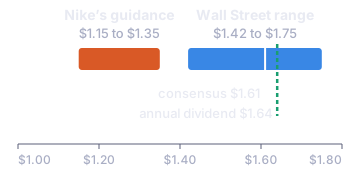
Earnings per share for the year to May 2027. The guidance excludes about $0.15 of restructuring costs; the analyst range and the consensus are the 13 estimates on Nasdaq’s earnings forecast page before the report. The dividend line is four quarterly payments of $0.41.
The stock had already fallen sharply before the report. The stock touched an intraday low of $35.02 on October 1, below the previous 52-week low, and was down 44.9% for the year from its December 31 close of $63.71, based on Nasdaq’s historical prices. In the week before the report one large broker turned negative. Bank of America downgraded the stock to underperform from neutral, writing that "risks are rising" amid sluggishness across the category and pointing to likely further disappointing results in China, according to CNBC’s preview of the report.
After-hours moves can reverse. In June the shares fell as much as 8% in extended trading after the fiscal fourth-quarter report, per CNBC, and then closed 4.9% higher the next day, at $43.06 against $41.05 (based on Nasdaq’s daily closes). Trading after the bell is thin, and the earnings call, scheduled for 5 p.m. ET, can move the price again before the next session opens.
The fiscal 2027 guidance and the rest of the year
Nike expects revenue to fall by a high-single-digit percentage in fiscal 2027, which runs to May 31, 2027, and adjusted earnings of $1.15 to $1.35 a share. The adjusted figure leaves out about $0.15 a share of restructuring costs for the Pace program described below, so earnings under GAAP accounting would come to roughly $1.00 to $1.20. The tax rate should be in the mid-20s, above the first quarter’s 22.7%. The release gave no forecast for the second quarter, and Hill said on the June call that Nike would share "the next phase of our growth strategy" at an Investor Day on November 16 and 17, per Nike’s official transcript.
Put next to the first quarter, the outlook says a good deal about the next nine months. Revenue fell 4% in the quarter just reported, so a decline of 7% to 9% for the year, which is what high single digits usually means, requires the remaining nine months, taken together, to fall faster, by roughly 8% to 11% against the $34.7 billion Nike booked in the same quarters of fiscal 2026. Earnings point the same way. The first quarter’s $0.48 a share, which the release reports without any restructuring adjustment, already covers 36% to 42% of the full-year adjusted range, which leaves $0.67 to $0.87 a share for the remaining three quarters, about $0.22 to $0.29 a quarter on average.
A year earlier, Nike earned $0.53, $0.35 and $0.72 a share in those three quarters, $1.60 in total, or $1.08 once the $0.52 tariff refund booked in the fourth quarter is taken out (with no other adjustment), per its quarterly releases, the last of them the fiscal 2026 results release. Against that $1.08, the guidance implies a drop of roughly 19% to 38% for the rest of fiscal 2027.
Fiscal 2026 also carried $385 million of severance costs, per Nike’s annual report, which an adjusted figure would leave out. If the $300 million of severance from the March plan, booked in the third quarter, is taken out as well, the base rises to about $1.24 a share at fiscal 2026’s 20.3% tax rate and the implied decline to roughly 30% to 46%. Removing all $385 million instead gives about $1.29 and roughly 32% to 48%, by our estimate. For the full year, the new adjusted range sits below even the $1.58 a share that fiscal 2026 earned once the refund alone is removed, the figure Friend gave on the June call.
Gross margin is the brighter part of the first quarter, although the release gives no full-year forecast for it. Nike’s quarterly gross margin fell from 45.4% in the first quarter of fiscal 2025 to a low of 40.2% in the third and fourth quarters of fiscal 2026 (before the tariff refund), and the 42.8% just reported is the first year-over-year gain, leaving the refund aside, after seven straight quarterly declines, per Nike’s quarterly releases. In both fiscal 2025 and fiscal 2026 the first quarter carried a higher gross margin than the two quarters after it, so a single reading says little about the rest of the year.
Greater China, Converse and the shrinking direct business
Revenue fell by $507 million from a year earlier, and one region explains most of it. Greater China brought in $1.18 billion against $1.51 billion, down 22% as reported and 26% on a currency-neutral basis (a stronger yuan made the reported figure look better than the local trend), so China alone accounts for $332 million, about two thirds of the company’s total decline. EBIT in the region fell 34% to $248 million, and its EBIT margin slipped to 21.0% from 24.9%. Sales to Chinese retailers fell 28%, and Nike’s own stores and digital sales there fell 13%. China now makes up 10.5% of Nike’s revenue, down from 12.9% a year earlier.
Where Nike’s $507 million sales drop came from
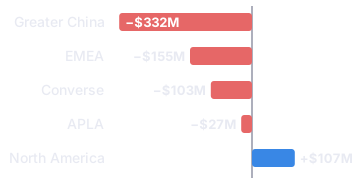
Change in revenue from the same quarter a year earlier, in millions of dollars. EMEA is Europe, the Middle East and Africa, and APLA is Asia Pacific and Latin America. Source: Nike’s fiscal first-quarter 2027 results release.
The decline widened from the previous quarter. In the fiscal fourth quarter, China revenue fell 12% as reported to $1.30 billion, per the fiscal 2026 results release, so the drop nearly doubled from one quarter to the next.
For fiscal 2026 as a whole the region brought in $5.85 billion, against a record $8.29 billion in fiscal 2021, and a CNBC analysis in July counted eight straight quarters of year-over-year declines while, citing GlobalData, the Chinese sportswear market as a whole grew 51% over five years. The same piece points to the shift toward local brands that gathered pace after the 2021 dispute over Xinjiang cotton, to better value from domestic rivals, and to a distribution clean-up in which Nike is closing online storefronts that its Chinese distributors had been allowed to run.
BNP Paribas analyst Laurent Vasilescu estimated those closures could cost Nike up to $1 billion of revenue a year, per CNBC. Nike’s sales to Chinese wholesale customers fell 28% in the first quarter, to $644 million from $893 million, and the release does not say how much of that came from the distribution changes and how much from weaker demand.
The local brands are still growing, at different speeds. Anta Sports’ group revenue rose 12.9% in the six months to June, per its interim results, although the Anta brand itself grew 4.8%, FILA 6.1% and the group’s smaller brands 44.2%, and Li Ning’s revenue rose 2.8%, per its results announcement. In Euromonitor figures reported in April 2025 by China Daily, Anta already held 23% of China’s sportswear market against Nike’s 20.7%.
Converse is the second weak spot. The brand, which sells the Chuck Taylor canvas sneaker, had revenue of $263 million, down 28% with declines in every territory, and EBIT of $25 million. Its revenue peaked at $2.43 billion in fiscal 2023, per the fiscal 2023 results release, and fell to $1.17 billion in fiscal 2026, a drop of about 52%, with EBIT down to $18 million from $240 million the year before. Bloomberg reported in March that Authentic Brands Group would be interested if Converse were put up for sale, adding that Nike had not engaged in talks, according to the Boston Globe, and Hill said in a February interview with Bloomberg Television that "we're committed to the Converse brand."
Together, China and Converse account for $435 million, about 86%, of the company’s $507 million revenue decline in the first quarter. The other two regions fell less. In Europe, the Middle East and Africa, revenue fell 5%, with footwear down 11% while apparel grew 5%, and Asia Pacific and Latin America was flat in local currencies.
The split by channel shows where the decline is concentrated. Nike sells in two ways, through wholesale partners such as sporting goods chains and department stores, and directly to shoppers through its own app, website and stores, which it calls Nike Direct. Wholesale revenue for the Nike brand was $6.80 billion, down 1%, while Nike Direct fell 8% to $4.14 billion, with digital sales down 13% and Nike-owned stores down 5%.
Some of that is deliberate. Nike has been cutting back on discount-led online sales, and on the June call it said that in Europe, the Middle East and Africa "off-price was down over 50% following aggressive actions to reduce promotions," which lifted the share of goods sold at full price, per Nike’s official transcript. Direct sales in that region fell another 12% this quarter.
Adidas had a stronger summer. It reported record second-quarter sales of 6.74 billion euros, up 14% on a currency-neutral basis, and raised its full-year outlook, per its July 30 release. The World Cup, held in North America in June and July, was the summer’s big event for both companies. Nike said in June that by the start of the tournament it had sold 2.5 times as many national-team kits as in the same period of the 2022 edition. The first-quarter release does not mention the tournament, and demand creation rose 5%, less than the high-single-digit growth Nike had planned for it in June.
North America wholesale and the sell-through question
North America was the only region that grew, by 2% to $5.13 billion, with EBIT up 3% to $1.17 billion. Inside it the two channels moved in opposite directions. Sales to wholesale customers rose 9% to $2.98 billion, while sales through Nike Direct fell 6% to $2.15 billion.
That split matters because of the way wholesale revenue is booked. Nike records a wholesale sale when the goods are shipped or delivered to the retailer (the industry calls this sell-in), and what the retailer orders next depends on how much of that stock it then sells to its own customers, the sell-through, so if shipments run ahead of what shoppers buy, the goods pile up on store shelves and the orders fall away later.
Retailers have been sending mixed signals on that. Dick’s Sporting Goods, which now owns Foot Locker, said on August 25 that comparable sales had risen 4.9% at Dick’s stores and fallen 3.6% at Foot Locker, cut Foot Locker’s comparable sales outlook to somewhere between a 2% decline and flat, and blamed fewer and weaker launches and Foot Locker’s exposure to "legacy footwear silhouettes," per its second-quarter release, which does not name Nike.
The benign reading of the North American numbers is that rebuilding wholesale is exactly what Nike set out to do. Nike Direct revenue nearly doubled from $11.8 billion in fiscal 2019 to $21.5 billion in fiscal 2024 as Nike put its own app, website and stores first, then fell back to about $17.7 billion in fiscal 2026, per Nike’s annual results releases, so some wholesale growth is the expected result of that shift going into reverse.
On the June call Hill said Nike had picked up 5 points of running market share in "statement footwear" across Western Europe and North America in fiscal 2026, and that "we've been rebuilding our wholesale relationships" (per Nike’s official transcript). The second-quarter numbers, along with whatever the large retailers say about Nike product in their own reports, would be the next real test of which reading is right.
Gross margin, tariffs and the refund
Comparisons with the previous quarter need care because of tariffs. On February 20, 2026, the US Supreme Court ruled that tariffs imposed under the International Emergency Economic Powers Act (IEEPA, the emergency-powers law used for most of the 2025 duties) were unauthorized, and in its fiscal fourth quarter Nike booked $986 million for the expected recovery of the IEEPA tariffs it had paid, per the fiscal 2026 results release. That lifted fourth-quarter gross margin by about 9 percentage points to 49.2% and earnings by $0.52 a share. The release says the benefit "largely offsets" the IEEPA tariff cost recognized during fiscal 2026, and Nike had received about $0.3 billion of the refunds in cash by May 31.
Most of the refund had not been collected by the end of the fiscal year. Nike had received $302 million and recorded $684 million as still outstanding at May 31, and its annual report, filed on July 15, says it received substantially all of the remaining amount after that date. That cash pays for a benefit already counted in fiscal 2026 earnings, so it does not recur.
The first quarter’s 42.8% carries no refund, which makes it the cleaner number, and the release does not mention tariffs at all. The duties did not disappear with the court ruling. On July 24, 2026, new Section 301 duties took effect at 12.5% on goods from China and Vietnam and 10% on goods from Indonesia, per the Federal Register notice of the trade representative’s action.
Those three countries make almost all of Nike’s shoes. Factories in Vietnam, Indonesia and China made about 52%, 27% and 16% of all Nike brand footwear in fiscal 2026, a worldwide figure that is not the same as the mix of shoes shipped into the US, per Nike’s annual report. Nike’s June planning assumed incremental tariffs of 10% through July and 15% after that, so the new Section 301 rates came in below that assumption. A year ago, Friend put the gross annualized cost of the 2025 tariffs at "approximately $1.5 billion," per Nike’s September 2025 call transcript. Most of those duties were the IEEPA tariffs the court later struck down, and the release gives no figure for the cost of the new ones.
For a sense of scale, Nike’s annual gross margin was 46.0% in fiscal 2022 and was 44.6% as recently as fiscal 2024, per its annual results releases, against 40.8% in fiscal 2026 once the refund is removed, the figure Friend gave in June. The last time margins fell this way, in the inventory glut of fiscal 2023, the quarterly gross margin bottomed at 42.9% on heavy markdowns and the annual margin was back to 44.6% the following year.
Small moves in this line matter a great deal to earnings at Nike’s current size. On revenue of about $42.7 billion, the midpoint of the new outlook, one percentage point of gross margin is worth about $430 million before tax, or roughly $0.22 a share after tax at a 25% rate, which is about a sixth of the $1.25 midpoint of the earnings guidance.
Pace and the $2.5 billion savings target
The release also introduced Pace, which Nike describes as an operating model transformation to "accelerate and scale the success of the Sport Offense." It folds in the cost realignment plan from March 2026 and adds a modernized global supply chain, a new campus in India for enterprise functions, a regrouping of the business into three geographies (Nike reports four regions today), and more streamlining of the organization, although the release does not say which three geographies it has in mind.
The March plan, approved on February 27 and disclosed in an 8-K filed on March 5, carried about $300 million of pre-tax charges, mainly severance, and in April Nike said it was cutting about 1,400 roles in its global operations, most of them in technology, and concentrating its technology teams in Beaverton and at the Nike India Technology Center, per its April 23 announcement. The October release says the new India campus is meant "to fuel its enterprise capabilities."
Nike expects about $2.5 billion of cumulative savings through fiscal 2031, against about $1.0 billion of pre-tax charges, mostly employee-related, on top of the roughly $0.3 billion of severance the release counts for fiscal 2026 (the annual report puts all fiscal 2026 severance at $385 million). About $0.3 billion of the charges should fall in fiscal 2027. The word cumulative matters here. Spread over the five fiscal years from 2027 to 2031, $2.5 billion averages about $0.5 billion a year, while selling and administrative expense was $3.91 billion in this quarter alone, about $15.6 billion a year at that rate, so the average is roughly 3% of that expense line and a smaller share of total costs, which also include the cost of making the products.
Net of the roughly $1.0 billion of charges still to come, the program’s savings come to about $1.5 billion over five years, before tax, and Nike says the estimate is stated before any reinvestment. The release does not say how much of the savings is already in this year’s guidance.
Against profit, the same money looks much larger. As a scale illustration only, half a billion dollars a year before tax is worth about $0.25 a share after tax at a 25% rate, about a fifth of the $1.25 midpoint of this year’s guidance, if all of it reached net income. How much will be reinvested in marketing and product, and how the savings are phased between now and 2031, are the details investors are likely to look for at the November Investor Day.
Nike’s dividend against the new earnings guidance
Nike pays $0.41 a share each quarter, or $1.64 a year, a yield of about 4.7% at the $35.10 close. The November 20, 2025 increase from $0.40 marked "the 24th consecutive year that NIKE has increased its quarterly dividend," per the company’s announcement. Nike returned about $610 million through dividends in the first quarter, 86% of the quarter’s net income. Over a year, at the current share count of about 1.48 billion, the dividend costs roughly $2.4 billion. You can check the yield math at other prices with our dividend yield calculator.
The new guidance changes the coverage arithmetic. The payout ratio, the share of earnings paid out as dividends, would be about 121% at the top of the adjusted range of $1.35 and about 143% at the bottom of $1.15, and higher again on GAAP earnings once restructuring costs are included. On the last four reported quarters, Nike earned $2.08 a share, which puts the current payout at 79%, but those quarters include the $0.52 tariff refund, and without it the ratio is about 105%. A payout above 100% means a company is paying out more than it earns in that year, which it can keep up only from cash on hand, borrowing, or cash flow that runs ahead of reported profit.
The cash side shows the same squeeze from another angle. In fiscal 2026 Nike generated $2.87 billion of operating cash flow and spent $0.68 billion on property and equipment, which leaves about $2.18 billion, while it paid $2.41 billion in dividends, per the cash flow figures in its annual report.
Part of that gap was timing. The annual report says changes in working capital and other items cut operating cash flow by $1.68 billion, mainly because receivables rose, largely on the uncollected tariff refund, which Nike then collected after May 31, and because income taxes payable fell. Five years earlier, in fiscal 2021, the same calculation of operating cash flow minus capital spending left $5.96 billion against $1.64 billion of dividends. Share buybacks have nearly stopped, at $123 million in fiscal 2026 against $5.5 billion in fiscal 2023, per the annual results releases.
On the balance sheet, Nike held $8.37 billion of cash and short-term investments at the end of August against $7.89 billion of debt, of which $2.0 billion is due within a year, per the balance sheet in the release, so net cash was about $0.5 billion, down from about $1.1 billion at the end of May. Cash and short-term investments fell by about $0.66 billion over the quarter, a period in which, by the annual report’s account, Nike also collected substantially all of the $684 million refund.
Whether future cash flow covers the dividend depends on how the business performs from here and on the board’s decisions. The most recent increase was declared in November, and if the board keeps to that timing, its next decision falls in the same weeks as the Investor Day.
Nike’s P/E under different profit margins
Nike’s P/E ratio, the share price divided by earnings per share, looks quite different depending on which earnings you use. At $35.10 the stock traded at 16.9 times the $2.08 a share Nike earned over its last four reported quarters, but those quarters include the $0.52 tariff refund, and without it the multiple would be about 22.5. On the $1.25 midpoint of the new guidance it is about 28, and at the $33.85 after-hours price of 4:57 p.m. about 27 (you can check the arithmetic with our P/E ratio calculator). So the share price is low against Nike’s own history while the multiple is high against this year’s expected earnings, since those earnings are so far below the company’s usual level.
Another way to look at the price is to vary the profit margin and see what happens to earnings and the P/E. Nike’s market value was about $52 billion at the close. The table below holds revenue at about $42.7 billion, the midpoint of the fiscal 2027 outlook, and the share count at 1.484 billion, and shows the earnings per share and P/E at $35.10 for several levels of net margin, the share of revenue that ends up as profit. The guidance midpoint corresponds to a net margin of about 4.3%.
| Net margin on $42.7 billion of revenue | Earnings per share | P/E at $35.10 |
|---|---|---|
| 4.3% (midpoint of the adjusted guidance) | about $1.25 | about 28 |
| 7.5% | about $2.16 | about 16 |
| 10% | about $2.88 | about 12 |
| 12.5% | about $3.60 | about 10 |
Nike’s own record gives those margins a context. Net income was 10.3% of revenue in fiscal 2019, 12.9% in both fiscal 2021 and fiscal 2022, 9.9% in fiscal 2023 and 11.1% in fiscal 2024, then 7.0% in fiscal 2025 and 6.7% in fiscal 2026, or about 5% once the tariff refund is removed, based on the annual figures in Nike’s 10-K filings. The two weak years before this stretch had clear one-off causes, US tax reform charges in fiscal 2018 (5.3%) and the pandemic in fiscal 2020 (6.8%).
Nike’s net profit margin, fiscal 2019 to 2027
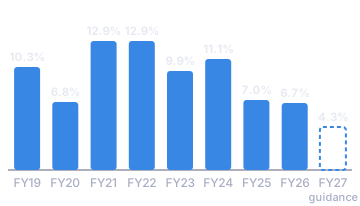
Net income as a share of revenue for fiscal years ending May 31, from Nike’s 10-K filings. Fiscal 2026 includes the tariff refund and would be about 5% without it. The fiscal 2027 bar is the midpoint of the adjusted earnings guidance on revenue of about $42.7 billion, so it leaves out restructuring costs.
The same table can be run backwards for an assumed multiple. At 15 to 20 times earnings, a range we use only for illustration (the stock traded at about 22 times the $1.61 consensus before the report), $35.10 corresponds to earnings of about $1.75 to $2.34 a share, or a net margin of roughly 6% to 8% on fiscal 2027 revenue. At those multiples, the earnings behind $35.10 imply a net margin above the roughly 4.3% implied by the new adjusted guidance and below the roughly 10% to 13% (under GAAP) Nike earned from 2019 to 2024 outside the pandemic year.
What the table leaves out. It assumes revenue stops falling at the fiscal 2027 level and that the share count stays flat, it ignores the timing of any recovery and the cost of Pace, and it mixes an adjusted guidance figure with historical GAAP margins. It shows how earnings and the P/E move with the margin, and our editorial policy explains how we handle estimates like this one.
The 2017 to 2019 reset, for comparison
Nike has gone through a reset before. In June 2017 the company announced the Consumer Direct Offense, "a new Company alignment designed to allow NIKE to better serve the consumer personally, at scale," per an SEC exhibit from that September. Through that period revenue kept growing, by 6% in fiscal 2017, 6% in fiscal 2018 and 7% in fiscal 2019, and the gross margin stayed between 43.8% and 44.7%, per the fiscal 2019 results release and the two before it.
The inventory glut of fiscal 2023 is the other recent precedent. Inventories peaked at $9.66 billion at the end of August 2022, up 44% from a year earlier, markdowns to clear them pulled the quarterly gross margin down to 42.9% in the following quarter, and the stock fell 12.8% the day after the September 2022 report and rose 12.2% after the December one, based on Nasdaq’s closing prices. Revenue still grew 10% that year, and the annual gross margin was back at 44.6% in fiscal 2024.
The present reset differs on the line that a recovery usually starts from. Revenue was flat in fiscal 2024, fell 10% in fiscal 2025 and was flat again in fiscal 2026, and if the new guidance holds, fiscal 2027 will be a fourth year in a row of flat or falling revenue, with revenue of roughly $42 billion to $43 billion, below the $44.5 billion of fiscal 2021. In both earlier episodes Nike was fixing margins on a growing business, and this time Pace, the wholesale rebuild and the China clean-up all have to work while sales shrink.
Dates and signals to watch
Most of the open questions will get new data on a known calendar. Nike said in June that it would share more of its outlook at the Investor Day on November 16 and 17, the last dividend increase was declared in November, and the fiscal second quarter ends on November 30 (last year’s second-quarter results came out on December 18).
| Signal | Latest reading | What a change would look like |
|---|---|---|
| Full-year revenue outlook | down high single digits for fiscal 2027 | a narrower or wider range at Investor Day or with second-quarter results |
| Greater China | -26% currency-neutral in Q1, after -17% in Q4 | the decline narrowing in the second quarter |
| North America channels | wholesale +9%, Nike Direct -6% | retailers such as Dick’s reporting better or worse Nike sell-through |
| Gross margin | 42.8%, +60 basis points, no refund benefit | further year-over-year gains in the second quarter |
| Dividend | $0.41 a quarter, 24 years of increases | the November decision to raise, hold or cut |
| Pace savings | $2.5 billion cumulative through fiscal 2031 | a yearly phasing and a reinvestment figure |
| Converse | -28% in Q1 | a slower decline, or a change in Nike’s plans for the brand |
| Analyst estimates | fiscal 2027 consensus $1.61 before the report, low estimate $1.42 (Nasdaq) | estimates moving into the $1.15 to $1.35 range, or staying above it |
Nike’s filings and press releases appear on its StockTitan SEC filings page and news feed as they come out.
Frequently asked questions
Did Nike beat earnings expectations?
On earnings, yes. Nike reported $0.48 a share for its fiscal first quarter against the $0.43 LSEG consensus, while revenue of $11.21 billion fell 4% and came in about $107 million below the $11.32 billion analysts expected. The full-year outlook, a high-single-digit revenue decline and adjusted earnings of $1.15 to $1.35 a share, was well below the $45.31 billion of revenue (LSEG, cited in CNBC’s preview) and $1.61 a share (Nasdaq consensus) analysts had been expecting.
Why is Nike stock down after earnings?
The shares fell as much as 6.6% in extended trading shortly after the release and were down about 3.6% just before the call, and the most likely reason is the guidance. The midpoint of the new adjusted earnings range, $1.25 a share, is about 22% below the $1.61 consensus, and the revenue outlook implies the rest of the year will be weaker than the first quarter. Greater China revenue also fell 22%, more than the 12% drop in the previous quarter.
Do Nike’s earnings cover its dividend?
The October release does not mention any change to the dividend, and it describes a "strong track record of returns to shareholders." The numbers are tighter than they were. The $1.64 annual dividend is above the entire adjusted earnings range of $1.15 to $1.35 a share, a payout of about 121% to 143%. In fiscal 2026, operating cash flow minus capital spending came to $2.18 billion against $2.41 billion of dividends, and the company held $8.4 billion of cash and short-term investments against $7.9 billion of debt at the end of August. Its most recent increase was declared in November 2025.
What is Nike’s guidance for fiscal 2027?
Nike expects revenue to fall by a high-single-digit percentage in the year to May 31, 2027, adjusted earnings of $1.15 to $1.35 a share (which leave out about $0.15 of restructuring costs), and a tax rate in the mid-20s. Since revenue fell 4% in the first quarter, the outlook implies declines of roughly 8% to 11% over the remaining three quarters.
How bad are Nike’s sales in China?
Greater China revenue fell 22% to $1.18 billion in the quarter, or 26% in local currency terms, and EBIT in the region fell 34%. China accounted for about two thirds of Nike’s total revenue decline, and the release lists it with Sportswear and Jordan among the businesses Nike is repositioning.
What is Nike’s P/E ratio after the fall?
It depends on the earnings you use. The shares are about 80% below their 2021 record close, but at $35.10 they trade at about 28 times the midpoint of this year’s earnings guidance, because those earnings are depressed. If net margin returned to around 10% on fiscal 2027’s expected revenue, the multiple would be about 12, which is why the margin outlook matters so much for the stock.
Where can I follow Nike on StockTitan?
Start with the NKE overview page, which has the price chart and the company profile. Nike’s press releases land in its news feed and its filings on the SEC filings page, and the financials page keeps the quarterly history. For more earnings coverage, our Micron fiscal Q4 2026 analysis looks at another report from this week, and our AMD Q2 2026 earnings article covers a chipmaker from this summer.
Sources
- StockTitan: Nike overview; Nike fiscal Q1 2027 results release; Nike financials; Nike SEC filings; dividend yield calculator; P/E ratio calculator; November 2025 dividend announcement.
- Nike filings: fiscal Q1 2027 results release (SEC); fiscal Q4 2026 results release (SEC); fiscal 2026 annual report (10-K); March 2026 restructuring 8-K; results releases for fiscal 2019 and fiscal 2023; 2017 Consumer Direct Offense exhibit; fiscal Q4 2026 call transcript (June 30); April 23, 2026 global operations announcement; fiscal Q1 2026 call transcript (September 2025).
- Market data and analysts: CNBC with LSEG estimates; CNBC on the fiscal Q4 2026 report; Nasdaq after-hours and historical prices; Nasdaq earnings forecast.
- Retail and competitors: adidas second-quarter 2026 release; Dick’s second-quarter 2026 release; Boston Globe on Converse.
- China and tariffs: CNBC on Nike in China; Anta interim results; Li Ning interim results; China Daily on market shares; Federal Register notice on the Section 301 duties.
The information provided in this article is for educational and informational purposes only. It does not constitute financial advice, investment recommendation, or an endorsement of any particular investment strategy. Past performance does not guarantee future results. Investors should conduct their own research and consult with a qualified financial advisor before making investment decisions.