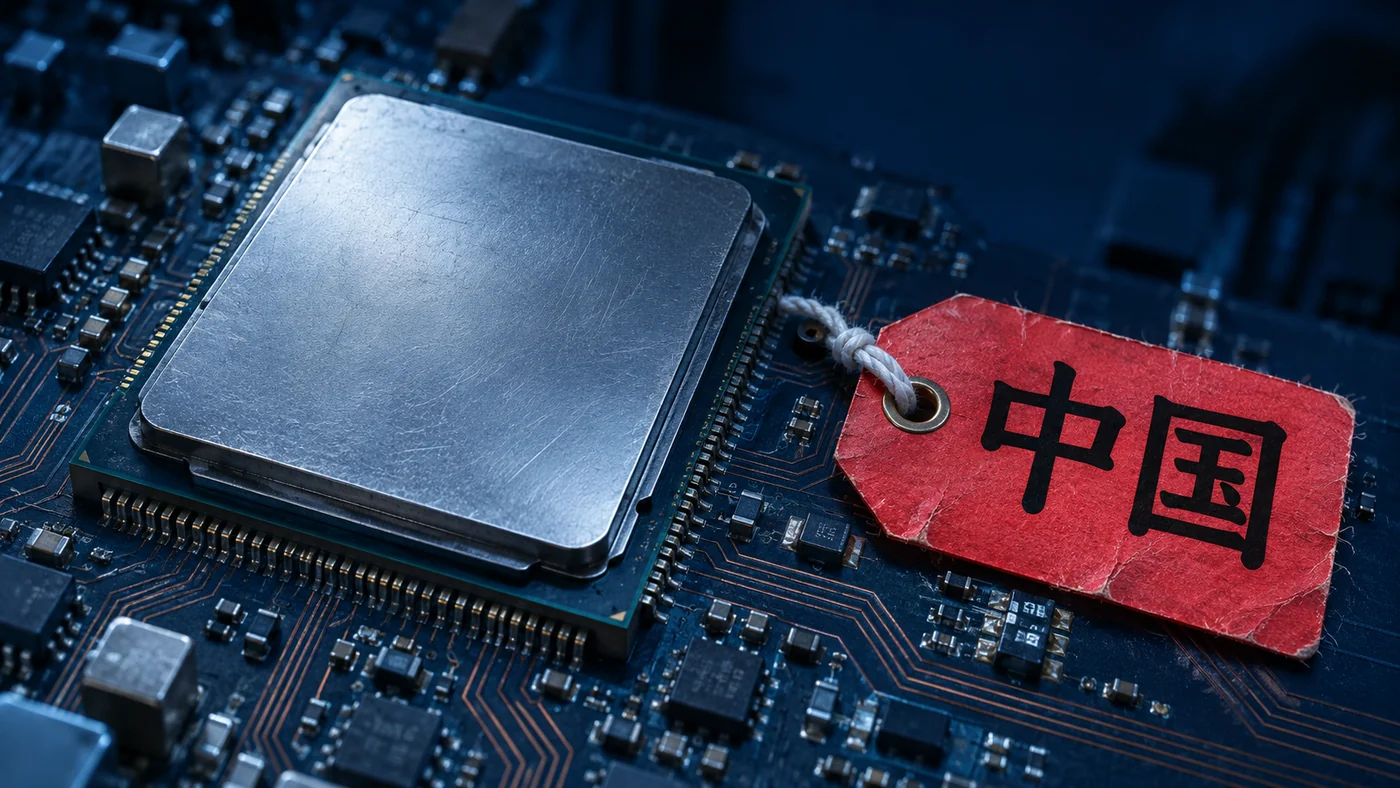
Nvidia (NVDA) shipped $2.4 billion of its Hopper AI chips to China in the three months to October 25, 2026, its most in a quarter since early 2025. Then, on its November 17 earnings call, interim chief executive Colette Kress said Nvidia is no longer shipping them.
The short answer. Nvidia says it has stopped shipping to China the AI chips it sold there under US licenses, right after a $2.4 billion quarter. It matters beyond Nvidia's owners because those licenses were the path the US opened in January 2026 for chips like the H200 to go to China.
Nvidia's own reports for the last seven quarters show how far its China chip shipments fell after a US license requirement of April 2025. They also show how small the comeback was, at about 2.2% of its sales to data centers, the buildings full of computers that run AI.
Nvidia's AI chip shipments to China, early 2025 and nowIn the quarter to October 2026, Hopper shipments to China reached about half their early 2025 value, inside a data center business almost three times as big, so China's slice fell from about 11.8% to about 2.2%.Figures from Nvidia first quarter fiscal 2026 results release, as of May 28, 2025; Nvidia CFO commentary, third quarter fiscal 2027, as of November 17, 2026.
Nvidia said on November 17 that it is no longer shipping the licensed Hopper data center chips it had been selling to China. Its forecast for the quarter to January 2027 counts on no data center computing sales from China at all.
The news came on the earnings call, not in the written results. Kress took over as interim chief executive when Jensen Huang resigned on November 12. She spoke about China in her prepared remarks on the call. "Our guidance does not have any licensed Hopper data center products included, and we are no longer shipping licensed Hopper data center products to China," she said on the call, which Nvidia carries as a webcast on its investor site. A transcript of the call published by StockAnalysis has the same words, and Bloomberg reported them on November 18. Guidance is Nvidia's forecast. The chips she named are the Hopper data center chips Nvidia sold to China under US licenses. Kress gave no reason for the stop in those remarks.
Nvidia also left China out of its written forecast for the next quarter. "We are not assuming any Data Center compute revenue from China in our outlook," reads the commentary from its chief financial officer (CFO), published with the results. Its forecasts have used that line since February 2026. The August forecast for the quarter just reported used it too, as StockTitan's look at the results notes.
The stop, as Kress worded it, covers licensed Hopper data center chips. Nvidia's August filing says it can still ship products that export controls do not cover to China, such as gaming and workstation chips.
Sec.02How big were Nvidia's China chip sales before the stop?
About $2.4 billion in three months. That is real money, but it is a small slice of a data center business that sold $107.6 billion in the same quarter.
The figure is one line in the CFO commentary Nvidia published with its results on November 17. It reads: "Shipments of Data Center Hopper products to China during the quarter were $2.4 billion." The quarter ran from late July to October 25, 2026.
Hopper is Nvidia's older family of AI chips for data centers, the buildings full of computers that train and run AI. Its filings describe a move from Hopper to the newer Blackwell chips in 2025. Rubin, the family after that, began shipping this year. The H20 and the H200, the two chips at the center of the China story, are both Hopper chips. Kress called the H200 "Hopper 200," and Nvidia counts its early 2025 H20 sales as Hopper shipments to China.
The commentary does not name the chip. In the quarter before, Kress, then finance chief, said on the August 26 call that Nvidia "shipped less than 1% of our total data center revenue in Hopper 200 products to customers based in China in accordance with the US government licenses."
Set against early 2025, the picture changes. In the three months to April 27, 2025, Nvidia's H20 sales came to $4.6 billion. That was about 11.8% of its $39.1 billion of data center sales. So the China business came back to about half its early 2025 size, inside a data center business that had nearly tripled.
It was also a jump from the quarter just before, when such shipments were less than 1% of data center sales. The $2.4 billion was more than 2.6 times that.
Sec.03Why Nvidia's China chip sales nearly stopped in 2025
A US license requirement. In April 2025 the US government told Nvidia it needed a license to ship its H20 chip to China, and for the next year Nvidia reported none or almost none.
Nvidia's results release of May 28, 2025 tells the start. It says the US government informed Nvidia on April 9, 2025 "that a license is required for exports of its H20 products into the China market." H20 sales had reached $4.6 billion in that quarter before the rule, and Nvidia said it was unable to ship another $2.5 billion.
The cost showed up at once. Nvidia took a $4.5 billion charge, a cost it booked for H20 chips and orders it no longer expected to sell. It also said its next forecast left out about $8.0 billion of H20 sales "due to the recent export control limitations."
Then came the quiet year. In the quarter to July 2025 there were "no H20 sales to China-based customers," the quarterly filing says; Nvidia instead sold about $650 million of H20 chips to a customer outside China. US licenses for some H20 sales came in August 2025, yet the annual report puts the revenue under them at about $60 million in all. In the three months to April 2026, Nvidia shipped no Hopper data center chips to China at all.
Read quarter by quarter, the $2.4 billion is the largest amount since the license rule. The table below gives each quarter in the words of Nvidia's own document.
Show the data
Quarter (Nvidia fiscal year)
Months
Hopper data center chips to China, as Nvidia reported
Nvidia data center sales
Q1 fiscal 2026
Feb to Apr 2025
$4.6 billion of H20 sales
$39.1 billion
Q2 fiscal 2026
May to Jul 2025
No H20 sales to China-based customers
$41.1 billion
Q3 fiscal 2026
Aug to Oct 2025
H20 sales "insignificant"; about $50 million under licenses to date
$51.2 billion
Q4 fiscal 2026
Nov 2025 to Jan 2026
No China line; about $60 million of H20 under licenses in all
$62.3 billion
Q1 fiscal 2027
Feb to Apr 2026
No shipments
$75.2 billion
Q2 fiscal 2027
May to Jul 2026
Less than 1% of data center sales, H200 under US licenses
$89.0 billion
Q3 fiscal 2027
Aug to Oct 2026
$2.4 billion
$107.6 billion
Source: Nvidia results releases, CFO commentaries, Forms 10-Q and the fiscal 2026 Form 10-K, May 28, 2025 to November 17, 2026.
Sec.04What the US approved for Nvidia chips to China
Since January 15, 2026, the Commerce Department looks at each request to sell H200 chips to China on its merits. Before, the answer was presumed to be no. Nvidia says it got licenses in February 2026 to ship small amounts.
The change came in a rule of the Bureau of Industry and Security, the part of Commerce that sets the rules on what can be sold abroad. It covers "the Nvidia H200 and its equivalents, as well as less advanced chips." A license still has to be granted, and the exporter must certify several things first.
There must be enough supply for US buyers. Shipments of the chip to China and Macau can be no more than 50% of what goes to US customers. Every shipment must also be checked by an independent testing lab in the United States before it leaves.
Nvidia says the US told it its H20 chip needs a license to go to China
Aug 2025
Nvidia says the US granted H20 licenses; it made about $60 million under them in all
Jan 15, 2026
Commerce moves H200 exports to China to case-by-case review, and a 25% import duty on some AI chips starts
Feb 2026
Nvidia says it got licenses to ship small amounts of H200 chips to some China-based customers
Aug 26, 2026
Nvidia reports Hopper shipments to China of under 1% of data center sales
Nov 17, 2026
Nvidia reports $2.4 billion of Hopper shipments to China in three months
That testing step has a cost. A presidential proclamation of January 14, 2026 set a 25% duty on some imported AI chips from January 15. Chips for US data centers and some other US uses are exempt. Because the H200s are inspected in the United States, Nvidia's August quarterly filing says they "are subject to a 25% tariff upon importation." Nvidia adds that it has been unable to pass any of that tariff on to its customers.
There was an earlier money question too. Nvidia's filings say US officials expected the government to get "15% or more" of the money from its licensed sales. Nvidia adds that the government did not publish a rule setting it.
Export cases are in the news too. The Commerce and Justice Departments said in a joint statement that Nvidia put the Singapore company Megaspeed on its "no sell" list in June 2025. The Justice Department posted the statement on November 17. The Justice Department now leads that investigation, which StockTitan covered here.
Sec.05What Nvidia said held back its China sales
Before the stop, Nvidia pointed to China's side too. Its filing of August 26, 2026 says China restricted the H200 sales the US had licensed, and that Nvidia was all but shut out of China's data center market.
The licenses alone did not open the door. "Such sales were restricted by the PRC government, and we have been unable to sell all the products for which we have licenses," Nvidia wrote in that filing of August 26. The PRC is the People's Republic of China.
The same filing says the Chinese government "encouraged customers to purchase from our China-based competitors." It also says China discouraged buyers from buying or using Nvidia's data center chips. Nvidia took a $0.4 billion charge on unsold H200 chips and orders in the first half of its fiscal year, "as the demand for H200 products diminished."
Its sharpest words sit in its list of risks. As of late July 2026, Nvidia wrote, "we were effectively foreclosed from competing in China's data center computing/compute market." Foreclosed here means shut out. Nvidia has used that phrase in each annual and quarterly report since late 2025.
Nvidia's forecasts left China out through all of this. In August, Kress gave the reason as "ongoing geopolitical uncertainty."
Sec.06How much of Nvidia's revenue comes from China?
Customers based in China and Hong Kong brought in $7.9 billion in the quarter to July 2026, or 8.2% of Nvidia's revenue. That line counts where buyers have their headquarters and includes chips such as gaming cards, so it is not the AI chip number.
Nvidia reports a sales line for "China (including Hong Kong)" in each quarterly filing. It counts where each direct buyer has its head office. Nvidia warns that "the end customer and shipping location may be different." The line also holds the gaming and workstation chips that Nvidia can still ship to China.
That is why the two numbers part ways. In the three months to April 2026, Nvidia shipped no Hopper data center chips to China, yet customers based there brought in $4.55 billion of revenue.
The long view is still a steep fall. Customers based in China made up about a fifth of Nvidia's revenue in fiscal 2024 and fiscal 2025, the annual report shows. In fiscal 2026, Nvidia's year to January 2026, they made up 9.1%. The share bottomed at 4.5% in the three months to January 2026 and climbed back to 8.2% by July. The figure for the quarter to October comes with the next quarterly filing. That line counts every sale to buyers based in China, so on its own it cannot show whether the licensed Hopper chips Kress said Nvidia stopped shipping resume.
Show the data
Period
China incl. Hong Kong revenue
Nvidia total revenue
Share
Fiscal 2024 (year to Jan 2024)
$12,330 million
$60,922 million
20.2%
Fiscal 2025 (year to Jan 2025)
$25,048 million
$130,497 million
19.2%
Fiscal 2026 (year to Jan 2026)
$19,677 million
$215,938 million
9.1%
Feb to Apr 2025
$9,659 million
$44,062 million
21.9%
May to Jul 2025
$3,985 million
$46,743 million
8.5%
Aug to Oct 2025
$2,973 million
$57,006 million
5.2%
Nov 2025 to Jan 2026
$3,060 million
$68,127 million
4.5%
Feb to Apr 2026
$4,550 million
$81,615 million
5.6%
May to Jul 2026
$7,880 million
$96,221 million
8.2%
Source: Nvidia Forms 10-Q for October 2025, April 2026 and July 2026, and the fiscal 2026 Form 10-K. Revenue by customer headquarters, as Nvidia recast earlier periods.
What to watch
China revenue for the quarter to October 2026, and whether Nvidia describes the stop or changes its license and "effectively foreclosed" wording: the quarterly filing, which Nvidia says it will file "in the coming weeks"
Hopper shipments to China in the quarter to January 2027: the China line of Nvidia's next CFO commentary, with its fourth quarter results, date not yet set
Our numbers
These figures are our calculations from the sources linked in this article. Where Nvidia gave no dollar figure for a quarter, the ranking uses the words of that quarter's report.
About 2.2% of data center sales: $2.4 billion of $107.6 billion in the quarter to October 25, 2026
About 11.8% in early 2025: $4.6 billion of H20 sales against $39.1 billion of data center sales in the quarter to April 27, 2025
About half the early 2025 size: $2.4 billion against $4.6 billion
The largest since the license rule: the seven quarterly figures in the table, from $4.6 billion to none, about $50 million, under 1% and $2.4 billion
More than 2.6 times the quarter before: less than 1% of $89.0 billion of data center sales is under $890 million, against $2.4 billion
Nearly tripled: data center sales of $107.6 billion against $39.1 billion
China's share of revenue by quarter and year: China (including Hong Kong) revenue divided by total revenue in each filing
$3,060 million for November 2025 to January 2026: $19,677 million for fiscal 2026 less $16,617 million for its first nine months
Sec.07Frequently asked questions
Only with a US license. Since January 15, 2026, the Commerce Department weighs each request for the H200 and less advanced chips on its merits. The conditions include testing in the US and a cap tied to US shipments. Nvidia says it received licenses in February 2026 for small amounts, and on November 17 Kress said it is no longer shipping those licensed chips.
The H200 is a data center chip from Nvidia's Hopper family, which Kress called "Hopper 200" on the August 26, 2026 call. The Commerce rule of January 2026 names it, with its equivalents and less advanced chips, as what its case-by-case review covers.
The H20 is a Hopper chip Nvidia sold in China until the US required a license for it in April 2025. Its sales were $4.6 billion in the quarter to April 27, 2025, and Nvidia then took a $4.5 billion charge on H20 inventory and orders.
No. Nvidia is an American company based in Santa Clara, California, its annual report says. Customers based in China and Hong Kong brought in 9.1% of its revenue in fiscal 2026.
Nvidia's forecasts since early 2026 have assumed no data center compute revenue from China. In August 2026, Kress said the reason was "ongoing geopolitical uncertainty." The November forecast repeats the assumption.
The Stock Titan Editorial Team is a group of market analysts and data scientists who specialize in transforming complex financial data into actionable insights.
Our team continuously monitors and integrates data from official sources including SEC filings, stock exchanges, and verified financial data providers directly into the StockTitan platform.
We maintain a neutral, unbiased approach to market analysis. Our goal is to present verified data clearly and accurately, helping investors of all experience levels understand market trends, sector performance, and individual stock movements.
Every article undergoes multi-source verification to ensure data accuracy and reliability.
Our mission: Make complex financial data accessible to everyone through thorough research, verified sources, and clear explanations.
Nvidia reported its best quarter ever as its stock slid, and it expects about $130.0 billion next quarter. The figures, the margin and who runs it now.
79 companies worth $2 billion or more report November 16 to 20, 2026: Nvidia on Tuesday evening, Home Depot and Disney that morning, Walmart on Thursday.