
USA Rare Earth (USAR) Earnings Show $3 Million in Sales and $1.2 Billion in Cash


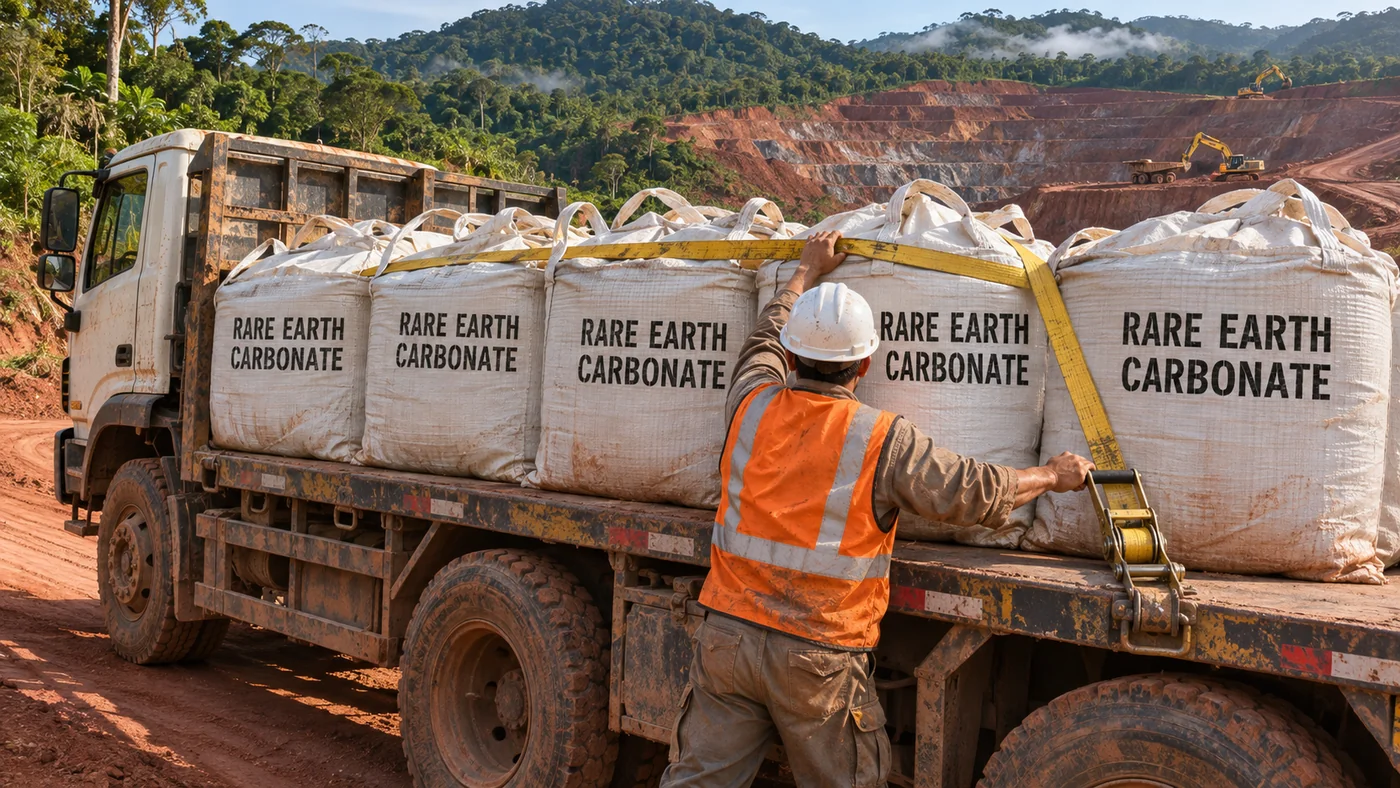
USA Rare Earth reported third quarter 2026 revenue of $3.0 million and a $141.4 million operating loss, with $1.2 billion in cash on September 30. Its bigger sales are just starting. Its Brazil mine began shipping in October, and the company expects it to sell at least 325 tonnes of rare earth oxides in the fourth quarter.
The short answer. USA Rare Earth still spends far more than it sells, and it covers the gap with cash raised from new shares. That matters beyond its shareholders, because its magnets and metals go into jet engines, motors and weapons, where the company says few suppliers exist outside Asia. Set beside the company's own target date for each plant, the quarter shows that the revenue that counts is only now starting, in Brazil.
USA Rare Earth third quarter 2026 at a glance
On this page
Every company reporting the same week, with its date and time, is in StockTitan's Earnings Calendar for the Week of November 9, 2026.
USA Rare Earth earnings for the third quarter
Sales were small and fell from the quarter before. The company sold $3.0 million of products in the three months to September 30 and lost $141.4 million from running the business.
USA Rare Earth released its results on November 9, 2026, at 4:05 PM ET, after the market closed. Revenue was $3.0 million, down from $5.8 million in the second quarter. A year earlier the company had no revenue at all.
Making those products cost more than they sold for. The cost of revenue was $22.9 million, so the company had a gross loss of $19.9 million, which means it lost money before paying for offices, staff and research.
Overhead grew much faster than sales. Selling, general and administrative costs were $103.7 million, against $11.4 million a year earlier. The company also bought Serra Verde in September and Texas Mineral Resources in August. Those new businesses are probably part of the reason.
The quarter had real firsts. The Stillwater, Oklahoma plant sold its first magnets in September. Serra Verde finished the first stage of its expansion on time and on budget. After the quarter ended, the mine began shipping and recorded its first sales in November.
In after hours trading the stock was at $8.40 at 4:41 PM ET, down 4.1% from its $8.76 close, according to StockTitan real-time Nasdaq data.
| Measure | Q3 2026 | Q3 2025 | Nine months 2026 |
|---|---|---|---|
| Revenue | $3.0 million | none | $14.5 million |
| Cost of revenue | $22.9 million | none | $35.9 million |
| Gross loss | $19.9 million | none | $21.4 million |
| Selling, general and administrative | $103.7 million | $11.4 million | $157.4 million |
| Research and development | $16.5 million | $4.5 million | $41.5 million |
| Loss from operations | $141.4 million | $15.9 million | $224.4 million |
Source: USA Rare Earth third quarter 2026 results release, condensed statements of operations (unaudited), November 9, 2026.
How much cash USA Rare Earth has left
The company had $1.2 billion in cash at the end of September, down from $1.6 billion at the end of June. Most of it came from selling new shares this year.
Cash, cash equivalents and restricted cash were $1.16 billion on September 30, 2026. Restricted cash is money set aside for a set purpose. Without it, cash and cash equivalents were $1.09 billion.
The money came mostly from one source. In the first nine months of 2026 the company raised $1.5 billion by selling new shares directly to investors, a deal known as a PIPE. That is why the share count jumped: the average diluted share count was 284.9 million in the quarter, against 102.6 million a year earlier.
Running the business used $143.7 million of cash in the third quarter, against $56.9 million in the second. Building plants is a separate cost. Over nine months, spending on plants and equipment deposits was $190.9 million, and buying Serra Verde used another $191.2 million after the cash it brought.
The biggest bill is still ahead. The company puts the new South Carolina plant at about $1.2 billion, roughly the size of its whole cash pile at the end of September. The release does not say how that plant will be paid for, and it lists the ability to raise capital, and possible dilution for shareholders, among its risks.
The company also carries debt. Its balance sheet shows $305.6 million of long term notes payable and a royalty obligation of $330.7 million due after one year, plus $31.5 million due within a year. The release announces no dividend and no share buyback.
| Item | September 30, 2026 | December 31, 2025 |
|---|---|---|
| Cash, cash equivalents and restricted cash | $1,163.6 million | $359.9 million |
| Cash and cash equivalents | $1,090.9 million | $359.9 million |
| Notes payable, non-current | $305.6 million | none |
| Royalty obligation, current | $31.5 million | none |
| Royalty obligation, non-current | $330.7 million | none |
| Warrant and earnout liabilities | $227.3 million | $128.2 million |
| Total liabilities | $2,126.3 million | $191.8 million |
Source: USA Rare Earth third quarter 2026 results release, condensed balance sheets and statements of cash flows (unaudited); cash at June 30, 2026 from the second quarter 2026 results release.
When the bigger revenue arrives
The first large sales come from the Brazil mine, starting this quarter. Its buyer is a company backed by the US government, which has agreed to take all of the mine's first stage output for 15 years.
Serra Verde mines and processes rare earths in Goiás, Brazil. It makes mixed rare earth carbonate, a blend of rare earths that still has to be separated into single elements. The company calls it the only scaled producer outside Asia of all four key rare earths used in magnets.
The mine began commercial shipments in October and booked its first sales in November, so none of it is in the third quarter's revenue. For the fourth quarter, the company expects Serra Verde to sell at least 325 tonnes of total rare earth oxides.
The price per kilogram depends on the market. So far this quarter, the company puts the basket's value at about $43 a kilogram at the contract's floor prices, and about $97 a kilogram at market prices. Both figures are after the contracted cost of separating the elements.
The buyer is US SIIE, LLC, a company set up to buy Serra Verde's output. Its deal is take or pay, which means the buyer pays for the agreed amount even if it does not take it. Its funding includes a $750 million investment by the US Department of War and a commitment for a bank credit line of up to $500 million.
The prices follow markets outside China, where these metals cost more. The company says recent prices outside China were 14 to 16 times higher than in China for dysprosium oxide, and 6 to 8 times higher for terbium oxide.
| Serra Verde milestone | Company target |
|---|---|
| Stage 1 ramp complete, 4,000 tonnes a year of rare earth oxides | Q2 2027 |
| SK-1300 technical report published | Q1 2027 |
| Stage 2 construction complete, commissioning starts | Q3 2027 |
| Stage 2 ramp complete, 6,400 tonnes a year | End of 2027 |
Source: USA Rare Earth third quarter 2026 results release, Fourth Quarter Outlook and Key Operational Targets, November 9, 2026. Basket values are the company's averages for the fourth quarter to date, based on the pricing terms of its 15 year offtake agreement.
Where the magnet plants stand
The Oklahoma plant has started selling magnets, though only in early, unfinished form so far. The much bigger South Carolina plant broke ground in September, and the company gives no start date for it.
The Stillwater plant is built for 600 tonnes of magnets a year. Its first sale, in September, was of sintered NdFeB block magnets, made of neodymium, iron and boron, to a maker of high performance materials. These are the strong permanent magnets used in electric motors and defense systems.
The next steps are on a short timeline. The company plans to sell finished prototype magnets to several customers by the end of 2026. It then plans a second line in the second quarter of 2027, which would double Stillwater's capacity to 1,200 tonnes a year.
The release gives two dates for a second finishing line, which shapes the blocks into finished parts. Its quarter review says the end of 2026, while its list of targets says the first quarter of 2027.
The South Carolina plant, in Blacksburg, is the long term bet. It covers about 800,000 square feet and is planned for 6,400 tonnes a year of magnets, fed by its own metal and alloy line. The company expects about 490 jobs there.
What the first yttrium oxide samples mean
USA Rare Earth made its first yttrium oxide at a test plant in Colorado and sent samples to one customer for testing. No sale has been made yet, and the customer still has to approve the material.
The samples came from a small plant in Wheat Ridge, Colorado, which runs around the clock. It uses solvent extraction, a process that pulls single rare earths apart using liquids. Its yttrium circuit has run for more than 1,600 hours.
The samples went out in October to a large defense, medical and specialty coatings company, which USA Rare Earth does not name, and the company announced them on November 9. That customer will use the samples for early testing and prototypes. The company calls the delivery a key step toward commercial qualification, the customer's approval that a material can be used in its products.
Yttrium matters because few places outside China make it. It goes into heat shields and protective coatings for jet engines, machines that make computer chips, lasers, medical devices and defense systems. Citing the price agency Argus, the company says recent Western prices for yttrium oxide were more than 100 times the price in China.
The test plant is a model for a bigger one. Its data feeds the design of a planned separation plant that would process both Serra Verde's carbonate and magnet scrap. The company's British unit, Less Common Metals, already poured its first commercial yttrium metal in April 2026.
The company says its first tests turning carbonate into oxide are done. The work now is making every batch the same, for outside buyers and for its own metal plant.
"We are refining specifications and consistency now so that we can serve both external customers and our internal metal-making business at commercial scale," said Dr. Alex Moyes, Head of Upstream, USA at USA Rare Earth.
Why the quarter shows a profit and a loss
The company reports net income of $11.7 million, but only because of an accounting gain. Its adjusted result, a measure that leaves out that gain and one smaller item, shows a loss of $125.6 million.
The gain came from a change in the value of financial instruments, a line that added $136.6 million in the third quarter. The balance sheet lists $227.3 million of warrant and earnout liabilities. Warrants are rights to buy shares later at a set price, and the company owes them as liabilities.
That is why the per share figures point in different directions. Net income was 4 cents per basic share. On a diluted basis, which counts shares that could still be issued, the company lost 2 cents a share.
The company's adjusted net loss, a measure it defines itself, was $125.6 million, or 44 cents per diluted share. A year earlier the adjusted loss was $25.6 million, or 25 cents a share.
| Measure | Q3 2026 | Q3 2025 |
|---|---|---|
| Net income (loss) attributable to USA Rare Earth | $11.7 million | ($156.7 million) |
| Per share, basic | $0.04 | ($1.64) |
| Per share, diluted | ($0.02) | ($1.64) |
| Gain (loss) on fair value of financial instruments, net | $136.6 million gain | $142.4 million loss |
| Adjusted net loss, non-GAAP | ($125.6 million) | ($25.6 million) |
| Adjusted net loss per diluted share, non-GAAP | ($0.44) | ($0.25) |
Source: USA Rare Earth third quarter 2026 results release, financial highlights and reconciliation of non-GAAP financial measures (unaudited).
What to watch
- Serra Verde's first quarter of sales: the fourth quarter 2026 results, against the outlook of at least 325 tonnes.
- Finished magnet sales from Stillwater: the company's target is prototype sales to several customers by the end of 2026, reported with its fourth quarter results.
- The yttrium samples: whether the customer qualifies the oxide, which the company would announce in a release.
- The full quarterly filing: the Form 10-Q for the third quarter, with more detail on cash, debt and costs.
Frequently asked questions
Did USA Rare Earth make a profit in Q3 2026?
Not from its business. It lost $141.4 million from operations. Its reported net income of $11.7 million came from a $136.6 million gain on the value of financial instruments. Its adjusted net loss was $125.6 million.
How much cash does USA Rare Earth have?
It had $1.16 billion in cash, cash equivalents and restricted cash on September 30, 2026, or $1.09 billion without the restricted cash. It used $143.7 million to run the business in the third quarter.
When will USA Rare Earth have meaningful revenue?
The company expects its Serra Verde mine in Brazil to sell at least 325 tonnes of rare earth oxides in the fourth quarter of 2026. It sells under a 15 year take or pay deal with a buyer backed by the US government. Third quarter revenue was $3.0 million.
When will the South Carolina magnet plant open?
The release gives no start date. The company broke ground in Blacksburg in September 2026 on a plant of about $1.2 billion, planned for 6,400 tonnes of magnets a year.
What is yttrium oxide used for?
It goes into heat shields and coatings for jet engines, chipmaking machines, lasers, medical devices and defense systems. USA Rare Earth sent its first samples to one customer for testing in October 2026 and announced them on November 9.
Does USA Rare Earth pay a dividend?
The results release announces no dividend and no share buyback. The company is spending its cash on building mines, plants and its magnet business.
Sources
- USA Rare Earth Reports Third Quarter 2026 Financial Results, November 9, 2026
- USA Rare Earth Delivers First Yttrium Oxide Samples from Wheat Ridge Demonstration Facility, November 9, 2026
- USA Rare Earth Reports Second Quarter 2026 Financial Results, August 10, 2026
- USA Rare Earth Form 8-K, items 2.02 and 9.01, November 9, 2026 (SEC)
The information provided in this article is for educational and informational purposes only. It does not constitute financial advice, investment recommendation, or an endorsement of any particular investment strategy. Past performance does not guarantee future results. Investors should conduct their own research and consult with a qualified financial advisor before making investment decisions.