
Agilent Launches AI-Driven Analysis Module for Agilent xCELLigence RTCA eSight
Agilent (NYSE:A) launched xCELLigence RTCA eSight AI, an AI-powered software module for its RTCA eSight instrument.
Sentiment and the balance of points
Rhea-AI Sentiment reads the wording of the document, how positive or negative its language is on a 1 to 5 scale. The balance of points shown with the takes weighs what the document actually discloses, so the two can disagree, for example when a trial that missed its main goal is described in upbeat language.




Simplifying label-free imaging analysis for more confident real-time cell analysis
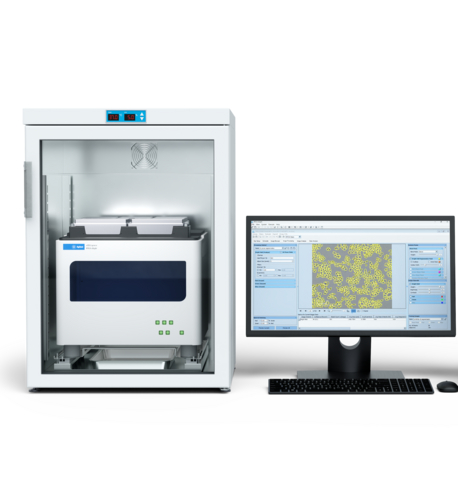
Agilent xCELLigence RTCA eSight System
Traditional cell segmentation workflows rely on time-consuming and subjective manual setup and analysis steps that increase variability, error and rework, slowing experimental timelines while also requiring a higher level of experimental expertise to achieve consistent results. As biopharma research increasingly demands more complex experiments, higher throughput and greater consistency, integrated workflows are key to efficient scientific progress. AI-driven imaging analysis can help reduce variability across users while decreasing time spent on manual analysis.
By replacing subjective, user-influenced thresholding and manual parameter tuning with a one-click approach, the new module delivers standardized analysis across skill levels, experiments and datasets. eSight imaging AI analysis is designed to ensure confident, reliable performance across users, cell types and assay conditions, providing the robustness and accuracy essential for real-world science and users with varying levels of imaging expertise.
The new module is expected to reduce time spent on manual analysis, rework and training while supporting broader application of label-free imaging workflows, specifically within drug discovery and in high-throughput biopharma research.
"The AI analysis module for xCELLigence RTCA eSight has substantially reduced the time our users spend for image analysis," said Carole Perrot, Ph.D., core facility director at Johns Hopkins All Children's Hospital. "Its automated, consistent performance across a variety of cell types and experimental conditions has improved workflow efficiency while helping ensure reproducible results. As a shared resource supporting multiple research projects, the xCELLigence is without a doubt one of our best instruments as it simplifies complex analyses and makes advanced imaging more accessible to our users."
Knut Wintergerst, vice president and general manager of the Life Sciences and Diagnostics Markets Group at Agilent, added, "With xCELLigence RTCA eSight Software 1.5.0, Agilent is bringing the same straightforward, objective analysis customers have long valued in impedance-based measurements to label-free live cell imaging. By making advanced AI-powered image analysis accessible to more labs, we’re enabling more consistent, reproducible insights that help accelerate discovery and translational research."
By simplifying label-free imaging analysis within an integrated imaging and impedance workflow, eSight AI helps researchers reduce complexity, gain more confident biological insights and accelerate the path from experiment to interpretation.
About Agilent Technologies
Agilent Technologies, Inc. (NYSE: A) is a global leader in analytical and clinical laboratory technologies, delivering insights and innovation that help our customers bring great science to life. Agilent’s full range of solutions includes instruments, software, services, and expertise that provide trusted answers to our customers' most challenging questions. The company generated revenue of
View source version on businesswire.com: https://www.businesswire.com/news/home/20260701778405/en/
MEDIA CONTACT:
Kate Coyle
Agilent Technologies Inc.
+1 302-633-7490
kate.coyle@agilent.com
Source: Agilent Technologies Inc.