STOCK TITAN

Robo.ai Subsidiary Neurovia AI Announces NeuroStream™ Architecture at ISNR 2026 and Initiates Commercial Proof of Concept Phase

(Neutral)
Tags
AI

Robo.ai (NASDAQ: AIIO) announced that subsidiary Neurovia AI has released its NeuroStream™ architecture and begun preparing Proof of Concept deployments with regional partners after ISNR 2026 in Abu Dhabi.

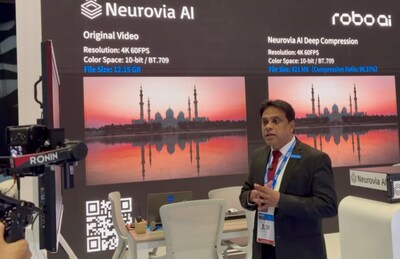
The Bitmap Vectorization Algorithm demo compressed a 12.15GB 4K/60fps video to 421MB, a 96.37% storage reduction, supporting AI-centric visual data processing.

Loading...
Loading translation...

Positive

  • NeuroStream™ architecture officially released for unstructured visual data processing
  • Live demo showed 96.37% compression from 12.15GB to 421MB with visually lossless quality
  • Preliminary feedback indicated market receptiveness to lowering hardware procurement costs
  • POC certification phase started with regional strategic partners
  • Focus on high-concurrency, enterprise-level environments for AI infrastructure

Negative

  • Technology still in POC certification phase before broader commercial deployment
  • Stability and efficiency must be validated in high-concurrency enterprise environments

News Market Reaction – AIIO

-20.12%
47 alerts
-20.12% Session close to close
-22.1% Trough in 15 hr 12 min
$63.90M Market Cap
0.1x Rel. Volume

In the May 22 session, AIIO declined 20.12%, reflecting a significant negative market reaction. Argus tracked a trough of -22.1% from its starting point during tracking. Our momentum scanner triggered 47 alerts that day, indicating elevated trading interest and price volatility.

Data tracked by StockTitan Argus on the day of publication.

Market Context

The stock dropped -20.1% in the session following this news. A negative reaction despite operational...
Analysis

The stock dropped -20.1% in the session following this news. A negative reaction despite operational progress would fit AIIO’s mixed history around AI-tagged news, where some ISNR-related updates coincided with declines. The move from pure demos toward commercial POC introduces execution and adoption risk that the market has sometimes discounted. Existing registration statements for large share resales and the stock’s position well below its 200-day MA may also contribute to cautious sentiment.

Key Figures

Raw video size: 12.15GB Video resolution: 4K Frame rate: 60 frames-per-second +2 more
5 metrics
Raw video size 12.15GB 4K 60fps raw video used in NeuroStream™ demo
Video resolution 4K Resolution of demo video in NeuroStream™ compression test
Frame rate 60 frames-per-second Frame rate of demo video in live compression test
Compressed size 421MB Output size after NeuroStream™ Bitmap Vectorization compression
Storage reduction 96.37% Reduction in storage volume while maintaining visually lossless quality

Previous AI Reports

5 past events · Latest: May 21 (Positive)
Same Type Pattern 5 events
Date Event Sentiment 24h Move Catalyst
May 21 ISNR demo wrap-up Positive -14.6% Showcased NeuroStream™ infrastructure and 96.37% compression at ISNR2026.
May 20 CTO ISNR briefing Positive -4.7% CTO detailed NeuroStream’s role in easing AI infrastructure strain.
May 18 ISNR debut Positive +39.3% Announced Neurovia AI’s debut at ISNR2026 to showcase NeuroStream™.
May 14 NeuroStream launch Positive +116.1% Launched NeuroStream™ platform with strong internal compression results.
Apr 10 Prototype deliveries Positive +0.2% Robus began deliveries of initial commercial prototype vehicles in Pakistan.

24h Move is the share-price change in the day after each event; other market factors may also have contributed.

Pattern Detected

AI-tagged news for AIIO has produced mixed reactions: some events led to substantial gains, while others saw notable selloffs despite positive operational or technology updates.

Recent Company History

Over recent months, AIIO has released several AI-tagged updates centered on Neurovia AI and its NeuroStream™ platform. Launch and debut announcements on May 14 and May 18 coincided with sharp gains, while subsequent ISNR-related technical showcases on May 20 and May 21 saw negative price reactions. An earlier April 10 update from subsidiary Robus on prototype vehicle deliveries produced only a modest move. Today’s announcement continues this sequence of AI infrastructure and commercialization milestones.

Key Terms

proof of concept (poc), bitmap vectorization algorithm, edge computing, physical ai, +1 more
5 terms
proof of concept (poc) technical
"entered the preparation stage for Proof of Concept (POC) deployments with strategic partners"
A proof of concept (PoC) is a small-scale test or demonstration that shows whether a new idea, product, or method is feasible and works as intended. It helps investors assess the potential value and risks before committing significant resources, similar to trying a sample before buying a full-sized item. PoCs are important because they provide early evidence that an idea has practical promise.
bitmap vectorization algorithm technical
"Neurovia AI demonstrated its Bitmap Vectorization Algorithm. The live technical demonstration"
A bitmap vectorization algorithm is a computer method that converts pixel-based images (made of colored dots) into a set of clean, scalable shapes and lines that can be resized without losing quality. For investors, it matters because this conversion underpins products and services like logo rendering, digital printing, map and design tools, and efficient file storage—areas that affect user experience, operational costs, software capability, and potential revenue streams.
edge computing technical
"company utilizes AI-native compression and edge computing to address data bottlenecks"
Edge computing is a technology that processes data close to where it is generated, such as sensors or devices, rather than sending it all to a distant central location. This allows for faster decision-making and reduces delays, much like having a local office handle urgent matters instead of waiting for instructions from a main headquarters. For investors, it signifies improved efficiency and real-time insights, which can enhance the performance of technology-dependent industries.
physical ai technical
"edge computing to address data bottlenecks in Physical AI. Its technology serves"
Physical AI combines artificial intelligence with physical devices or environments, enabling machines to interact with and adapt to the real world in a human-like way. It matters to investors because it can lead to smarter robots, autonomous vehicles, or advanced sensors that improve efficiency and open new markets, potentially creating significant business opportunities and competitive advantages.
high-concurrency technical
"evaluate the stability and efficiency of the underlying architecture within high-concurrency, enterprise-level"
High-concurrency describes a system’s ability to handle many users or transactions at the same time without slowing down or failing. For investors, it signals whether a company’s online services — like trading platforms, payment systems, or consumer apps — can scale reliably as demand grows; think of it like a doorway wide enough for a crowd to enter smoothly rather than a single-file line that causes bottlenecks and lost customers.

AI-generated analysis. How Rhea-AI works. Not financial advice.

See more from StockTitan in Google Search and AI answers. Adds StockTitan as a preferred source · opens Google
Add on Google

ABU DHABI, UAE, May 22, 2026 /PRNewswire/ -- Robo.ai announced that its subsidiary, Neurovia AI, disclosed its recent technological and commercial developments following the conclusion of the 2026 International Exhibition for National Security and Resilience (ISNR) in Abu Dhabi. In a media interview, Mansoor Ali Khan, Chief Technology Officer of Neurovia AI, outlined the official release of the NeuroStream™ technology architecture and confirmed that the company has entered the preparation stage for Proof of Concept (POC) deployments with strategic partners in the region.

Neurovia AI CTO

The NeuroStream™ architecture is designed to address the structural limitations that current computing and storage infrastructures face when processing unstructured data. During the exhibition, Neurovia AI demonstrated its Bitmap Vectorization Algorithm. The live technical demonstration compressed a 12.15GB, 4K resolution at 60 frames-per-second raw video file to 421MB, representing a 96.37% reduction in storage volume while maintaining visually lossless quality. According to Khan, this standard of data compression provides an intact data source for subsequent artificial intelligence operations, supporting a transition in visual data architecture from human observation to machine processing.

In conjunction with the technical demonstration, the Neurovia AI team conducted closed-door meetings with regional government officials, corporate executives, and commercial users. Discussions focused on the financial and operational requirements of long-term data retention for compliance purposes. Preliminary feedback indicated market receptiveness to the NeuroStream™ architecture's capacity to lower hardware procurement costs and alleviate infrastructure constraints associated with large-scale artificial intelligence deployment.

Following the preliminary cooperation frameworks established during ISNR, Neurovia AI has commenced the POC certification phase with its regional partners. The stated objective for this phase is to evaluate the stability and efficiency of the underlying architecture within high-concurrency, enterprise-level environments. Khan noted that the company is transitioning from the technology demonstration phase to commercial delivery. Robo.ai will issue further market updates upon the achievement of material commercial milestones.

About Neurovia AI Limited
Neurovia AI (www.neuroviaai.ae) provides AI data processing and visual infrastructure through its NeuroStream™ platform. Dedicated to transitioning visual data from human viewing to machine understanding, the company utilizes AI-native compression and edge computing to address data bottlenecks in Physical AI. Its technology serves autonomous driving, smart cities, and intelligent manufacturing, providing a foundational layer for global machine perception and collaboration.

About Robo.ai Inc.
Robo.ai Inc. (NASDAQ: AIIO) is a technology company dedicated to building an artificial intelligence machine economy platform. Its mission is to integrate smart terminals through AI software, intelligent hardware, and smart assets to construct a unified artificial intelligence operating system and a blockchain-empowered ecosystem to pioneer an intelligent future.

Safe Harbor Statement
This press release contains forward-looking statements as defined in the Private Securities Litigation Reform Act of 1995. Actual results may differ from expectations; for further details, please refer to the documents the company has filed with the U.S. Securities and Exchange Commission.


Cision View original content to download multimedia:https://www.prnewswire.com/news-releases/roboai-subsidiary-neurovia-ai-announces-neurostream-architecture-at-isnr-2026-and-initiates-commercial-proof-of-concept-phase-302780161.html

SOURCE Robo.ai

FAQ

What did Robo.ai (NASDAQ: AIIO) announce about Neurovia AI at ISNR 2026?

Robo.ai announced that Neurovia AI released its NeuroStream™ architecture and began preparing Proof of Concept deployments with regional partners. According to Robo.ai, this follows live demonstrations at the ISNR 2026 exhibition in Abu Dhabi focused on AI-driven visual data infrastructure.

How does Neurovia AI's Bitmap Vectorization Algorithm improve video data compression?

The Bitmap Vectorization Algorithm compressed a 12.15GB 4K/60fps raw video file to 421MB, a 96.37% reduction. According to Neurovia AI, this compression maintains visually lossless quality, preserving an intact data source for downstream artificial intelligence operations on visual content.

What is the goal of the NeuroStream™ Proof of Concept phase for AIIO investors?

The Proof of Concept phase aims to evaluate NeuroStream™ architecture stability and efficiency in high-concurrency, enterprise environments. According to Neurovia AI, this certification step follows initial cooperation frameworks with regional partners and precedes broader commercial delivery of the technology.

How could NeuroStream™ architecture impact AI infrastructure costs for Robo.ai partners?

Preliminary feedback suggested NeuroStream™ could reduce hardware procurement needs and infrastructure constraints tied to long-term data retention. According to Neurovia AI, discussions with government and corporate stakeholders emphasized compliance-driven storage demands and the architecture’s potential to ease large-scale AI deployment requirements.

Which markets does Neurovia AI target with the NeuroStream™ platform?

Neurovia AI targets autonomous driving, smart cities, and intelligent manufacturing with its NeuroStream™ platform. According to Neurovia AI, the technology provides AI-native compression and edge computing to support global machine perception, forming a foundational layer for Physical AI applications.

What strategic shift did Neurovia AI describe for its NeuroStream™ technology?

Neurovia AI described a transition from pure technology demonstration to commercial delivery of NeuroStream™. According to the company, Robo.ai plans further market updates when material commercial milestones are achieved, aligning the architecture with enterprise-level, machine-centric visual data processing needs.