
Alaska Energy Metals Announces Positive Metallurgical Testing Results, Nikolai Nickel Project, Alaska
Alaska Energy Metals (OTCQB:AKEMF) reported positive locked cycle flotation test results from the Core Eureka Zone 2 (CEZ2) at its 100%-owned Nikolai nickel-copper-cobalt-PGE project in Alaska.
Rhea-AI Summary
Alaska Energy Metals (OTCQB:AKEMF) reported positive locked cycle flotation test results from the Core Eureka Zone 2 (CEZ2) at its 100%-owned Nikolai nickel-copper-cobalt-PGE project in Alaska. The LCT-1 bulk concentrate achieved metal recoveries of 49.4% nickel, 50.5% copper, 21.0% cobalt, 49.1% platinum, 43.1% palladium and 43.9% gold, with concentrate grades of 7.22% Ni, 4.01% Cu and 0.30% Co.
A total of 506 g of concentrate, or 1.68% of feed mass, was produced, and de-sliming was determined unnecessary, which the company views as a potential flowsheet cost saving. Concentrates from two locked cycle tests will be shipped to Lifezone Metals for hydrometallurgical amenability testing. According to Alaska Energy Metals, these results allow completion of an internal economic analysis and may support a future Preliminary Economic Assessment for Nikolai, which hosts six U.S. Government-listed critical minerals.
Positive
- LCT-1 metal recoveries: 49.4% Ni, 50.5% Cu, 21.0% Co, 49.1% Pt, 43.1% Pd, 43.9% Au
- LCT-1 concentrate grades: 7.22% Ni, 4.01% Cu, 0.30% Co from 0.26% Ni, 0.13% Cu, 0.03% Co feed
- Mass pull limited to 1.68% of feed for 506 g concentrate
- De-sliming not required, simplifying flowsheet and potentially reducing processing costs
- Open cycle tests showed 47.7% Ni, 50.5% Cu, 20.9% Co recoveries in rougher plus scavenger concentrates
- Hydrometallurgical testing planned with Lifezone Metals to assess on-site refining potential
Negative
- None.
Details
News Market Reaction – AKEMF
In the Jul 16 session, AKEMF gained 7.48%, reflecting a notable positive market reaction.
Data tracked by StockTitan Argus on the day of publication.
AI-generated analysis. How Rhea-AI works. Not financial advice.




HIGHLIGHTS
Recent locked cycle flotation test shows strong recoveries of nickel (
49.4% ), copper (50.5% ) and cobalt (21.0% ) in a bulk flotation concentrate, also with strong platinum-group-element and gold recoveries: platinum (49.1% ), palladium (43.1% ) and gold (43.9% )Recent open cycle flotation tests indicate potential for increased metal recovery and concentrate grade
Follow-up locked cycle tests using further refinements are in progress and results anticipated in early August
Concentrate samples obtained in the locked cycle tests will be sent to Lifezone Metals for hydrometallurgical refining amenability testing
Internal economic analysis to be completed and as warranted plans for an independent Preliminary Economic Analysis will be made
CEO: "If successful, hydrometallurgical refining would allow us to produce [nickel and multiple other critical and strategic] metals on site in Alaska for the American technology and industrial market and the US defense industrial base."
VANCOUVER, BC / ACCESS Newswire / July 16, 2026 / Alaska Energy Metals Corporation (TSXV:AEMC)(OTCQB:AKEMF) ("AEMC" or the "Company") is pleased to report positive results from locked cycle testing ("LCT") of drill core from the 2023-2024 exploration campaigns for the Core Eureka Zone ("CEZ2"), Eureka Deposit, at its
The results represent a significant advancement in the company's primary asset and clarifies the development path for the Nikolai deposit.
AEMC CEO Gregory Beischer commented: " Metal recovery rates are the primary input to an economic analysis. We now know the metals present in the Nikolai deposit are recoverable at robust rates. Therefore, we can complete our internal economic analysis and upon successful completion, commission a Preliminary Economic Assessment. With metallurgical recoveries now proven, Nikolai is emerging as a significant source of nickel, copper and cobalt, producible in the USA. Going forward, we will evaluate the amenability of further refining produced concentrates with hydrometallurgical processes. If successful, hydromet would allow us to produce metals on site in Alaska for the American technology and industrial market and the US defense industrial base. Nikolai potentially provides a domestic solution for the country's near-total reliance on foreign imports for nickel and can contribute to domestic metal supply chain security for multiple critical and strategic metals.
RESULTS
Locked cycle test one (LCT-1) successfully achieved metal recoveries of
Table 1. LCT-1 Bulk Flotation Concentrate Metal Recoveries and Grades
Bulk Flotation Concentrate | |||||||||||
Mass (g) | Weight (%) | Ni (%) | Cu (%) | Co (%) | Pt (g/t) | Pd (g/t) | Au (g/t) | Fe (%) | S (%) | MgO (%) | |
Feed | 30,054 | 100 | 0.26 | 0.13 | 0.03 | 0.08 | 0.16 | 0.03 | 10.1 | 0.95 | 36.3 |
Concentrate | 506 | 1.68 | 7.22 | 4.01 | 0.30 | 2.33 | 4.10 | 0.78 | 39.6 | 18.6 | 8.17 |
Metal Recovery (%) | 49.4 | 50.5 | 21.0 | 49.1 | 43.1 | 43.9 | 6.59 | 36.3 | 0.38 | ||
FUTURE METALLURGICAL TEST WORK
Recent Open Cycle Tests (OCT), using various reagents, indicate the potential to further improve metal recoveries and concentrate grade. Based on these OCT results, further LCT are being completed. It is anticipated the results of this test work will be published in August 2026.
The concentrates produced by the two LCT will be sent to Lifezone Metals for hydrometallurgical amenability testing. On-site hydrometallurgical refining would eliminate the need to ship concentrate to an existing smelter (there are none in the US), increase metal payability, serving to improve project economics, but balanced against increased capital costs. Importantly, this could allow production of refined nickel and other critical and strategic metals in Alaska for American industrial markets and the US Department of War. Additionally, future metallurgical work will also focus on the magnetic concentrate to see if a saleable iron - chrome product can be realized. In all, the nickel-dominant Nikolai Project hosts six U.S. Government-listed Critical Minerals.
STUDY OBJECTIVES AND SAMPLE SELECTION
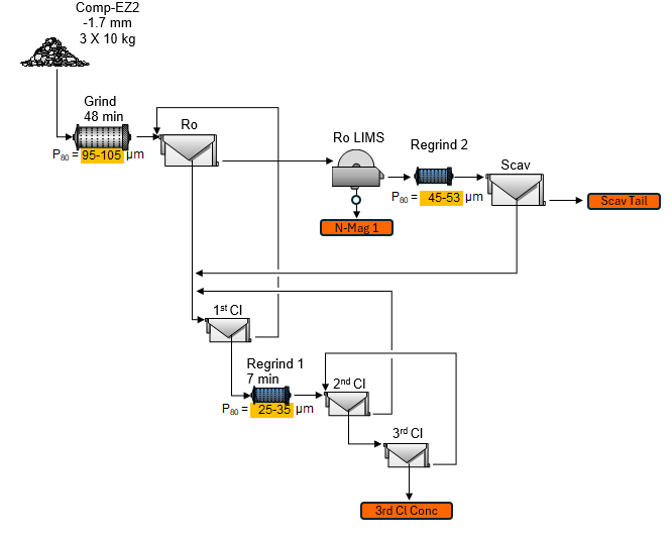
The main objective of this metallurgical study was to examine the potential of flotation for recovering valuable minerals into a marketable concentrate. To accomplish this objective, composite samples were subjected to feed characterization, grindability, flotation, and magnetic separation testing. The data collected was to be sufficiently rigorous to include in potential future preliminary economic studies.
Drill core samples were used to create modeled mineralized domains of composite samples of the Core Eureka Zone 2 "CEZ2" that represent the average grade of the 2025 Mineral Resource Estimate of the Eureka Deposit. Feed grade for the CEZ2 LCT assayed
LOCKED CYCLE TESTING - CEZ2
Open cycle variability and optimization testing was used to develop a flow sheet which consists of simple grinding, flotation and magnetic separation processes. A flotation concentrate, and a magnetic concentrate are produced. Nickel, copper, and cobalt sulfides report to the flotation concentrate. A significant amount of the precious metals - platinum, palladium and gold also partition with the sulfides. Iron and chromium oxides report to the magnetic concentrate. Challenges have included: 1) grain size, 2) depressing iron sulfide flotation to increase concentrate grade, 3) separating nickel from copper sulfide, and 4) recovering awaruite to the flotation concentrate. Optimization testing revealed desliming was not necessary on the Nikolai mineralization. Final open circuit optimization testing resulted in a rougher plus scavenger concentrate (1st - 3rd cleaners) recoveries of
QUALIFIED PERSON
Gregory Beischer, the Company's President & CEO, is the qualified person, as defined under National Instrument 43-101 Standards of Disclosure for Mineral Projects, responsible for, and having reviewed and approved, the technical information contained in this news release.
For additional information, visit: https://alaskaenergymetals.com/
ABOUT ALASKA ENERGY METALS
Alaska Energy Metals Corporation (AEMC) is an Alaska-based corporation with offices in Anchorage and Vancouver working to sustainably deliver the critical materials needed for U.S. national security and a bright energy future, all while generating superior returns for shareholders.
AEMC is focused on delineating and developing the large-scale, bulk tonnage, polymetallic Nikolai Project and related Eureka deposit containing nickel, copper, cobalt, chromium, iron, platinum, palladium, and gold. Located in Interior Alaska near existing transportation and power infrastructure, its flagship project, Nikolai, is well-situated to become a significant domestic source of strategic metals for North America. In January 2026, AEMC's Nikolai Project was accepted for Fast-41 Transparency Dashboard listing to streamline federal permitting for overland access and man camp placement for the next phase of Eureka deposit drilling. AEMC also holds a secondary project in western Quebec; the Angliers - Belleterre project. Today, material sourcing demands excellence in environmental performance, technological innovation, carbon mitigation and the responsible management of human and financial capital. AEMC works every day to earn and maintain the respect and confidence of the public and believes that environmental, social and governance performance is measured by action and led from the top.
ON BEHALF OF THE BOARD
"Gregory Beischer"
Gregory Beischer, President & CEO
FOR FURTHER INFORMATION, PLEASE CONTACT:
Gregory A. Beischer, President & CEO
Toll-Free: 877-217-8978 | Local: 604-609-7149
Some statements in this news release may contain forward-looking information (within the meaning of Canadian securities legislation), including but not limited to: further metallurgical including hydrometallurgical testing, the marketability of concentrates produced at the Nikolai project, and follow-on economic analysis. These statements address future events and conditions and, as such, involve known and unknown risks, uncertainties, and other factors which may cause the actual results, performance, or achievements to be materially different from any future results, performance, or achievements expressed or implied by the statements. Forward-looking statements speak only as of the date those statements are made. Although the Company believes the expectations expressed in such forward-looking statements are based on reasonable assumptions, such statements do not guarantee future performance and actual results may differ materially from those in the forward-looking statements. Factors that could cause the actual results to differ materially from those in forward-looking statements include but are not limited to uncertainty relating to the estimation of mineral resources, regulatory actions, market prices, and continued availability of capital and financing, and general economic, market or business conditions. Investors are cautioned that any such statements are not guarantees of future performance and actual results or developments may differ materially from those projected in the forward-looking statements. Forward-looking statements are based on the beliefs, estimates and opinions of the Company's management on the date the statements are made. Except as required by applicable law, the Company assumes no obligation to update or to publicly announce the results of any change to any forward-looking statement contained or incorporated by reference herein to reflect actual results, future events or developments, changes in assumptions, or changes in other factors affecting the forward-looking statements. If the Company updates any forward-looking statement(s), no inference should be drawn that it will make additional updates with respect to those or other forward-looking statements.
Neither the TSX Venture Exchange nor its Regulation Services Provider (as that term is defined in the policies of the TSX Venture Exchange) accepts responsibility for the adequacy or accuracy of this press release.
SOURCE: Alaska Energy Metals Corp.
View the original press release on ACCESS Newswire
FAQ
AI-generated questions and answers. How Rhea-AI works. Not financial advice.