
Actinium Pharmaceuticals Oral Presentation at SNMMI 2026 Highlights ATNM-400 Overcoming Resistance to All Three Approved Androgen Receptor Inhibitors and Offers Flexible, Well-Tolerated Dosing in Prostate Cancer Models
Actinium Pharmaceuticals (NYSE American: ATNM) presented new preclinical data on ATNM-400 at SNMMI 2026 in prostate cancer models.
Rhea-AI Summary
Actinium Pharmaceuticals (NYSE American: ATNM) presented new preclinical data on ATNM-400 at SNMMI 2026 in prostate cancer models. ATNM-400 stayed active in tumors resistant to all three approved androgen receptor inhibitors, achieved up to 94% tumor growth inhibition as monotherapy and 107% in combinations, and showed flexible, well-tolerated single and repeat dosing.
ATNM-400 matched or exceeded PSMA-targeted radioligands across PSMA expression levels, while its non-PSMA target is not expressed in salivary glands, so xerostomia is not expected. Actinium highlights a potential addressable population of over 100,000 mCRPC patients annually across ARPI-resistant and PSMA-ineligible segments.
Positive
- ATNM-400 achieved 94% tumor growth inhibition in ARPI-resistant 22Rv1 model
- Combination with ARPIs reached 107% tumor growth inhibition and ≥57% complete responses
- Single bolus and repeat 30 µCi/kg dosing maintained tumor control to day 60
- Minimal deviation from vehicle in blood, liver, kidney safety markers reported
- Comparable to 225Ac-PSMA-617 and superior to 177Lu-PSMA-617 at ~1/1000 radioactivity
- Actinium estimates >100,000 mCRPC patients may be addressable annually
Negative
- Data are preclinical in tumor models; no human clinical results reported
- ATNM-400 is described as moving toward the clinic, indicating development risk
Details
News Market Reaction – ATNM
In the Jun 3 session, ATNM declined 4.92%, reflecting a moderate negative market reaction.
Data tracked by StockTitan Argus on the day of publication.
Key Figures
- Tumor growth inhibition
- 94%
- ATNM-400 monotherapy in ARPI-resistant 22Rv1 tumor model
- Apalutamide control
- 32% tumor growth inhibition
- Apalutamide in same ARPI-resistant tumor model
- Darolutamide control
- 5% tumor growth inhibition
- Darolutamide in same ARPI-resistant tumor model
- Combination inhibition
- 107% tumor growth inhibition
- ATNM-400 plus apalutamide or darolutamide in ARPI-resistant model
- Complete responses
- ≥57% (4/7 and 5/7 mice)
- ATNM-400 plus ARPI combinations in ARPI-resistant model
- Dose level
- 40 or 30 µCi/kg
- Single bolus ATNM-400 in low-PSMA 22Rv1 tumor model
- Comparator dose
- 40 mCi/kg
- Administered radioactivity for 177Lu-PSMA-617 comparator
- ARPI annual sales
- >$12 billion
- Androgen receptor pathway inhibitors in 2025
Historical Context
-
Oncology expert Steffen Heeger appointed CMO to lead radiotherapy pipeline.
-
SNMMI 2026 data showed CAR optimization improved Actinium-225 radioconjugate properties.
-
Two Canadian patent allowances strengthened protection for Actimab-A and Iomab-ACT.
-
ATNM-400 SNMMI update paired with NYSE American stockholders’ equity deficiency notice.
-
Announced three SNMMI 2026 presentations for ATNM-400 and radiochemistry optimization.
24h Move is the share-price change in the day after each event; other market factors may also have contributed.
Key Terms
androgen receptor pathway inhibitors medical
mcrpc medical
psma medical
antibody radioconjugate medical
actinium-225 medical
radioligand therapies medical
xerostomia medical
therapeutic window medical
AI-generated analysis. How Rhea-AI works. Not financial advice.




- New data demonstrated ATNM-400 remains potently active in prostate cancer cells and tumors resistant to all three approved androgen receptor inhibitors (ARPIs) -enzalutamide (Xtandi®), apalutamide (Erleada®), and darolutamide (Nubeqa®)- directly targeting the point of failure for a high proportion of mCRPC patients
- ATNM-400 substantially outperformed apalutamide and darolutamide in an ARPI-resistant tumor model, and in combination with either ARPI it showed durable complete responses, supporting both monotherapy and combination strategies in refractory disease similar to prior data with enzalutamide
- ATNM-400 delivered superior tumor control as a single bolus or repeat dose with a consistent safety profile and minimal off-target toxicity across treatment regimens, indicating dosing flexibility and a wide therapeutic window that could de-risk clinical translation.
- In high PSMA expressing disease, ATNM-400 outperformed 177Lu-PSMA-617 in terms of activity and was similar to 225Ac-PSMA-617. However, as its target is not expressed in the salivary glands, ATNM-400 is not expected to cause xerostomia which is a key limitation of PSMA directed therapies
Androgen receptor pathway inhibitors (ARPIs) such as enzalutamide (Xtandi®, Astellas/Pfizer), apalutamide (Erleada®, Johnson & Johnson), and darolutamide (Nubeqa®, Bayer) are foundational to advanced prostate cancer care, but virtually all patients eventually develop resistance and progress -with up to 50,0001 patients per year exhausting ARPI therapy- creating a large and recurring unmet need. ATNM-400, Actinium's first-in-class Actinium-225 antibody radioconjugate, targets a non-PSMA antigen linked to aggressive prostate cancer biology and delivers a high-energy alpha-particle payload that kills tumor cells through a mechanism independent of PSMA expression and androgen receptor signaling. In preclinical head-to-head studies, this PSMA-independent mechanism allowed ATNM-400 to match or exceed PSMA-targeted radioligand therapies, including 177Lu-PSMA-617 (active ingredient of Pluvicto®, Novartis) and 225Ac-PSMA-617, across PSMA-high, PSMA-low, and PSMA-negative models.
_______________________________ |
1 Candelieri-Surette D, Lee J, Lynch JA, et al. Epidemiology of Metastatic Castration-Resistant Prostate Cancer in Veterans Nationwide. J Natl Compr Canc Netw. 2025;23(8):307–313. doi:10.6004/jnccn.2025.7032. |
The new data presented at SNMMI 2026 address three key questions: whether ATNM-400 can overcome ARPI resistance in the mCRPC setting, whether it works as both a single agent and in combination, and how its dosing and safety profile support translation to patients. The data answer each: ATNM-400 remained potent against cells and tumors resistant to all three approved ARPIs, achieved
Prostate cancer is one of oncology's largest commercial opportunities: androgen receptor pathway inhibitors generate more than
Sandesh Seth, Actinium's Chairman and CEO, said, "ARPI resistance is a central problem in advanced prostate cancer as once these drugs stop working there are few good options left. The new data are compelling as ATNM-400 stayed potent in cells and tumors resistant to all three approved ARPIs, outperformed apalutamide and darolutamide on its own similar to previous data with enzalutamide, and produced durable complete responses when combined with them. Equally important for development, ATNM-400 worked across single-dose and repeat-dose regimens with a consistent, clean safety profile, giving us real flexibility as we move toward the clinic. We believe these findings position ATNM-400 as a differentiated option for patients who have run out of ARPI choices. The same resistance-targeting biology underlies the compelling activity we have reported in non-small cell lung cancer and breast cancer, positioning ATNM-400 as a potential pan-tumor backbone for large, resistance-driven patient populations, alone or in combination. We look forward to sharing additional data across these programs in the coming months as we advance ATNM-400 toward the clinic."
Highlights from the SNMMI 2026 Poster Presentation
Poster Titled: ATNM-400: A First-in-Class Non-PSMA Actinium-225 Antibody Radioconjugate Demonstrates Superior Efficacy to PSMA-617 Radioligands and ARPIs With Favorable Safety Profile in Prostate Cancer Models
New data presented at SNMMI 2026 highlight several findings central to ATNM-400's development in prostate cancer:
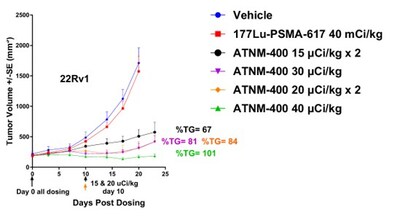
- In a low-PSMA, moderate-target tumor model (22Rv1), a single bolus dose of ATNM-400 (40 or 30 µCi/kg) delivered superior tumor control versus fractionated dosing, and a repeat 30 µCi/kg regimen sustained tumor control and survival through day 60 with all regimens outperforming 177Lu-PSMA-617 and showing minimal deviation from vehicle in blood, liver, and kidney safety markers. Flexible, well-tolerated dosing gives clinicians multiple ways to balance efficacy and safety and points to a wide therapeutic window.
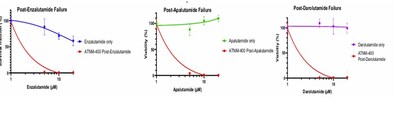
- ATNM-400 produced potent, dose-dependent killing of prostate cancer cells that are resistant to enzalutamide, apalutamide, and darolutamide, driving cell viability toward zero after each ARPI had failed, while the ARPIs alone left the resistant cells largely intact. Demonstrating activity specifically after ARPI failure addresses the most common point of progression in advanced prostate cancer and supports ATNM-400 as a treatment option for patients with few alternatives.
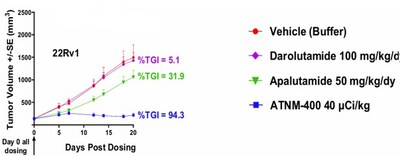
- As monotherapy in an ARPI-resistant tumor model (22Rv1), ATNM-400 achieved
94% tumor growth inhibition versus just32% for apalutamide and5% for darolutamide, roughly three- to eighteen-fold greater tumor control than the ARPIs themselves. Working on its own in tumors that no longer respond to standard ARPIs positions ATNM-400 as a potential stand-alone therapy after resistance, not only an add-on.
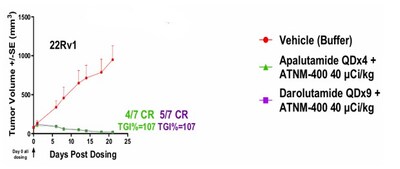
- In combination with either apalutamide or darolutamide in the same ARPI-resistant model, ATNM-400 delivered durable tumor control at
107% tumor growth inhibition, with complete responses in at least57% of mice (4/7 and 5/7). Turning resistant tumors into complete responses by pairing ATNM-400 with the very drugs that had failed supports a combination strategy that could extend the commercial and clinical value of approved ARPIs.
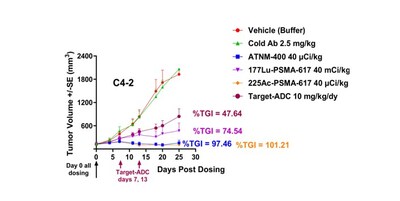
- In a high-PSMA, high-target tumor model (C4-2), ATNM-400 matched or exceeded both PSMA-targeted radioligands-comparable to 225Ac-PSMA-617 and superior to 177Lu-PSMA-617-while being given at roughly one-thousandth the administered radioactivity of 177Lu-PSMA-617 (40 µCi/kg versus 40 mCi/kg), with durable survival and favorable tolerability. Because ATNM-400 acts independently of PSMA, this activity carries across PSMA-high, PSMA-low, and PSMA-negative models, reaching the PSMA-variable patients that PSMA-directed radioligand therapy serve least well. Moreover as the ATNM-400 target is not expressed in the salivary glands xerostomia, a limitation of PSMA directed therapies and especially PSMA-Ac-225 based agents, is not expected.
About Actinium Pharmaceuticals, Inc.
Actinium is a pioneer in targeted radiotherapies designed to improve outcomes for patients with cancer. The company employs a biology-driven approach to develop differentiated radiopharmaceuticals for solid tumors and hematologic malignancies. Its mission is to transform cancer treatment through innovative radioconjugates that maximize therapeutic efficacy while minimizing toxicity to healthy tissue by combining expertise in tumor biology, translational medicine, and radiochemistry. Since inception, Actinium has focused on developing innovative radiotherapies. Its pipeline reflects this strategy across three areas: (1) solid tumor therapeutics including ATNM-400 and Actimab-A with pan-tumor potential; (2) Actimab-A as a therapeutic backbone for acute myeloid leukemia (AML) and myelodysplastic syndrome (MDS) in collaboration with the National Cancer Institute (NCI); and (3) targeted conditioning agents including Iomab-B for bone marrow transplant and Iomab-ACT for cell and gene therapy conditioning. ATNM-400 targets a novel antigen distinct from PSMA and has demonstrated preclinical activity across metastatic castration-resistant prostate cancer (mCRPC), non-small cell lung cancer (NSCLC), and breast cancer. Actimab-A has shown improved survival in relapsed/refractory AML with CLAG-M and is advancing toward a Phase 2/3 trial, with additional development ongoing through a CRADA with the NCI. Actinium is also advancing preclinical solid tumor programs and holds ~250 patents and patent applications, including intellectual property related to cyclotron-based production of Ac-225. For more information, please visit www.actiniumpharma.com.
Forward-Looking Statements
This press release may contain projections or other "forward-looking statements" within the meaning of the "safe-harbor" provisions of the private securities litigation reform act of 1995 regarding future events or the future financial performance of the Company which the Company undertakes no obligation to update. These statements, including statements as related to regaining compliance with the rules of the NYSE American and submission of a compliance plan, are based on management's current expectations and are subject to risks and uncertainties that may cause actual results to differ materially from the anticipated or estimated future results, including the risks and uncertainties associated with preliminary study results varying from final results, estimates of potential markets for drugs under development, clinical trials, actions by the FDA and other governmental agencies, regulatory clearances, responses to regulatory matters, the market demand for and acceptance of Actinium's products and services, performance of clinical research organizations and other risks detailed from time to time in Actinium's filings with the Securities and Exchange Commission (the "SEC"), including without limitation its most recent annual report on form 10-K, subsequent quarterly reports on Forms 10-Q and Forms 8-K, each as amended and supplemented from time to time.
Investors: investorrelations@actiniumpharma.com

 View original content to download multimedia:https://www.prnewswire.com/news-releases/actinium-pharmaceuticals-oral-presentation-at-snmmi-2026-highlights-atnm-400-overcoming-resistance-to-all-three-approved-androgen-receptor-inhibitors-and-offers-flexible-well-tolerated-dosing-in-prostate-cancer-models-302789403.html
SOURCE Actinium Pharmaceuticals, Inc.
FAQ
AI-generated questions and answers. How Rhea-AI works. Not financial advice.